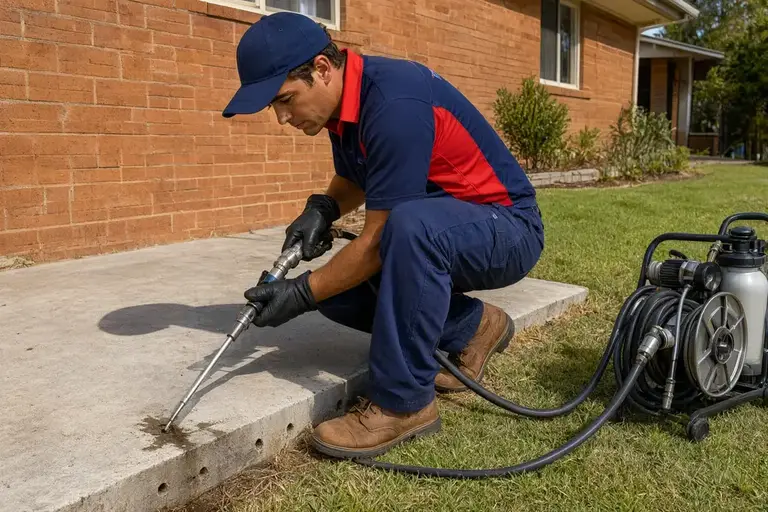
Termites are a fact of life across most of Australia, and the damage they cause is rarely covered by standard home insurance. A professionally installed termite barrier creates a continuous treated zone around your home that stops termites before they can reach the structure.
What Termite Treatment & Barrier Systems Protects You From
Termites feed on cellulose, which means the timber in your wall frames, roof trusses, flooring, skirting boards and window frames is all potential food. They work from the inside out and stay hidden, so by the time damage becomes visible it is often extensive. Subterranean termites, the most destructive type found in Australia, travel from nests in the soil into buildings through concealed mud tunnels, entering through cracks only a few millimetres wide.
The real cost is not just the timber they eat. It is the repair bill, the disruption, and the discovery of damage at the worst possible time, such as during a pre-sale building inspection. A barrier treatment addresses the problem at its source by treating the soil around and beneath your home so foraging termites cannot pass through it.
- Structural damage: wall frames, bearers, joists and roof timbers weakened to the point where major repairs are needed.
- Hidden activity: termites consume timber from the inside, leaving a thin outer shell that looks sound until it fails.
- Safety hazards: compromised flooring, stairs, decks and pergolas that can give way under load.
- Repair costs: significant timber repairs that standard home insurance policies generally will not pay for.
- Resale problems: damage or live activity found in a building inspection can delay or derail a sale.
- Spread across the block: untreated activity can move through fencing, landscaping timber and sheds into the main structure.
How We Treat It
Every property is different, so we follow a proven process rather than a one-size-fits-all spray.
- Inspect. Every job starts with a thorough termite inspection of the interior, exterior, roof void, subfloor, fences, gardens and nearby trees. We look for live activity, damage, entry points and the conditions, such as moisture and timber in contact with soil, that invite termites in.
- Identify. We confirm the termite species involved and how far activity has spread, then assess your home’s construction type, soil conditions and drainage. This determines where the treated zone needs to go and whether any existing activity needs direct treatment first.
- Treat. Our licensed technicians apply professional-grade products to the soil around and, where accessible, beneath the building to form a continuous treated zone. Active workings receive targeted applications, and where concrete paths or slabs block access we drill and inject through small, neatly patched holes.
- Exclude and proof. Licensed treatment methods work best alongside sensible prevention. We point out, and where practical help fix, the things working against you: leaking taps and poor drainage, timber stored against walls, garden beds built up over weep holes, and untreated landscaping timber.
- Follow-up. We record everything in writing, explain the expected life of your treatment, and schedule follow-up checks so the barrier stays intact. If the treated zone ever needs topping up or a section needs re-treating, we handle it.
What’s Included
- A full on-site inspection and written assessment before any treatment begins
- A treatment plan tailored to your home’s construction, soil type and level of activity
- Installation of a continuous treated zone around the perimeter and accessible subfloor areas
- Targeted treatment of any live termite activity found on the day
- Drilling and neat patching of concrete paths or slabs where access requires it
- A written treatment record for your files, plus a follow-up and maintenance schedule
Aussie Pest Strike vs Other Operators
Termite protection is only as good as the operator installing it, so it pays to compare before you book.
| Aussie Pest Strike | Typical operators | |
|---|---|---|
| Licensing & insurance | Fully licensed and insured | Varies; not always shown |
| Warranty | Written warranty provided | Often verbal or limited |
| Written documentation | Detailed reports and records | Minimal or no paperwork |
| Follow-up | Scheduled follow-up included | Charged as an extra |
| Local knowledge | Technicians who know local conditions | Generic, one-size approach |
| Response time | Prompt booking and attendance | Long waits are common |
What It Costs
Pricing depends on the size of your home, its construction type, the total perimeter that needs treating and whether live termites require direct treatment first. The ranges below are a realistic guide for the Australian market; for a fuller breakdown, see our guide to how much termite treatment costs in Australia.
| Service | Typical range (AUD) |
|---|---|
| Termite inspection and written report | $200 – $350 |
| Targeted treatment of active termites | $250 – $800 |
| Barrier treatment installation (standard home) | $1,500 – $3,500 |
| Barrier for large or complex properties | $3,500 – $6,000+ |
Exact pricing follows an on-site inspection, because no two properties, or termite problems, are identical. You will receive a clear written quote before any work begins, with no obligation and no surprise extras on the day.
FAQs
How long does a termite treatment barrier last in Australian homes?
A professionally installed termite barrier can remain effective for several years, with the exact lifespan depending on the licensed treatment method used, your soil type, drainage and local termite pressure. Regular inspections are the surest way to confirm it is still performing, and we will state the expected protection period for your property in writing.
Can I install a termite barrier myself?
In practical terms, no. Creating a continuous treated zone requires professional-grade products, specialised application equipment and the training to meet label and licensing requirements, and gaps in a DIY application are exactly where termites get through. Our honest comparison of DIY versus professional termite treatment explains the differences in detail.
Is a termite barrier better than baiting?
Neither is universally better, because they work in different ways. A termite barrier protects the structure continuously, while baiting and monitoring systems target the colony itself, and many homes benefit from a combination of both. We have broken down the pros and cons in our guide to termite baiting versus barrier treatments, and your technician will recommend the right fit after inspecting your property.
Do you treat white ants?
Yes — white ants are termites, and white ant treatment is one of our most common jobs. We use AS 3660.2-compliant chemical barriers and baiting systems to eliminate the colony, not just the termites you can see.
How long does a termite barrier last?
A properly installed chemical termite barrier typically protects a home for up to 8 years, with annual inspections recommended to keep the protection — and your warranty — in force.