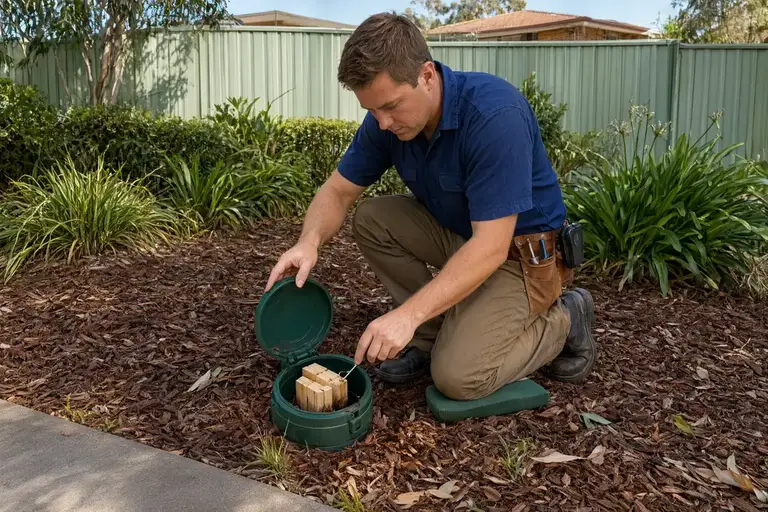
A professionally installed termite baiting system gives your property continuous protection by intercepting termites before they reach the structure. Aussie Pest Strike designs, installs and monitors termite baiting and monitoring programs for homes and businesses across Australia, using licensed treatment methods and regular scheduled checks. It’s a proven, low-disruption way to detect activity early and eliminate colonies at the source.
What Termite Baiting & Monitoring Systems Protects You From
Termites work silently and out of sight, often for months or years before any visible sign appears. By the time damage is noticed, repairs can run into the tens of thousands of dollars, and standard home insurance policies in Australia generally do not cover termite damage.
A monitoring and baiting program addresses the risk at its source by detecting activity early and acting on it before the colony reaches your home. Without some form of ongoing protection in place, your property remains exposed to:
- Structural damage to wall frames, roof timbers, bearers and joists
- Damage to flooring, skirting boards, door frames and window frames
- Costly repairs that are typically excluded from home insurance
- Reduced property value and complications when selling
- Hidden activity inside walls, subfloors and roof voids going undetected
- Ongoing colony pressure from surrounding bushland, fences and gardens
How We Treat It
- Inspect: We carry out a thorough assessment of your property, including the perimeter, subfloor, roof void and garden areas, to identify activity, conducive conditions and the best placement for stations. You can read more about what’s covered in our guide to what a termite inspection includes.
- Identify: We confirm the species present and map likely foraging paths, so the system is positioned where termites are actually travelling, not just where it’s convenient.
- Treat: Monitoring stations are installed around the property. When activity is detected, targeted applications of professional-grade products are placed inside the stations, which foraging termites carry back to the colony.
- Exclude and proof: We advise on practical steps to reduce pressure on your home, such as fixing moisture issues, removing timber debris and clearing garden beds away from walls.
- Follow-up: Stations are checked on a scheduled basis, activity is recorded in writing, and the program is adjusted as needed to keep your property protected year-round.
What’s Included
- A full property assessment before any installation begins
- Professional installation of monitoring stations around the perimeter
- Targeted applications when activity is detected, at no surprise
- Scheduled monitoring visits with written service reports
- Practical advice on reducing conditions that attract termites
- Ongoing support from licensed, insured local technicians
If you’re weighing up your options, our comparison of baiting versus barrier treatments explains the differences in plain terms, and our guide to how termite monitoring stations work walks through the process step by step.
Aussie Pest Strike vs Other Operators
Not all pest control providers deliver the same standard of termite protection, so it pays to compare before you book.
| Aussie Pest Strike | Typical operators | |
|---|---|---|
| Licensing & insurance | Fully licensed and insured | Varies, not always verified |
| Warranty | Clear written warranty terms | Often vague or verbal only |
| Written documentation | Detailed report every visit | Minimal or no paperwork |
| Follow-up | Scheduled monitoring program | One-off visit, little follow-up |
| Local knowledge | Australia-wide local technicians | Generalists, limited termite focus |
| Response time | Prompt booking and attendance | Long waits, hard to reach |
What It Costs
Pricing depends on the size of your property, the number of stations required and the level of activity found. The table below gives a realistic guide to typical industry ranges.
| Service | Typical range (AUD) |
|---|---|
| Initial inspection and assessment | $200 – $350 |
| Baiting and monitoring system installation | $1,500 – $3,500 |
| Ongoing monitoring (annual program) | $400 – $900 |
| Targeted colony treatment when active | Quoted on inspection |
Exact pricing follows an on-site inspection, as every property is different. We’ll always give you a clear written quote before any work begins, with no hidden extras.
FAQs
How does termite baiting monitoring actually work?
Stations are installed in the ground around your property and checked on a regular schedule. When termites are found feeding in a station, a targeted application is introduced, which the termites carry back to the nest, eliminating the colony over time rather than just repelling it.
Is a termite baiting system better than a barrier treatment?
Neither is universally better; the right choice depends on your property’s construction, soil type and history of activity. Many homes benefit from baiting where a continuous barrier is difficult to achieve, and our technicians will recommend the most suitable option after inspection, which may include professional termite treatment and barrier services where appropriate.
How often should a termite baiting system be checked?
Stations are typically checked every few months, with more frequent visits when activity is present. Regular monitoring is the key to the whole approach, which is why we pair every installation with a scheduled program and recommend periodic professional termite inspections for complete peace of mind.
Is termite baiting safe around pets and children?
Yes. Termite bait stations are locked, tamper-resistant and installed in-ground or on active leads, so children and pets can’t access the bait. The active ingredient targets termite biology specifically.
Is termite baiting better than a chemical barrier?
Neither is universally better — baiting excels at colony elimination and suits blocks where trenching isn’t practical, while barriers give fast perimeter protection. Many homes use both. We recommend the right setup after inspecting your property.