Flour Mites:The InvisiblePantry Pest
Flour mites the — flour mites are tiny (0.3–0.7 mm) pale arachnids that infest stored flour, grains and dried pet food, and are usually spotted only as a...
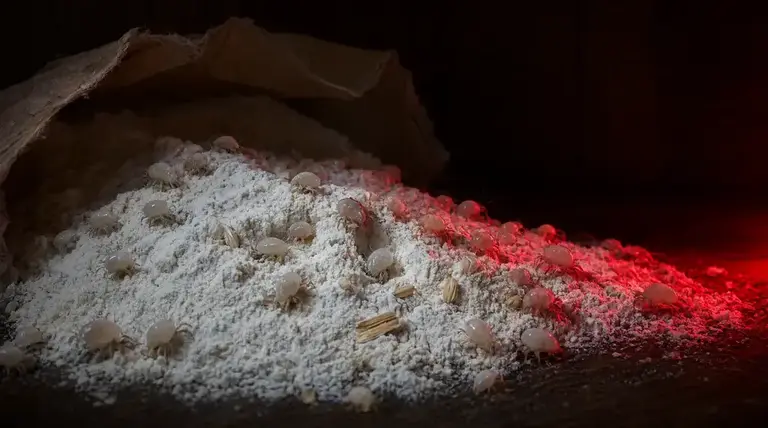
Flour mites are tiny (0.3–0.7 mm) pale arachnids that infest stored flour, grains and dried pet food, and are usually spotted only as a moving “dust” or a faint minty smell rather than as individual insects. Because they are so small, most Australian households only realise they have a problem once an entire bag of plain flour turns grey and lifeless-looking almost overnight.
A single female can lay up to 800 eggs, and in warm Australian pantries the population can double roughly every week. This guide covers how to identify flour mites, why our climate suits them so well, how to clear an infestation yourself, and when it makes sense to call in professional pest control.
- Flour mites (Acarus siro) are microscopic arachnids, not insects, and are usually detected as a shimmering “mite dust” or a minty, sickly-sweet odour.
- They need warmth and humidity above roughly 60% to breed, making Australian summer pantries ideal habitat.
- You cannot sift mites out — infested flour, grains and pet food must be discarded, and the whole pantry vacuumed, washed and dried.
- Airtight glass or hard-plastic containers, stock rotation and monthly checks are the only reliable long-term defence.
- Recurring or widespread infestations usually mean a hidden source; a licensed technician can inspect and treat safely around food areas.
Why flour mites thrive in Australian pantries
Flour mites need two things to explode in number — warmth and humidity above about 60% — and Australian kitchens deliver both for much of the year. Across a typical summer (December to February), kitchen temperatures of 25–30°C combined with coastal humidity in Brisbane, the Gold Coast, Sydney and Darwin create perfect breeding conditions.
In that environment the lifecycle from egg to adult can complete in as little as 9–14 days, so a light contamination inside one packet becomes a full infestation within a fortnight. Housing style matters too. Older Queenslanders with ventilated but humid subfloors, brick veneer homes with poorly ventilated walk-in pantries, and slab-on-ground kitchens that trap cooking steam all give mites the stable, moist air they prefer. Cooler southern cities like Melbourne and Hobart are not immune either — a warm, steamy kitchen in winter can hold enough local humidity to sustain a population year-round.
Flour mites rarely wander in from outside. They almost always arrive inside already-contaminated packaged goods, then spread to anything containing cereal starch. Long-stored bulk flour, home-baking stockpiles and bulk dry pet food are the most common starting points.
Warning signs of a flour mite infestation
The clearest signs of flour mites are a greyish “dust” that moves on the surface of flour and a faint minty smell, because the mites themselves are too small to see individually. Check your pantry against this list:
- Mite dust: a fine tan or greyish layer over the surface of flour, semolina or oats that appears to shimmer or crawl in good light.
- Minty or sickly-sweet smell: heavy infestations release a distinctive odour from the mites and their waste — sniff any suspect bag before use.
- Brown blotches: clumps where thousands of mites gather at the edges and seams of containers or packaging.
- Itchy hands: handling heavily infested flour can cause “grocer’s itch,” a temporary skin irritation that settles once the product is removed.
- Spreading spoilage: neighbouring packets of cereal, rice, dried fruit or pet food developing the same dusty film.
Flour mites frequently travel alongside other stored-product pests. While you’re inspecting, it’s worth checking for weevils in flour and rice, cross-referencing our pantry beetle identification and control guide, and watching for the webbing that signals Indian meal moths and other pantry moths.
DIY vs professional treatment for flour mites
Most light flour mite infestations can be cleared with a thorough DIY clean-out, because the only reliable fix is removing the food source and denying the mites humidity. Professional pest control becomes the smarter option when infestations keep returning, have spread through multiple cupboards, or sit inside a commercial kitchen, bakery or food-storage business where hygiene compliance matters.
| Factor | DIY approach | Professional treatment |
|---|---|---|
| Best for | Single contaminated packet, caught early | Recurring, widespread or commercial infestations |
| Method | Discard stock, vacuum, hot soapy wash, dry fully, freeze suspect goods | Source inspection, targeted treatment of harbourages, humidity and storage advice |
| Typical cost | Cost of discarded food plus cleaning supplies | Roughly $180–$450 AUD depending on scope |
| Time to resolve | One full day of cleaning, then monitoring | Usually one visit plus a follow-up check |
| Risk of recurrence | Higher if the source packet or humidity issue is missed | Lower — technicians trace hidden sources and entry points |
If you take the DIY route: discard (never sift) anything showing dust or odour, empty the entire pantry, vacuum shelves, corners and hinge gaps, wash with hot soapy water and dry completely, and freeze at-risk dry goods at −18°C for 4–7 days to kill mites and eggs. Any chemical treatment around food areas should only be applied by a licensed technician using APVMA-registered products.
How much does flour mite pest control cost in Australia?
Across the Australian pest control industry, professional pantry pest control for flour mites generally sits between $180 and $450 AUD in 2025-26, depending on the size of the infestation and whether the property is residential or commercial. The figures below reflect typical market rates charged across the industry — not any one company’s pricing. Your final quote will depend on pantry size, pest spread and follow-up needs.
| Service | Typical market rate (AUD) | What’s included/notes |
|---|---|---|
| Inspection and identification | $0–$120 | Often free with a booked treatment; confirms species and source |
| Single pantry treatment (residential) | $180–$280 | Targeted treatment of shelving and harbourages plus prevention advice |
| Whole-kitchen / multi-cupboard treatment | $280–$450 | For infestations spread across several storage areas, may include follow-up |
| Commercial kitchen or storeroom program | Quoted per site | Ongoing monitoring and treatment schedule for food businesses |
These are typical Australian market rates — and it’s worth knowing that Aussie Pest Strike typically comes in well under these figures while still delivering a thorough, professional treatment. For an exact quote tailored to your property, give us a call on [aps_phone] and we’ll sort you out.
Seasonal activity: when flour mites peak in Australia
Flour mite activity in Australia peaks through the warm, humid months from November to March and drops sharply in the cooler, drier winter. Heated kitchens can sustain low-level populations year-round, but summer is when small contaminations blow out fast.
Jan
Feb
Mar
Apr
May
Jun
Jul
Aug
Sep
Oct
Nov
Dec
Indicative activity levels: flour mite breeding accelerates with summer heat and coastal humidity, peaks December–February, and eases through the dry southern winter.
Nine times out of ten, a “mystery” flour mite problem traces back to one forgotten bulk bag at the back of the shelf. People clean the obvious packet, miss the source, and the mites are back in a fortnight. Empty the whole pantry in one hit, drop the humidity, and you’ll only have to do it once.
Discard every suspect dry good today, deep-clean and fully dry the pantry, then restock into airtight glass or hard-plastic containers in quantities you’ll use within a month. If mites return after a proper clean-out, book a professional inspection — there’s almost certainly a hidden source. Our Silverfish & Pantry Pest Control service covers the full range of stored-product pests in one visit.
Frequently Asked Questions
What are flour mites and how do I identify them?
Flour mites (Acarus siro) are tiny pale arachnids, not insects, measuring just 0.3–0.7 mm, so you rarely see them individually. The clearest signs are a fine tan or greyish 'mite dust' that shimmers or appears to crawl on the surface of flour, semolina or oats, plus a faint minty or sickly-sweet smell from heavy infestations. Brown blotches at container seams and spreading spoilage to neighbouring packets are also warning signs.
Why do flour mites thrive in Australian pantries?
Flour mites need warmth and humidity above roughly 60% to breed, which Australian kitchens deliver for much of the year. Older Queenslanders with humid subfloors, poorly ventilated walk-in pantries and slab-on-ground kitchens that trap cooking steam all provide the stable, moist air mites prefer.
How do flour mites get into my pantry?
Flour mites rarely wander in from outside. They almost always arrive inside already-contaminated packaged goods, then spread to anything containing cereal starch. Long-stored bulk flour, home-baking stockpiles and bulk dry pet food are the most common starting points. Nine times out of ten, a mystery infestation traces back to one forgotten bulk bag at the back of the shelf that was missed during an earlier clean-out.
Can I sift flour mites out of my flour instead of throwing it away?
No. You cannot sift mites out — infested flour, grains and pet food must be discarded. Because the mites and their eggs are microscopic, sifting leaves contamination behind and the problem simply returns. Anything showing dust or odour should go straight in the bin, along with neighbouring packets that may have been reached. Only unopened or unaffected goods stored in sealed containers are worth keeping.
How do I clear a flour mite infestation myself?
Discard every suspect dry good, empty the entire pantry in one hit, vacuum shelves, corners and hinge gaps, wash with hot soapy water and dry completely. Freeze at-risk dry goods at −18°C for 4–7 days to kill mites and eggs before restocking. Then decant food into airtight glass or hard-plastic containers in quantities you will use within a month, and monitor monthly. A full day of cleaning is usually enough for light infestations caught early.
When should I call a professional pest controller for flour mites?
Professional treatment makes sense when infestations keep returning after a proper clean-out, have spread through multiple cupboards, or sit inside a commercial kitchen, bakery or food-storage business where hygiene compliance matters. Recurring problems usually mean a hidden source packet or humidity issue has been missed. A licensed technician can inspect, trace hidden sources and entry points, and apply targeted treatment safely around food areas using APVMA-registered products only.
How much does professional flour mite treatment cost in Australia?
Professional flour mite treatment costs vary with the size of the infestation and the type of property. A single pantry treatment is usually the cheapest option, while treating an entire kitchen or running a commercial program costs more. Many providers include an inspection when you book a treatment, and final quotes depend on how far the mites have spread and whether follow-up visits are needed.
When is flour mite season in Australia?
Flour mite activity peaks through the warm, humid months from November to March, accelerating with summer heat and coastal humidity and peaking between December and February. Activity drops sharply in the cooler, drier southern winter. However, heated kitchens can sustain low-level populations year-round — a warm, steamy kitchen in winter can hold enough local humidity to keep mites breeding even in cooler cities like Melbourne and Hobart.
I have followed the prevention steps in this article but flour mites keep coming back. How can Aussie Pest Strike help?
If mites return after a proper clean-out, there is almost certainly a hidden source such as a forgotten bulk bag or a humidity issue that DIY cleaning missed. Aussie Pest Strike can inspect your pantry, trace the hidden source and entry points, and carry out targeted treatment of harbourages safely around food areas. Their Silverfish & Pantry Pest Control service covers the full range of stored-product pests in one visit, with follow-up checks where needed.
What should I do first if I suspect flour mites in my pantry right now?
Start today by discarding every suspect dry good showing dust or odour, then deep-clean and fully dry the pantry before restocking into airtight glass or hard-plastic containers. If you would rather have the infestation confirmed and treated properly, contact Aussie Pest Strike for an inspection tailored to your property. They can identify whether flour mites, weevils, pantry beetles or moths are involved and advise on the right treatment scope for your kitchen.
Sources & further reading
Found Something
Dangerous?
Don’t touch it. Don’t spray it. Keep kids and pets clear, take a photo from a safe distance, and call us — or book a free inspection and we’ll come to you.
02 7235 0050