Pigeons Nesting onYour Roof:Problems and Solutions
Pigeons nesting on — Pigeons nesting roof — Pigeons on roof — pigeons on your roof cause more than mess their acidic droppings corrode roofing and solar...
If you’ve got pigeons on roof ledges, gutters or solar panels, you’re not alone — feral pigeons are one of the most common pest problems across Australian homes and commercial buildings. The short answer: physical exclusion combined with removing what attracts them is the only lasting fix, because pigeons are strongly site-loyal and repellents alone rarely hold up.
Pigeons nesting on your roof cause more than mess. Their acidic droppings corrode roofing and solar panels, block gutters, and harbour mites and disease, while nesting material is a fire and pest risk. This guide covers the warning signs, realistic costs, and the solutions that actually work for Australian conditions — and when professional pest control is the smarter call.
- A breeding pair of feral pigeons can raise up to six broods a year — a small roost multiplies fast.
- Acidic droppings etch roofing, render and solar panels, block gutters, and carry pathogens linked to psittacosis and cryptococcosis.
- Physical exclusion (netting, spikes, solar mesh) plus removing food sources is the most reliable long-term solution.
- Native birds — including crested pigeons and many doves — are protected, so correct species identification matters before any action.
- Acting early, while only a pair or two are roosting, is far cheaper than tackling an entrenched flock.
Why pigeons on roof are such a problem in Australia
Australian housing is almost tailor-made for pigeons. Flat ledges, box gutters, sheltered eaves, ridge caps and the warm cavity under solar panels all provide ideal roosting and nesting sites, and our mild winters in most regions mean pigeons breed nearly year-round rather than seasonally.
The feral pigeon (Columba livia) is the main culprit around Australian homes and city buildings. Because it’s an introduced species, it faces few natural checks in urban areas, and its droppings are strongly acidic. Left to accumulate on tile, Colorbond or terracotta roofing, droppings etch and stain surfaces, corrode fixings, and wash into gutters and downpipes where they block drainage. During a wet summer, blocked gutters and valleys let water back up under tiles and into ceilings — turning a minor bird issue into a roof-repair and water-damage bill.
Roof style matters too. Low-pitch brick veneer homes with wide eaves give pigeons sheltered perches; older Queenslanders with decorative ridge details and deep verandahs offer endless ledges; and any home with rooftop solar has a ready-made warm, predator-proof cavity beneath the panels. Add a food source — spilled bird seed, pet food, scraps or open bins — and pigeons will keep returning. Remove the food source and half the battle is won, but established roosts usually need exclusion work as well.
Warning signs: how do I know pigeons are nesting on my roof?
The clearest signs are droppings, noise and nesting debris concentrated around one area of the roof. Pigeons are creatures of habit, so evidence tends to build up in the same spots rather than spreading evenly. Check for:
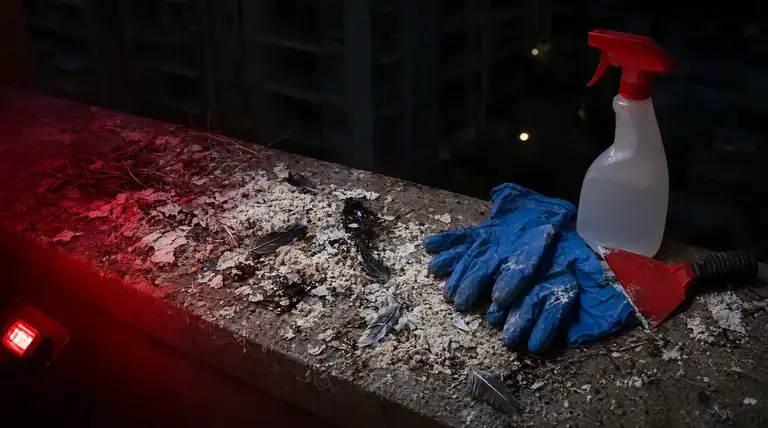
- Droppings build-up — white-grey splatter concentrated on one slope, ledge, ridge cap or around solar panels, often with staining on walls or paths below.
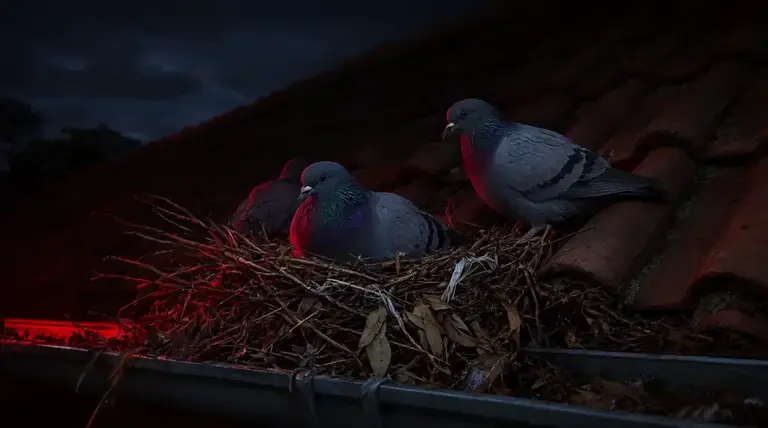
- Nesting material — twigs, straw and feathers in gutters, valleys, eaves or visible under the edge of solar panels.
- Cooing and scratching sounds — persistent cooing at dawn, or shuffling and scratching heard through the ceiling, especially in the early morning.
- Regular flight paths — the same birds landing on the same section of roof at the same times of day, day after day.
- Blocked or overflowing gutters — water spilling over gutters in rain where nests or droppings have caused a dam.
- Mites or lice indoors — tiny crawling insects near windows, vents or ceiling fixtures can signal mites migrating from a nest overhead. Our article on bird mites and lice: when nests become a pest problem explains what to look for.
Pigeons are also strongly site-loyal: once a roost is established they return to the same spot year after year, and their young imprint on the location and come back to breed there too. That’s why a problem left unaddressed tends to grow rather than fade, and why simply shooing birds away rarely achieves anything lasting.
DIY vs professional pigeon control: what actually works?
DIY can handle prevention — cutting off food, cleaning up droppings safely, and installing basic spikes on accessible ledges — but established nests, roof-height work and solar panel proofing are usually jobs for a licensed technician. Working at roof height carries serious fall risk, and effective exclusion requires correct materials and tensioning to stop birds simply shifting a metre along the roofline. If you’re cleaning accumulated droppings yourself, read our guide to bird droppings: health risks and safe cleanup first, because dry droppings can release harmful dust.
| Approach | Best for | Effectiveness |
|---|---|---|
| Source removal (secure bins, remove seed) | Every site | Essential first step, but won’t shift an established roost alone |
| Anti-roosting spikes | Ledges, ridge caps, gutters | Good on narrow surfaces if installed correctly |
| Bird netting | Courtyards, eaves, large gaps, under solar | Excellent long-term physical barrier; needs professional tensioning |
| Solar panel mesh | Panel perimeters | Highly effective; blocks the favoured cavity beneath panels |
| Ultrasonic devices, plastic owls | Short-term deterrence | Poor — pigeons learn to ignore them within weeks |
| Professional exclusion program | Established roosts, two-storey roofs, solar arrays | Most reliable; combines nest removal, cleanup and proofing |
Because the cavity under panels is a favourite roost for pigeons on roof edges, our solar panel bird proofing service and our dedicated guide to bird-proofing solar panels cover that job in detail. For whole-of-roof work, professional bird control and proofing combines all of the above into one tailored program.
A word on the law: feral pigeons are an introduced species and are not protected, so control is generally permitted. Native birds, however — including many doves and the crested pigeon — are protected under state wildlife legislation, so correct identification matters before any action is taken. A licensed technician can confirm the species and choose a lawful, humane method, and any chemical treatments should only ever be applied by a licensed pest control professional following APVMA-registered label directions.
How much does pigeon control cost in Australia?
Across the Australian pest control industry, most residential pigeon control jobs are quoted between $300 and $2,500, depending on roof access, the size of the roost and how much proofing is needed. The table below shows typical market rates charged across the industry for 2025-26 — these are general Australian industry figures, not any one company’s pricing, and every site is different, so treat them as a guide rather than a quote.
| Service | Typical market rate (AUD) | What’s included/notes |
|---|---|---|
| Inspection and quote | $0 – $150 | Roof assessment, species ID, proofing plan; often free with booking across the industry |
| Nest removal and dropping cleanup | $250 – $600 | Removal of nests, safe cleanup, sanitising of affected areas |
| Anti-roosting spike installation | $300 – $800 | Spikes on ledges, ridge caps and gutters; typically priced by linear metre |
| Solar panel mesh proofing | $600 – $1,500 | UV-stable mesh around panel perimeter; varies with array size and roof pitch |
| Full netting/exclusion program | $1,000 – $2,500+ | Netting over eaves, courtyards or large gaps on bigger or two-storey homes |
Compare those market rates with the cost of doing nothing: gutter repairs, ceiling water damage and re-spraying etched render routinely run well past these figures. Acting early, while only a pair or two are roosting, is far cheaper and simpler than tackling an entrenched flock.
It’s worth knowing that Aussie Pest Strike typically comes in well under these general market rates, while still delivering the same thorough, professional standard of work. For an exact quote tailored to your property, give us a call on [aps_phone] and we’ll sort you out.
When are pigeons most active in Australia?
Pigeons breed all year in most of Australia, but nesting and roof activity peaks from late winter through summer — roughly August to February — when longer days and warmer weather drive breeding. Activity dips through late autumn and early winter, which is often the best window to get proofing installed before the next breeding surge.
Jan
Feb
Mar
Apr
May
Jun
Jul
Aug
Sep
Oct
Nov
Dec
Indicative pigeon nesting activity across most Australian regions: lowest in mid-winter, building from August and peaking through the warmer months. Northern regions may see less seasonal variation.
Nine times out of ten, when we get called to a pigeon job there’s already a solar array involved — the cavity underneath is perfect shelter. People try plastic owls and ultrasonic gadgets for months, but pigeons work those out fast. Once the panels are meshed and the food source is gone, the birds move on within days and they don’t come back.
Don’t waste money on repellents and fake predators. Secure all food sources first, then invest in proper physical exclusion — spikes on ledges and ridge caps, and mesh around any solar panels. If birds are already nesting, have a licensed technician remove the nests, clean the droppings safely and install the proofing in one visit, ideally before the spring breeding peak.
Frequently Asked Questions
Why do pigeons keep nesting on my roof?
Australian homes offer ideal pigeon habitat: flat ledges, box gutters, sheltered eaves, ridge caps and the warm cavity under solar panels all make perfect roosting and nesting sites. Pigeons are strongly site-loyal, so once a roost is established they return to the same spot year after year, and their young imprint on the location and come back to breed there too. Add a food source such as spilled seed, pet food or open bins, and the problem keeps growing rather than fading.
What damage can pigeons nesting on a roof cause?
Feral pigeon droppings are strongly acidic, so they etch and stain tile, Colorbond and terracotta roofing, corrode fixings, and mark render and solar panels. Droppings wash into gutters and downpipes where they block drainage; during wet weather this can let water back up under tiles and into ceilings. Nesting material creates a fire and pest risk, and nests can harbour mites that migrate indoors, along with pathogens linked to diseases such as psittacosis and cryptococcosis.
How do I know if pigeons are nesting on my roof?
The clearest signs are droppings build-up concentrated on one slope, ledge, ridge cap or around solar panels, often with staining below. Look for twigs, straw and feathers in gutters, valleys, eaves or under panel edges, persistent cooing and scratching at dawn through the ceiling, the same birds landing at the same times daily, gutters overflowing during rain, and tiny mites near windows, vents or ceiling fixtures indoors.
Do plastic owls and ultrasonic devices work against pigeons?
No. Plastic owls and ultrasonic devices rate poorly for pigeon control because pigeons learn to ignore them within weeks. They may offer short-term deterrence at best, but they will not shift an established roost. Physical exclusion — netting, anti-roosting spikes and solar panel mesh — combined with removing food sources is what actually works long term, especially when installed correctly so birds cannot simply shift a metre along the roofline.
Can I remove pigeons from my roof myself?
DIY suits prevention: secure bins, remove spilled bird seed and pet food, clean up droppings safely, and fit basic spikes on accessible ledges. However, established nests, roof-height work and solar panel proofing are usually jobs for a licensed technician because of serious fall risk and the need for correct materials and tensioning. Dry droppings can release harmful dust, so read up on safe cleanup before handling accumulated mess yourself.
Are pigeons protected in Australia?
Feral pigeons are an introduced species and are not protected, so control is generally permitted. Native birds are different: many doves and the crested pigeon are protected under state wildlife legislation, so correct species identification matters before taking any action. A licensed technician can confirm which species you have and choose a lawful, humane method, and any chemical treatments should only be applied by licensed professionals following APVMA-registered label directions.
When are pigeons most active in Australia?
Pigeons breed nearly year-round across most of Australia thanks to mild winters, but nesting and roof activity peaks from late winter through summer, roughly August to February, driven by longer days and warmer weather. Activity dips through late autumn and early winter, making that period the best window to install proofing before the next breeding surge. Northern regions may see less seasonal variation than southern areas.
How much does pigeon control cost in Australia?
Pigeon control costs vary widely because every roof presents different challenges. Pricing typically depends on how easily the nesting areas can be accessed, how many birds are involved, and which proofing methods suit your property. Simple deterrents cost less than extensive work like solar panel mesh or full netting installations. The best approach is to arrange an inspection so a professional can assess your specific situation and provide an accurate, tailored quote.
What happens during an Aussie Pest Strike inspection for pigeons nesting on my roof?
An inspection typically involves assessing your roof, identifying the bird species to confirm whether it's an unprotected feral pigeon or a protected native species, and locating the roosting and nesting sites — including the favoured cavity beneath solar panels. From there, a proofing plan is tailored to your property, covering options like spikes, netting and solar mesh alongside food-source removal. Inspections are commonly free with booking across the industry, and Aussie Pest Strike can confirm details for your specific situation.
When is the best time to book Aussie Pest Strike for pigeon proofing?
Late autumn and early winter are generally the smartest window, since pigeon activity dips then and proofing installed before August beats the breeding surge that builds through spring and summer. Acting early while only a pair or two are roosting is far cheaper and simpler than tackling an entrenched flock later. If pigeons are already nesting under your solar panels or along your roofline, contacting Aussie Pest Strike promptly helps stop the problem multiplying.
Sources & further reading
Found Something
Dangerous?
Don’t touch it. Don’t spray it. Keep kids and pets clear, take a photo from a safe distance, and call us — or book a free inspection and we’ll come to you.
02 7235 0050