Wasp Season inAustralia: WhenNests Become Dangerous
Wasp season in Australia peaks Feb–Apr when nests turn dangerous. Learn the colony calendar, regional timing and when to act. Book a free inspection today.
Wasp season in Australia peaks in late summer and early autumn – roughly February to April – when colonies reach maximum size and become most aggressive. A nest that looked like a small grey golf ball in spring can hold thousands of wasps by March, which is exactly when stinging incidents spike in backyards from Brisbane to Perth.
Put simply: wasp season is the annual cycle in which a lone queen builds a small nest in spring, workers multiply through summer, and the colony hits peak size and aggression in late summer before dying back in winter. Knowing that cycle helps you act at the safest, easiest time – and know when a nest has crossed the line from nuisance to genuine hazard.
- Australian wasp season runs from spring nest-founding through to a dangerous peak in February–April.
- Late summer colonies can hold thousands of workers and defend the nest aggressively – never disturb a mature nest.
- In Melbourne, Canberra, Tasmania and the Adelaide Hills, mild winters let some European wasp nests over-winter and grow enormous.
- Spring is the safest and cheapest time for nest removal; small starter nests are quick jobs for a licensed technician.
- Year-round prevention – closed bins, covered food, cleared fallen fruit – cuts the attractants that draw foraging wasps.
Why Wasp Season Matters Across Australia
Wasp season matters because Australia’s varied climate means almost every region has a high-risk window, and the timing shifts by location. Whether you live in a brick veneer in Sydney’s west, a weatherboard Queenslander on stumps, or a slab-on-ground home in outer Melbourne, the sheltered spots wasps love – eaves, sheds, retaining walls, roof voids – are part of the Australian housing landscape.
In warm-temperate Sydney and coastal NSW, activity ramps up from October and peaks around March, which is why wasps feature prominently among the common summer pests in Sydney homes. Cooler Melbourne, Canberra and Tasmania run a few weeks behind, but face a different problem: their milder winters let some European wasp nests survive into a second year. In subtropical south-east Queensland, warm conditions stretch paper wasp activity over a much longer window – the same humidity that drives other pest pressure, as covered in our guide to humidity and pests on the Gold Coast, keeps wasps active well beyond the southern season. The Adelaide Hills and Perth hills, meanwhile, suit European wasps perfectly with their Mediterranean summers.
Warning Signs a Wasp Nest Is Becoming Dangerous
A nest becomes dangerous when worker numbers climb and the colony starts defending its territory aggressively. Watch for these signs around your property, especially from December onward:
- Steady wasp traffic: a constant stream of wasps flying to and from one spot – an eave, wall cavity, shed or garden bed – signals an established nest nearby.
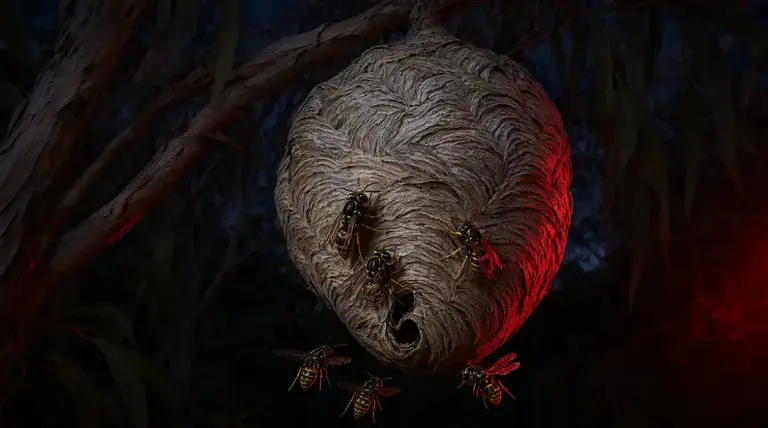
- Visible nest growth: a papery grey structure that has grown from golf-ball size to football size or larger in a few weeks.
- Wasps around food and drink: persistent wasps hovering at barbecues, pet bowls, soft drink cans and fruit trees indicate a large colony foraging hard.
- Aggressive behaviour: wasps that approach or dive at people who come within a few metres of a particular area are defending a mature nest.
- A nest that survived winter: in southern regions, a nest still active in late winter or early spring is likely an over-wintered European wasp nest and a serious hazard.
DIY vs Professional Wasp Nest Removal
Only a tiny spring starter nest – smaller than a golf ball, with the queen alone – is ever a candidate for DIY treatment, and even then only with great care. Once worker numbers build, disturbing a nest can trigger a mass stinging response, and European wasps can sting repeatedly. Anything beyond that small spring stage belongs with a licensed pest control technician who has the protective gear, APVMA-approved products and experience to treat it safely.
| Factor | DIY approach | Professional treatment |
|---|---|---|
| Best timing | Spring only, tiny starter nests | Any stage, including peak-season colonies |
| Sting risk | High without protective equipment | Managed with full protective gear |
| Nest access | Limited to reachable, visible nests | Roof voids, wall cavities, underground nests |
| Products used | Hardware-store aerosols, variable results | APVMA-approved professional-grade treatments |
| Over-wintered nests | Never attempt | Essential – always professional |
Wasp Nest Removal Costs in Australia (2025–26)
Across the Australian pest control industry, professional wasp nest removal generally costs between $150 and $450 as a typical market rate, depending on nest size, location and access. Small, easy-access spring nests sit at the low end of what the industry charges; large, concealed or over-wintered colonies command higher market prices because of the time, equipment and risk involved. The figures below reflect typical Australian industry rates for 2025–26 — they are a guide to what the market generally charges, not a quote.
| Service | Typical market rate (AUD) | What’s included/notes |
|---|---|---|
| Small spring nest removal | $150–$220 (industry-typical) | Single accessible starter nest, treatment and removal |
| Standard nest treatment | $200–$320 (industry-typical) | Established nest in eaves, shed or garden; knockdown treatment |
| Concealed or cavity nest | $280–$450 (industry-typical) | Wall cavity, roof void or underground nest; may need follow-up visit |
| Seasonal inspection | Often free–$120 (industry-typical) | Property check of eaves, sheds and retaining walls; quote for any work |
Acting in spring is safer and usually cheaper than tackling a peak-season colony, which is why a quick seasonal check pays off. Across the market, spring call-outs consistently sit at the lower end of the industry price ranges above.
Here’s the good news: Aussie Pest Strike typically comes in well under these typical Australian market rates, while still delivering licensed, fully insured treatment with a satisfaction guarantee. For an exact, obligation-free quote tailored to your property, call us on [aps_phone] today.
Wasp Activity by Month in Australia
Wasp activity follows a clear seasonal curve: low through winter, building from spring, and peaking from February to April. The chart below shows typical relative activity across a calendar year for most populated regions, with subtropical Queensland running a flatter, longer season.
Jan
Feb
Mar
Apr
May
Jun
Jul
Aug
Sep
Oct
Nov
Dec
Typical wasp activity pattern for temperate Australia: queens emerge in spring, colonies build through summer, and activity peaks February–April before most nests die off over winter. Subtropical regions see a longer, flatter curve; southern regions carry a small winter risk from over-wintered European wasp nests.
When and How to Act Each Season
The right action depends on the season: inspect and remove early in spring, monitor through summer, and call a professional once a colony matures. A ten-minute walk around the eaves, sheds and garden edges in September can save you a fraught, dangerous encounter in March.
- Spring (Sep–Nov): inspect eaves, sheds, retaining walls and roof voids; a lone queen’s starter nest is the easiest removal of the year.
- Early summer (Dec–Jan): watch for rising wasp traffic and locate flight paths from a safe distance – worker numbers are building rapidly.
- Late summer/autumn (Feb–Apr): do not disturb mature nests. Colonies are at peak size and defend fiercely; call a professional.
- Winter (May–Aug): most nests die as workers perish and new queens hibernate, but in mild southern areas report any nest that stays active – it may be an over-wintered European wasp nest. And while wasps quieten down, other pests move indoors; see our guide to winter pest problems in Melbourne.
- Year-round: keep bins closed, cover food and drinks outdoors, pick up fallen fruit and don’t leave pet food sitting out.
The over-wintering issue deserves emphasis. In cooler southern regions – Melbourne, Canberra, Tasmania and the Adelaide Hills – a mild winter occasionally lets a European wasp nest survive into a second year. These nests can grow to hold more than 100,000 wasps and reach the size of a small car. That is never a DIY situation: it’s a genuine hazard that always needs professional handling.
The jobs that worry me are the ones where a homeowner has watched a nest grow all summer and then tries to knock it down with a broom in March. By then there are thousands of wasps and they will defend that nest hard. Call us in spring when it’s the size of a golf ball – it’s quicker, cheaper and nobody gets stung.
Book a seasonal inspection each September or October, before colonies build. If you find an active nest between December and April, keep people and pets away and call a licensed pest control technician – never attempt to remove a mature nest yourself. If you’re in a southern region and spot a nest still active in winter, treat it as urgent and get professional advice straight away.
Frequently Asked Questions
How does wasp season affect nest danger levels in Australia?
Wasp season runs from spring, when a lone queen founds a small nest, through summer as workers multiply, to a dangerous peak in late summer and early autumn – roughly February to April – when colonies reach maximum size and aggression. Most nests die back over winter.
Why are wasp nests most dangerous in February to April?
By late summer and early autumn, colonies have reached their maximum size, often holding thousands of workers in a nest that started as a golf-ball-sized structure in spring. A mature nest should never be disturbed – this is the stage where professional treatment matters most.
What warning signs show a wasp nest is becoming dangerous?
Watch for steady wasp traffic flying to and from one spot such as an eave, wall cavity, shed or garden bed; visible nest growth from golf-ball to football size or larger within weeks; persistent wasps hovering around barbecues, pet bowls, drink cans and fruit trees; and wasps that approach or dive at people coming within a few metres of an area. In southern regions, a nest still active in late winter or early spring may be an over-wintered European wasp nest.
Can I remove a wasp nest myself?
Only a tiny spring starter nest – smaller than a golf ball with the queen alone – is ever a candidate for DIY treatment, and even then only with great care. Once worker numbers build, disturbing a nest can trigger a mass stinging response, and European wasps can sting repeatedly. Anything beyond that early spring stage belongs with a licensed pest control technician who has protective gear, APVMA-approved products and experience treating nests safely.
Where do European wasp nests survive winter in Australia?
In cooler southern regions with mild winters – Melbourne, Canberra, Tasmania and the Adelaide Hills – some European wasp nests over-winter and continue into a second year. These nests can grow enormous, holding more than 100,000 wasps and reaching the size of a small car. Any nest still active in winter should be treated as urgent and handled only by professionals.
When is the best time to remove a wasp nest?
Spring (September to November) is the safest and easiest time for removal, when a lone queen's starter nest is small and quick to treat. Through early summer you should monitor rising wasp traffic from a safe distance. From February to April, mature colonies defend fiercely and must not be disturbed – call a licensed technician instead. Acting in spring avoids the fraught, dangerous encounters that peak-season colonies create.
How does wasp activity differ across Australian regions?
Timing varies with climate. Cooler Melbourne, Canberra and Tasmania run a few weeks behind but face over-wintering European wasp nests. The practical next step is to note the signs, inspect the relevant area carefully, and seek property-specific advice if the issue continues.
How can I prevent wasps around my home year-round?
Year-round prevention focuses on removing attractants that draw foraging wasps: keep bins closed, cover food and drinks outdoors, pick up fallen fruit from the garden, and don't leave pet food sitting out. It also helps to inspect eaves, sheds, retaining walls and roof voids each spring so any new queen's starter nest is spotted early, when it is still small and simple for a technician to treat.
What information should I provide when booking Aussie Pest Strike for a wasp nest?
When contacting Aussie Pest Strike about a wasp nest, it helps to describe where the nest is located – eaves, shed, wall cavity, roof void or underground – roughly how large it is, how long it has been there, and how much wasp traffic you're seeing. Mention whether anyone or any pets have been stung or approached aggressively, and whether the nest has survived winter. This helps the technician plan safe access and appropriate treatment.
What practical next step should I take if I find an active wasp nest on my property?
Keep people and pets well away from the area and avoid disturbing the nest or blocking its flight path. Note the nest's location and size from a safe distance, then contact Aussie Pest Strike for an obligation-free quote tailored to your property. If you're in a southern region and the nest is still active during winter, treat it as urgent, as it may be an over-wintered European wasp nest requiring prompt professional handling.
Sources & further reading
Found Something
Dangerous?
Don’t touch it. Don’t spray it. Keep kids and pets clear, take a photo from a safe distance, and call us — or book a free inspection and we’ll come to you.
02 7235 0050