Bed Bug Treatment:Heat vs Chemical— Which Works?
Bed bug treatment: heat kills eggs fast while chemicals give lasting protection. Compare both methods to find what works, then book a free inspection.
Few pests cause as much stress in Australian homes as bed bugs, and once you’ve confirmed them the big question arrives quickly: should you choose heat treatment or chemical treatment? Both methods work, and the honest answer is that the best bed bug treatment for your property depends on the severity of the infestation, your home’s construction and your budget — something a licensed assessment settles fast.
In short, bed bug treatment is the professional process of eliminating every life stage of Cimex lectularius — adults, nymphs and eggs — using heat, residual insecticides or a combination of both. Below we compare the two approaches head-to-head, cover realistic Australian pricing, and explain why preparation matters more than the method itself. If you’re still at the “is this even bed bugs?” stage, start with our guide to Bed Bug Bites: Identification and Your First Steps before spending a dollar on treatment.
- Heat treatment kills all life stages including eggs in a single visit, but leaves no residual protection once the room cools.
- Chemical treatment provides weeks of residual protection but usually needs two or more visits to break the egg cycle.
- Many professionals combine both: heat for immediate knockdown, chemical perimeter for ongoing defence.
- Preparation — laundering, decluttering, moving furniture — makes or breaks either method.
- Expect to pay roughly $300–$800 per room for chemical treatment and $800–$2,500+ for whole-room heat treatment in Australia in 2025–26.
Why Bed Bugs Are a Growing Problem Across Australia
Bed bugs thrive Australia-wide because our housing stock and travel habits suit them perfectly — they hitchhike in luggage, furniture and clothing, then breed year-round in our temperature-controlled bedrooms regardless of the season outside. Unlike cockroaches or ants, they aren’t drawn by food scraps or moisture, so a spotless home is just as vulnerable as a cluttered one.
Australian conditions give them a leg-up in a few specific ways. Warm northern climates in Queensland and the NT accelerate their breeding cycle — eggs can hatch in as little as six days in sustained heat. Older housing stock helps too: Queenslanders with tongue-and-groove walls, brick veneer homes with wall cavities, and subfloor gaps in raised weatherboard houses all create endless harbourage points within metres of where you sleep. High-density apartment living in Sydney, Melbourne and Brisbane lets infestations spread between units through shared walls. Understanding How Bed Bugs Actually Spread (And How They Don’t) helps you cut off the routes they use — and if you travel regularly, our five-minute routine for checking a hotel room for bed bugs is the single best prevention habit you can build.
Warning Signs You Need Bed Bug Treatment
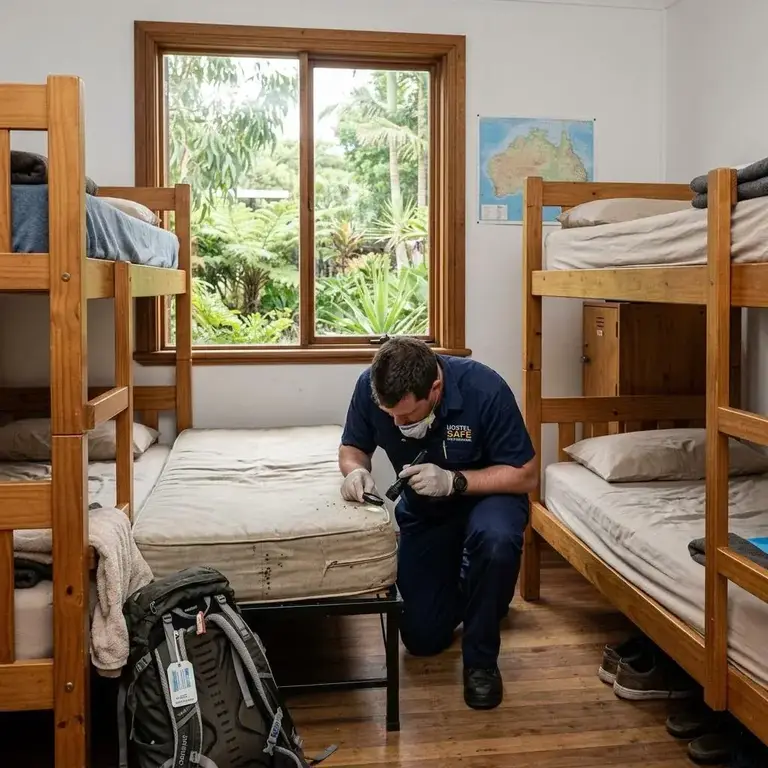
The clearest signs of an infestation are bites in lines or clusters, dark faecal spotting on bedding, and live bugs or shed skins in mattress seams. Bed bugs hide within a few metres of sleeping areas, so check the bed first, then bedside furniture, skirting and power points. Work through this checklist:
- Bite patterns — itchy red welts appearing in rows or clusters of two to three, often on arms, neck and shoulders after sleeping.
- Faecal spotting — small black or rust-coloured dots on sheets, mattress piping, bed heads and skirting boards.
- Blood smears — tiny rust-red stains on pillowcases or sheets where bugs have been crushed overnight.
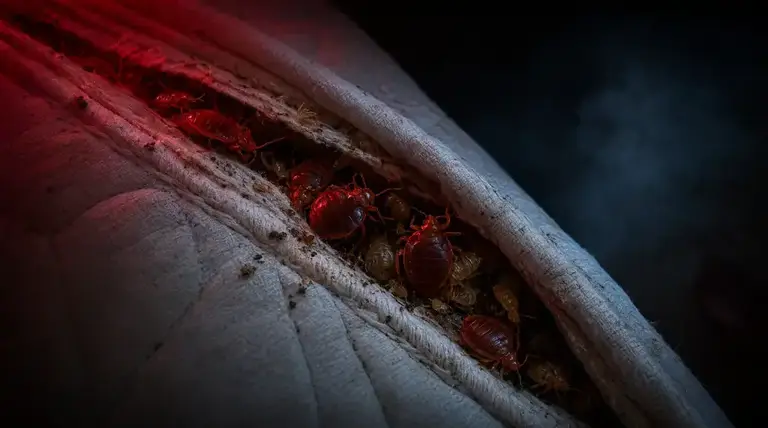
- Shed skins and eggs — pale translucent casings and pinhead-sized white eggs in mattress seams, bed frame joints and furniture crevices.
- Live bugs — apple-seed-sized, flat, reddish-brown insects, most active just before dawn.
- Musty odour — a sweet, musty smell in heavier infestations, caused by bug pheromones.
Spotting even one or two of these signs warrants a professional inspection — early infestations are dramatically cheaper and faster to clear than established ones.
How Heat Treatment Works
Heat treatment kills bed bugs by raising the room temperature to around 50–60°C and holding it there long enough to penetrate every crack, mattress core and wall void. Bed bugs die at sustained temperatures above roughly 45°C, so a controlled heat treatment reaches lethal levels in the deep harbourage points where sprays struggle to reach — and it kills adults, nymphs and eggs in one pass.
Technicians use industrial heaters and circulating fans, monitoring temperatures with remote sensors to ensure lethal heat reaches cold spots without damaging the room. The strengths and limits:
- Kills eggs immediately, which many chemicals miss.
- Often completed in a single day with no chemical residue left behind.
- Reaches deep harbourage points inside furniture and wall voids.
- Offers no lasting protection once the room cools — reinfestation is possible.
- Heat-sensitive items (aerosols, candles, medications, vinyl records, some electronics) must be removed first.
How Chemical Treatment Works
Chemical treatment uses professional-grade residual insecticides applied to mattress seams, bed frames, skirting, carpet edges and other harbourage points by a licensed pest control technician. The residue keeps working for weeks, killing bugs that hatch or emerge after the initial application — a crucial advantage, because eggs typically hatch within 6–10 days of being laid. It usually requires two or more visits spaced a fortnight apart to fully break the life cycle.
Products used in Australia are APVMA-registered and applied strictly to label directions, targeted into cracks and crevices rather than sprayed across open surfaces. Reputable operators will never claim any chemical is “100% safe” — instead, they manage risk through correct product selection, precise application and clear re-entry guidance, which is why chemical application should always be left to licensed professionals.
DIY vs Professional Bed Bug Treatment
DIY bed bug treatment almost always fails because supermarket sprays don’t kill eggs and can’t reach deep harbourages, while professionals have the heat equipment, residual products and inspection experience to clear every life stage. Here’s the honest comparison:
| Factor | DIY Approach | Professional Treatment |
|---|---|---|
| Kills eggs | Rarely — most retail products don’t | Yes (heat immediately; chemical with follow-up) |
| Residual protection | Minimal to none | Weeks of protection from residual products |
| Reaches deep harbourages | No — sprays can’t penetrate wall voids or mattress cores | Yes — heat penetrates; technicians dust voids |
| Typical success rate | Low; often spreads bugs to new rooms | High when preparation is done properly |
| True cost | $100–$300 in products, repeated for months | Higher upfront, resolved in weeks |
Our dedicated Bed Bug Treatment & Removal service starts with a proper inspection so the method matches the infestation, not the other way around.
What Does Bed Bug Treatment Cost in Australia?
In 2025–26, the typical Australian market rate for professional bed bug treatment sits around $300–$800 per room for chemical programs and $800–$2,500 or more for whole-room heat treatment, with combined approaches generally priced accordingly. Across the industry, final pricing depends on the number of rooms, infestation severity, property access and whether follow-up visits are bundled in.
| Service | Typical market rate (AUD) | What’s included/notes |
|---|---|---|
| Inspection and assessment | $0–$150 | Often free with a booked treatment; confirms species and extent |
| Chemical treatment (per room) | $300–$800 | Initial application plus one to two follow-up visits |
| Heat treatment (per room/zone) | $800–$2,500+ | Single-day treatment; heaters, fans, monitoring included |
| Combined heat + chemical | $1,200–$3,000+ | Heat knockdown plus residual perimeter for ongoing protection |
| Whole-house programs | Quoted on inspection | Multi-room or multi-unit infestations, short-stay properties |
Be wary of any pest control quote that seems dramatically cheaper than these typical market ranges — under-dosed chemical jobs and rushed heat treatments are the most common reasons infestations bounce back.
These figures reflect what the Australian industry generally charges — not what you’ll pay with us. Aussie Pest Strike typically comes in well under these market rates while still delivering thorough, guaranteed work. For an exact quote tailored to your property, give us a call on [aps_phone].
Seasonal Bed Bug Activity in Australia
Bed bugs remain active all year across Australia because they live indoors in climate-controlled bedrooms, but reported activity peaks through the warmer months and holiday travel periods from October to March. Faster breeding in summer heat and increased movement of luggage, visitors and second-hand furniture all drive the spike.
Jan
Feb
Mar
Apr
May
Jun
Jul
Aug
Sep
Oct
Nov
Dec
Indicative activity pattern: bed bug reports climb through spring and peak over the summer holidays, when warm temperatures speed up breeding and holiday travel spreads bugs between homes, hotels and short-stay accommodation. Activity never drops to zero because they live indoors year-round.
Preparation Makes or Breaks the Result
No matter which method you choose, thorough preparation is the single biggest factor in whether a bed bug treatment succeeds — and poor preparation is the leading reason treatments appear to fail. Before the technician arrives, you’ll typically be asked to launder and hot-dry all bedding and clothing, declutter affected rooms, pull furniture away from walls, and empty drawers and wardrobes so every harbourage point is accessible.
For heat treatment, heat-sensitive items — aerosols, candles, medications, vinyl records and some electronics — must be removed first. Skipping steps leaves untreated pockets where survivors regroup and rebuild, which is exactly how a “$2,000 treatment that didn’t work” story usually begins. Your pest control provider should give you a written preparation checklist; follow it to the letter.
“Nine times out of ten, when someone tells me a treatment failed, the prep wasn’t done — bugs were sitting in a drawer nobody emptied. Heat is brilliant for a fast knockdown, but I’ll still run a chemical perimeter afterwards because homes get reintroduced bugs all the time. The method matters less than doing the job completely.”
For a light, early infestation, a chemical program with scheduled follow-up visits is usually the most cost-effective choice. For heavy or long-standing infestations — or where speed matters, such as short-stay accommodation — choose heat treatment paired with a residual chemical perimeter. Either way, book a professional inspection first and complete the preparation checklist fully before treatment day.
Frequently Asked Questions
What is the difference between heat and chemical bed bug treatment?
Heat treatment raises a room to around 50–60°C, killing adults, nymphs and eggs in a single visit, but leaves no residual protection once the room cools. Chemical treatment uses APVMA-registered residual insecticides applied to harbourage points by a licensed technician, providing weeks of ongoing protection but usually requiring two or more visits spaced about a fortnight apart to break the egg cycle.
Does heat treatment kill bed bug eggs?
Yes. Bed bugs die at sustained temperatures above roughly 45°C, so a controlled heat treatment held at around 50–60°C kills eggs as well as adults and nymphs in one pass. Technicians use industrial heaters, circulating fans and remote sensors to ensure lethal heat reaches cold spots inside mattress cores, furniture joints and wall voids where sprays often cannot penetrate.
How many visits does chemical bed bug treatment need?
Chemical treatment usually requires two or more visits spaced roughly a fortnight apart. This is because bed bug eggs typically hatch within 6–10 days of being laid, and the residual insecticide keeps working for weeks to kill bugs that emerge after the initial application. A licensed technician applies products strictly to label directions, targeting cracks and crevices rather than open surfaces.
Can I treat bed bugs myself with supermarket sprays?
DIY treatment almost always fails because most retail sprays do not kill eggs and cannot reach deep harbourages such as wall voids or mattress cores. Bugs are often spread to new rooms in the process. Professionals have heat equipment, residual products and inspection experience to clear every life stage, which is why DIY typically costs more over time through repeated failed attempts.
How much does professional bed bug treatment cost in Australia?
Professional bed bug treatment costs in Australia vary with the method and scale of the job. Chemical programs are generally the more affordable option, while whole-room heat treatment commands a premium because it requires specialised equipment and careful monitoring. Combined approaches typically fall between the two. Be wary of quotes that seem dramatically cheaper than competitors, as they often indicate under-dosed chemicals or rushed work that will not eliminate the infestation.
What preparation is needed before bed bug treatment?
Preparation makes or breaks either method. It generally includes laundering bedding and clothing, decluttering rooms, and moving furniture so technicians can access harbourage points. For heat treatment specifically, heat-sensitive items such as aerosols, candles, medications, vinyl records and some electronics must be removed first. Your technician should provide clear preparation instructions before the scheduled visit.
Why do professionals sometimes combine heat and chemical treatments?
Many professionals combine both methods: heat delivers immediate knockdown of all life stages, including eggs, while a chemical perimeter provides residual defence against any bugs that hatch later or re-enter from adjoining areas. This combination addresses the main weakness of each approach — heat's lack of lasting protection and chemicals' slower action against eggs — and is generally priced accordingly.
For Bed Bug Treatment: Heat vs Chemical — Which Works, when are bed bugs most active in Australia?
Bed bugs remain active all year because they live indoors in climate-controlled bedrooms, but reported activity peaks through warmer months and holiday travel periods from October to March. Summer heat speeds up breeding — eggs can hatch in as little as six days in sustained warmth — while increased luggage movement, visitors and second-hand furniture spread bugs between homes, hotels and short-stay accommodation.
Can I check whether Aussie Pest Strike handles bed bug infestations like mine?
Aussie Pest Strike treats bed bug infestations using heat, residual chemical or combined approaches, matched to the severity of the problem after a proper inspection. Whether you have a single bedroom issue or a multi-room or multi-unit situation, the best way to confirm how your property would be handled is to get in touch and describe what you have found, so an appropriate assessment can be arranged.
What is the next step if I think I have bed bugs?
If you have noticed bites in lines or clusters, dark faecal spotting on bedding, shed skins or live bugs, the practical next step is a professional inspection to confirm the species and extent before spending money on treatment. Aussie Pest Strike starts with an assessment so the chosen method matches the infestation, and can provide a quote tailored to your property based on what the inspection finds.
Sources & further reading
Found Something
Dangerous?
Don’t touch it. Don’t spray it. Keep kids and pets clear, take a photo from a safe distance, and call us — or book a free inspection and we’ll come to you.
02 7235 0050