10 Warning Signsof Termitesin Australian Homes
Learn the 10 warning signs of termites in Australian homes, from mud tubes to hollow timber, and what to do next. Spot them early. Book a free inspection today.
If I had to name the single most destructive pest in Australian housing, it would be termites — and the 10 warning signs of termites in Australian homes are things every property owner should know by heart. Termites are silent, hidden timber-eaters that can compromise the structural integrity of a house before you see a single insect, which is why recognising the early indicators matters so much.
Put simply, the warning signs of termites are the visible traces an active colony leaves behind — mud tubes, hollow timber, discarded wings and subtle warping — and any one of them justifies an urgent professional inspection. This guide walks you through each sign, how to tell termites from lookalikes, what DIY can and can’t achieve, and what treatment typically costs in Australia in 2025-26.
- The clearest termite warning signs are mud tubes on foundations, hollow-sounding timber and discarded wings after swarming.
- Never spray or disturb termite workings — it causes the colony to relocate and spread damage.
- Annual professional inspections are the standard recommendation across Australia, more often in high-risk regions.
- Termite damage is almost never covered by standard home insurance, making prevention far cheaper than repairs.
- Licensed technicians use APVMA-approved treatments that target the whole colony, not just visible insects.
Why Termites Are Such a Serious Threat in Australia
Australia has some of the highest termite pressure in the world because our warm, humid climate suits subterranean species perfectly, and our housing stock gives them exactly what they want: timber, moisture and concealed entry points. Industry estimates consistently suggest around one in three Australian homes will experience termite activity at some point.
The risk varies by construction and region. Queenslanders and other homes on stumps offer sub-floor access through piers and bearers. Brick veneer homes on concrete slabs are vulnerable at slab edges, weep holes and any cracking that lets termites bridge the barrier. Post-war weatherboard and hardwood-framed homes across New South Wales, Victoria and South Australia remain prime targets, especially where garden beds, mulch or leaking downpipes sit against external walls.
Australia’s most destructive species, Coptotermes acinaciformis, builds central nests and can forage up to 50 metres from the colony — often reaching a home from a tree or fence you’d never suspect. Because damage is excluded from virtually all standard home insurance policies, the financial risk sits entirely with the homeowner, which is why a scheduled Termite Inspections & Reports program is the backbone of sensible pest control in this country.
10 Warning Signs of Termites — the Checklist I Use on Every Job
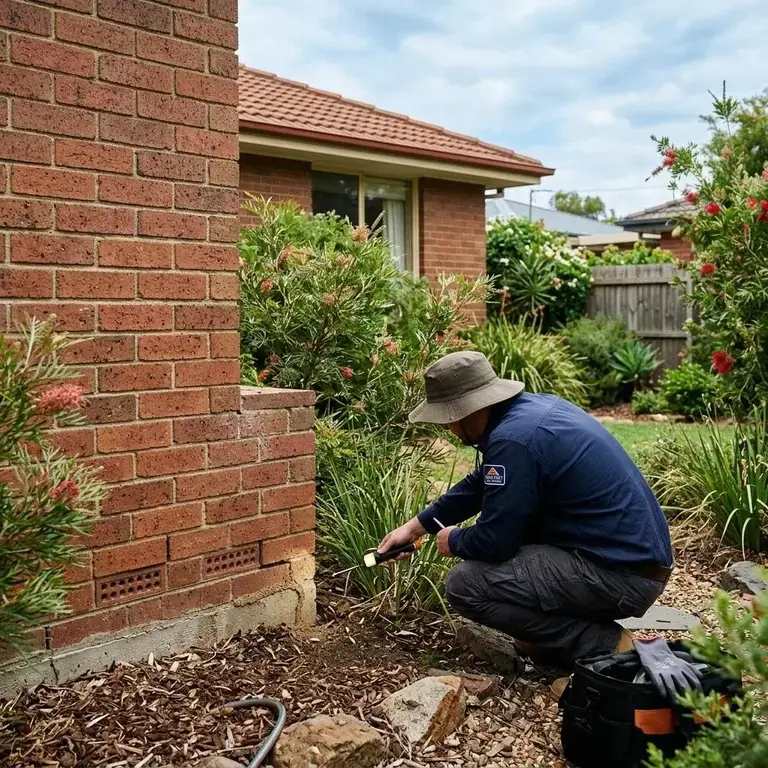
No single sign confirms termites on its own, but any of the following warrants an urgent professional inspection. If I find even one of these at a property, I treat it as active until proven otherwise.
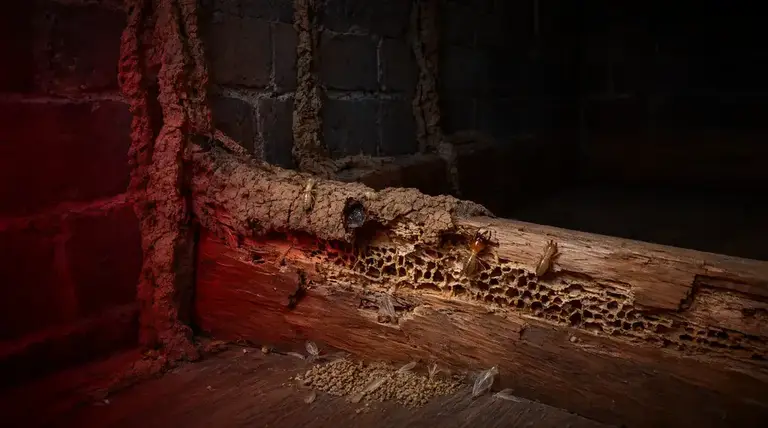
- 1. Mud tubes — pencil-width earthen tunnels on foundations, piers, slab edges and walls, built to protect travelling workers.
- 2. Hollow-sounding timber — a dull, papery sound when you tap skirtings, architraves or door frames.
- 3. Discarded wings — small piles of equal-length wings near windowsills and light fittings after a swarm, usually in spring.
- 4. Bubbling or blistered paint — caused by moisture and termite activity behind the surface film.
- 5. Sagging or springy floors — weakened floorboards and bearers underfoot.
- 6. Doors and windows sticking — frames warping as termites and associated moisture distort the timber.
- 7. Frass (droppings) — tiny pellet-like debris pushed out by drywood species.
- 8. Faint clicking or rustling — soldier termites tapping their heads to signal danger inside wall cavities.
- 9. Tight-fitting or cracked architraves — subtle movement in trim as timber behind it is consumed.
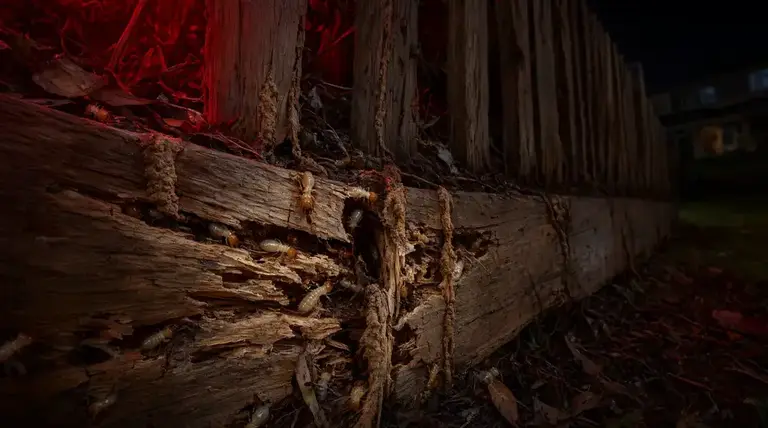
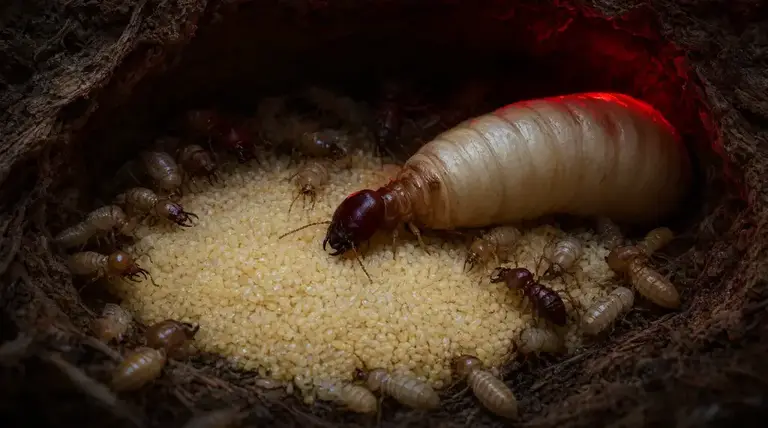
- 10. Live termites — creamy-white workers exposed when timber or a mud lead is disturbed.
These signs show up first in predictable places: wet areas behind bathrooms, laundries and kitchens; around hot-water systems; sub-floor bearers and stumps; the base of door frames; skirting boards on external walls; and timber nearest garden beds or leaking downpipes. In the roof void, check where framing meets brickwork.
How to Tell Termites from Flying Ants
Swarming termites are routinely mistaken for flying ants, but three features separate them instantly up close: the waist, the antennae and the wings. Getting this identification right matters, because one is a nuisance and the other can eat your house.
| Feature | Termite | Ant |
|---|---|---|
| Waist | Straight, broad | Pinched, narrow |
| Antennae | Straight, beaded | Bent (elbowed) |
| Wings | Equal length | Front pair longer |
DIY vs Professional Termite Control
DIY has almost no legitimate role in termite management: surface sprays kill only the workers you can see and cause the colony to seal off and re-route elsewhere in the structure, while professional treatment uses live activity as an entry point to dose and eliminate the whole colony. If I’m honest, the single worst thing a homeowner can do is reach for a can of insecticide.
| Factor | DIY approach | Licensed professional |
|---|---|---|
| Detection | Visual checks only; misses concealed activity | Moisture meters, thermal imaging, sounding tools |
| Effect on colony | Scatters and relocates the infestation | Targets the nest via baits, dusts or barriers |
| Products | Hardware-store surface sprays | APVMA-registered termiticides applied by licensed technicians |
| Documentation | None | Written report; useful for sales and insurance |
| Long-term outcome | Damage often accelerates unseen | Colony elimination plus ongoing protection |
Our guide to Termite Inspection: What It Includes and Why It Matters explains exactly what a proper assessment covers, and What Is a Termite Barrier and How Does It Protect Your Home? breaks down your long-term defence options.
How Much Does Termite Treatment Cost in Australia?
As a guide to typical Australian market rates for 2025-26, the industry generally charges $250-$450 for a professional termite inspection, while full chemical barrier installations commonly sit between $2,000 and $5,000 across the market depending on home size, construction type and perimeter length. Baiting and monitoring systems typically range from $2,500 to $4,000 installed, with ongoing servicing on top. For a detailed breakdown, see How Much Does Termite Treatment Cost in Australia?
| Service | Typical market rate (AUD) | What’s included / notes |
|---|---|---|
| Termite inspection & report | $250–$450 (industry average) | Full internal, external, subfloor and roof void assessment with written report |
| Spot treatment of active termites | $300–$800 (industry average) | Dusting or foaming of live workings; first step before broader protection |
| Chemical soil barrier | $2,000–$5,000 (industry average) | Trenching and treating the full perimeter; lifespan varies by product |
| Baiting & monitoring system | $2,500–$4,000 + annual servicing (industry average) | In-ground stations with ongoing colony monitoring |
These market rates shift with slab versus subfloor construction, block size and access, which is why every property needs to be scoped individually. Our Termite Treatment & Barrier Systems page outlines how we assess and quote each home.
It’s worth noting that Aussie Pest Strike typically comes in well under these general market rates while still delivering the same thorough, licensed treatment. For an exact quote tailored to your property, give us a call on [aps_phone] today.
Seasonal Termite Activity Across Australia
Termites are active year-round in Australia, but visible swarming and surface activity peak from late spring through summer, particularly after warm rain in October to February. Northern regions see pressure all year, while southern activity dips in winter without ever stopping entirely.
Jan
Feb
Mar
Apr
May
Jun
Jul
Aug
Sep
Oct
Nov
Dec
Indicative termite activity pattern across Australia: swarming and detectable activity peak November–February, ease through autumn and winter, then build again from September. Feeding inside timber continues year-round regardless of visible signs.
The homes that cost owners the most are the ones where someone sprayed the termites and waited six months to call us. Leave the workings alone, get an inspection within days, and we can use that live activity to take out the whole colony. Early action is almost always the cheapest option on the table.
If you’ve noticed any of the ten warning signs, don’t disturb the area and don’t spray. Book a professional inspection immediately, then follow up with a chemical barrier or baiting system matched to your home’s construction. Annual inspections after that keep you ahead of the problem.
Frequently Asked Questions
What are the most reliable early warning signs of termites in an Australian home?
The clearest indicators are mud tubes on foundations, piers or slab edges, hollow-sounding timber when you tap skirtings or door frames, and piles of discarded equal-length wings near windowsills after a swarm. Bubbling paint, sagging floors, sticking doors, frass droppings, faint clicking inside walls and live creamy-white workers are also strong signs. Any one of these warrants an urgent professional inspection.
How can I tell swarming termites apart from flying ants?
Look at three features up close: the waist, the antennae and the wings. Termites have a straight, broad waist, straight beaded antennae and two pairs of equal-length wings. Flying ants have a pinched narrow waist, bent elbowed antennae and a front wing pair longer than the rear. Getting this right matters because one is a nuisance while the other can seriously damage your home.
Why should I never spray termites I find around my home?
Spraying visible termites with hardware-store insecticide kills only the workers you can see. The colony then seals off and re-routes elsewhere in the structure, so damage often accelerates unseen. Live termite activity is actually useful to a licensed technician, who can use it as an entry point to dose and eliminate the whole colony with baits, dusts or barriers.
Where do termite warning signs usually appear first?
Termites favour moisture and concealed entry points, so check wet areas behind bathrooms, laundries and kitchens, around hot-water systems, sub-floor bearers and stumps, the base of door frames, skirting boards on external walls, and timber nearest garden beds or leaking downpipes. In the roof void, look where framing meets brickwork. Homes on stumps and brick veneer on slabs each have their own vulnerable points.
Which termite species causes the most damage to Australian homes?
Coptotermes acinaciformis is Australia's most destructive species. It builds central nests and can forage up to 50 metres from the colony, meaning it may reach your home from a tree, fence or other source you would never suspect. Combined with Australia's warm, humid climate and timber-rich housing stock, this makes local termite pressure among the highest in the world.
Does home coverage cover termite damage in Australia?
This is why prevention is far cheaper than repairs. A scheduled annual professional inspection program, more frequent in high-risk regions, is considered the backbone of sensible termite management for Australian properties. The practical next step is to note the signs, inspect the relevant area carefully, and seek property-specific advice if the issue continues.
When is termite activity most visible throughout the year?
Termites feed inside timber year-round, but visible swarming and surface activity peak from late spring through summer, particularly after warm rain between October and February. Northern regions experience pressure all year, while southern activity dips in winter without ever stopping completely. Feeding continues regardless of whether you can see any external signs.
What does professional termite treatment typically involve compared with DIY products?
Licensed technicians use APVMA-registered termiticides applied with tools such as moisture meters, thermal imaging and sounding equipment to target the whole colony through baits, dusts or soil barriers. DIY approaches rely on visual checks and surface sprays that miss concealed activity and scatter the infestation rather than eliminating it.
Can I check whether Aussie Pest Strike handles this kind of termite problem at my property?
Yes. Aussie Pest Strike deals with active termite findings like mud tubes, hollow timber and live workings, and scopes every property individually because slab versus subfloor construction, block size and access all affect the approach. The simplest way to confirm they can assist with your specific situation is to get in touch and describe what you have noticed, then arrange an assessment of the property.
What should I do first if I have just spotted possible termite signs at my home?
Leave the area alone and do not spray anything. Disturbing the workings causes the colony to relocate and spread damage, while leaving live activity intact lets a licensed technician use it to eliminate the whole colony. Contact Aussie Pest Strike promptly to book an inspection, then follow up with a chemical barrier or baiting system matched to your home's construction.
Sources & further reading
Found Something
Dangerous?
Don’t touch it. Don’t spray it. Keep kids and pets clear, take a photo from a safe distance, and call us — or book a free inspection and we’ll come to you.
02 7235 0050