What Happens DuringTermite Treatment:Step by Step
What Happens During Termite Treatment — professional termite treatment in Australia follows a clear sequence: a licensed technician inspects your property,...
Professional termite treatment in Australia follows a clear, proven sequence: a licensed technician inspects your property, identifies the species and activity, installs a chemical barrier or baiting system, then schedules follow-up checks to confirm the colony is gone. From the first inspection to the final sign-off, e very stage is designed to do one thing — eliminate the colony and keep it from coming back.
If you have never booked a termite treatment before, the process can feel opaque. This guide walks you through exactly what happens at each step, what it costs in 2025-26, how to prepare your home, and what to do afterwards to protect your warranty — whether you own a brick veneer in Melbourne, a post-war Queenslander in Brisbane, or a slab-on-ground home in Perth.
- Every professional termite treatment starts with a detailed inspection to Australian Standard AS 3660.2 — no exceptions.
- The two main treatment options are chemical soil barriers (fipronil or imidacloprid) and baiting/monitoring systems, often used in combination.
- Most Australian homes pay $2,000-$4,000 for a full chemical barrier; baiting systems typically start around $2,500 plus ongoing monitoring fees.
- A correctly installed barrier can protect your home for five to eight years, but annual inspections are essential — especially in coastal NSW and South East Queensland.
- Standard home insurance does not cover termite damage, so treatment plus yearly checks is your only real safety net.
Why Termite Treatment Matters So Much in Australia
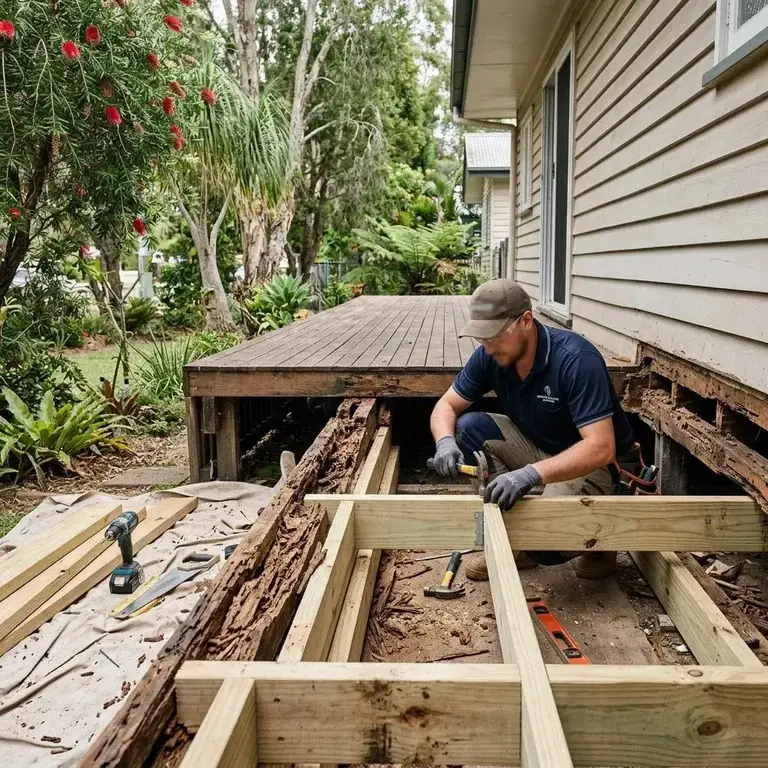
Australia has some of the highest termite pressure on earth, and virtually every mainland home sits within foraging range of at least one destructive species. Warm, humid conditions along the eastern seaboard and across the north let colonies stay active almost year-round, while our housing stock — timber-framed Queenslanders on stumps, older homes with suspended subfloors, and modern slab-on-ground brick veneer with concealed slab edges — gives termites plenty of hidden entry points.
The usual culprit is Coptotermes acinaciformis, the most destructive termite species in the country, though Schedorhinotermes is common in Queensland and the Northern Territory and Mastotermes darwiniensis causes serious damage in tropical regions. Because termites work inside timber and underground, significant structural damage often occurs before any visible sign appears. Standard home insurance policies across Australia exclude termite damage, which is exactly why professional pest control treatment — not DIY guesswork — is the sensible path once activity is suspected. If you are unsure whether you have a problem, our guide to the 10 warning signs of termites in Australian homes is a good place to start.
Warning Signs You Need Termite Treatment — e Signs to Check First
The most reliable early indicators of termite activity are mud leads, hollow-sounding timber and discarded wings from swarmers. If you spot any of the following, book a professional inspection before the colony spreads further through the structure.
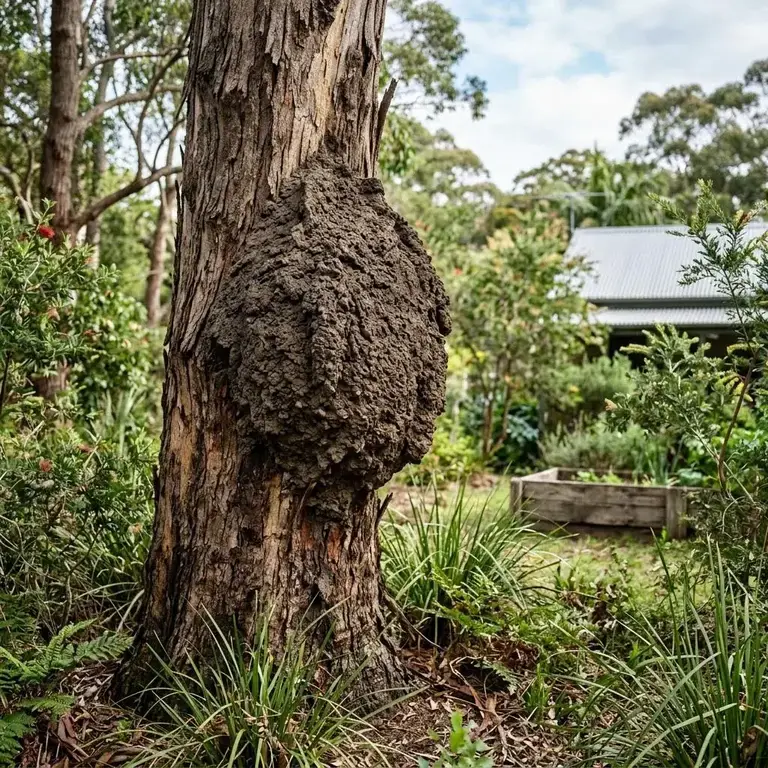
- Mud leads or tubes — pencil-width earthen tunnels running up stumps, piers, brickwork or slab edges.
- Hollow or papery-sounding timber — skirting boards, door frames or floorboards that sound empty when tapped.
- Discarded wings — piles of identical translucent wings near windowsills or lights after a spring or summer swarm of alates.
- Tight-fitting doors and windows — termite moisture warps frames, making them suddenly hard to open.
- Bubbling or uneven paint — damage just beneath the surface of architraves and wall linings.
- Faint clicking in walls — soldier termites banging their heads when the colony is disturbed.
- Frass or mud spots — small earthen patches on walls or ceilings where termites have sealed a breach.
Why a Thorough Inspection Comes First
Every effective termite treatment begins with a detailed inspection carried out to Australian Standard AS 3660.2, because you cannot treat what you have not found. Your technician checks the subfloor, roof void, skirting boards, fences, garden sleepers and nearby trees, using moisture meters and thermal imaging where conditions call for it.
Identifying the species matters — it shapes the entire treatment plan. Coptotermes nests aggressively and responds well to non-repellent barriers, while other species may suit baiting. At the end of the visit you receive a written report mapping entry points, mud leads and damage, plus a fixed quote before any work begins. You can read the full breakdown in our article on a termite inspection: what it includes and why it matters, or book directly through our Termite Inspections & Reports service page.
Choosing the Right Termite Treatment Method
There is no single fix for termites — licensed pest managers generally recommend a chemical barrier, a baiting system, or a combination of both, depending on your home’s construction, soil type and where the nest sits. Our guide on what a termite barrier is and how it protects your home explains the mechanics in more detail.
Chemical Barriers
A liquid termiticide such as fipronil or imidacloprid is applied to the soil around and under the home, creating a treated zone termites cannot cross without contacting the chemical. Modern products are non-repellent, so foraging workers carry the active ingredient back to the nest, destroying the colony over several weeks. A correctly installed barrier can last up to eight years. Our Termite Treatment & Barrier Systems team installs these to AS 3660.1 across Australia.
Baiting and Monitoring Systems
Where trenching or drilling is impractical — tight access, sensitive landscaping, complex construction — technicians install in-ground stations around the perimeter. Foraging termites feed on cellulose bait containing an insect growth regulator, share it with the colony, and the nest gradually collapses. Baiting takes longer, often three to six months, but eliminates whole colonies rather than simply repelling them.
DIY vs Professional Termite Treatment
DIY termite products sold in hardware stores are not APVMA-registered for colony elimination at the concentrations professionals use, and misapplied chemicals can scatter a colony deeper into your home. Termite treatment is one area of pest control where licensed technicians, calibrated equipment and compliance documentation genuinely determine whether the job works.
| Factor | DIY approach | Professional treatment |
|---|---|---|
| Chemical access | Consumer-grade repellents only | APVMA-registered non-repellent termiticides |
| Species identification | Guesswork | Confirmed on inspection, treatment matched to species |
| Colony elimination | Rarely — often disturbs and splits the colony | Transfer effect carries chemical back to the nest |
| Compliance & resale | No certificate; can complicate a sale | Treatment certificate issued for your records |
| Typical upfront cost | $50-$300 in products | $2,000-$4,000 for a full barrier |
What Happens on Treatment Day
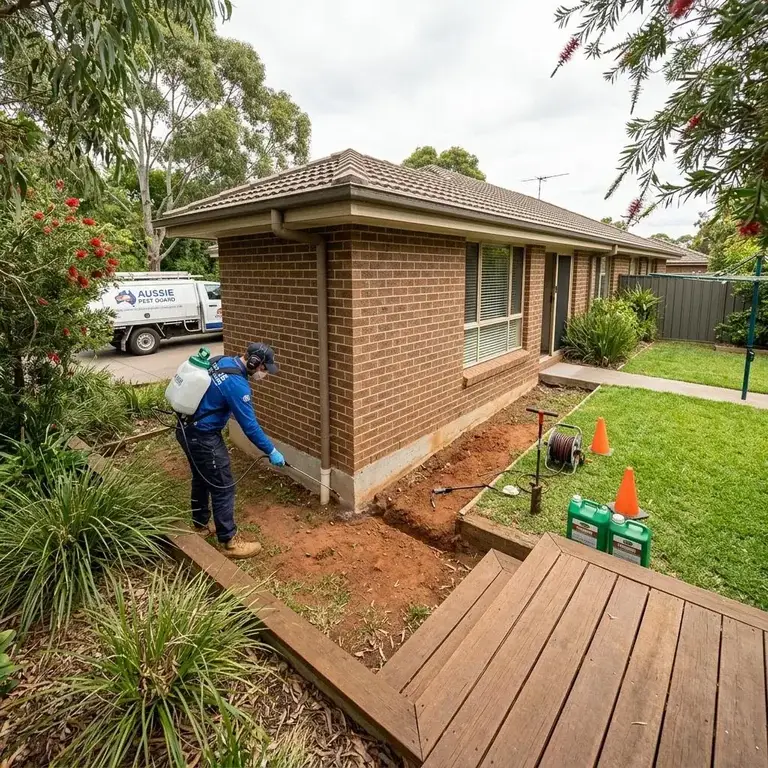
On treatment day the crew confirms the plan, runs through safety instructions, then trenches, drills and injects termiticide around the perimeter — a process that typically takes three to six hours for an average home. To keep things moving, prepare the property before they arrive:
- Clear stored items, vehicles and garden furniture away from external walls and the subfloor access point.
- Cover fish ponds and bring pet bowls, bedding and toys indoors; seal aquariums and switch pumps off.
- Trim vegetation touching the house and unlock gates, the garage and subfloor or roof access.
- Keep children and pets off treated soil until it has dried, usually a few hours.
Technicians inject termiticide into the soil, treat piers and pipe penetrations, patch drill holes neatly and record every application point for your compliance certificate.
How Much Does Termite Treatment Cost in Australia?
Across the Australian market, a full chemical barrier on a standard house generally runs between $2,000 and $4,000, while baiting systems typically start around $2,500 plus ongoing monitoring fees. Final pricing depends on home size, construction type, soil conditions and the method chosen — be wary of very cheap quotes, because correct chemical volume and application rates are what make a barrier actually work.
| Service | Typical market rate (AUD) | What’s included/notes |
|---|---|---|
| Termite inspection (AS 3660.2) | $250-$400 | Full inspection with written report; some operators waive the fee |
| Chemical barrier, standard home | $2,000-$4,000 | Trenching, drilling, soil injection, compliance certificate |
| Baiting/monitoring system install | From $2,500 | In-ground stations around perimeter |
| Bait system servicing | $600-$1,200/yr | Checks every 6-12 weeks; colony elimination can take 3-6 months |
| Large homes/complex sites | $4,000-$6,500+ | Acreage, Queenslanders on stumps, combination treatments |
The figures above are typical Australian market rates — what the industry generally charges. Aussie Pest Strike typically comes in well under these prices, with no cut corners on chemical volume or application. For an exact quote on your property, call us on [aps_phone].
When Are Termites Most Active in Australia?
Termites forage year-round in most of Australia, but activity — and especially swarming of alates — peaks through the warmer, wetter months from October to March. Spring and summer humidity triggers flights where winged reproductives leave established nests to start new colonies, which is why so many infestations are first noticed after a warm storm.
Jan
Feb
Mar
Apr
May
Jun
Jul
Aug
Sep
Oct
Nov
Dec
Indicative termite activity across southern and eastern Australia. Swarming peaks late spring through summer; winter activity slows in cooler states but stays elevated year-round in Queensland and the Northern Territory.
After Treatment: Follow-Up and Protecting Your Warranty
After treatment you should receive a certificate noting the chemical, concentration and application rate — keep it with your house documents, because it matters when you sell. Annual inspections are strongly recommended everywhere, and in high-pressure areas like coastal New South Wales and South East Queensland they are essential for warranty validity.
Baiting systems need servicing every six to twelve weeks. Around the garden, avoid digging beds against walls or stacking firewood against the house — bridging a barrier gives termites a free pass back in. Chemical barriers installed to AS 3660.1 typically protect a home for five to eight years, while baiting systems work for as long as they are serviced.
The treatment itself is only half the job — the other half is what the homeowner does afterwards. We see barriers fail because someone ran a new garden bed or a paving edge straight over the treated zone. Keep your annual inspections booked and keep soil, mulch and timber away from the walls, and a good barrier will look after you for years.
If you suspect termites — or you simply cannot remember your last inspection — book a professional inspection first. Never disturb mud leads or spray visible termites, as this scatters the colony and makes treatment harder. Once the species and extent are confirmed, choose a licensed technician using APVMA-registered products, get the fixed quote in writing, and diarise your annual follow-up before the crew leaves the driveway.
Frequently Asked Questions About Termite Treatment
How much does termite treatment cost in Australia?
Most Australians pay between $2,000 and $4,000 for a full chemical barrier on a standard house, while baiting systems start around $2,500 plus monitoring fees. Costs vary with home size, construction and method. Be wary of very cheap quotes — correct chemical volume and application rates are what make a barrier work.
Is termite treatment safe for my family and pets?
When applied by a licensed technician using APVMA-registered products, modern termiticides are low in mammalian toxicity and go into soil, not living areas. Keep children and pets away until treated soil dries and protect fish ponds, which are sensitive. Your technician will provide written aftercare instructions on the day.
Do I need to leave the house during treatment?
Usually not. External barrier and baiting work happens outside, so most families stay home. If indoor dusting of active workings is required, you may be asked to vacate affected rooms for a few hours. Pregnant women, infants and anyone with respiratory conditions are often advised to be out for the day as a precaution.
Termite treatment is straightforward when it is done properly: inspect, treat, follow up. If you have spotted warning signs, seen swarmers this season, or you are simply due for an annual check, Aussie Pest Strike offers free inspections and honest, fixed-price quotes from licensed pest control technicians across Australia. Call Aussie Pest Strike on [aps_phone] to book your free termite inspection today and protect your biggest investment before termites cost you thousands.
Sources & further reading
Found Something
Dangerous?
Don’t touch it. Don’t spray it. Keep kids and pets clear, take a photo from a safe distance, and call us — or book a free inspection and we’ll come to you.
02 7235 0050