Wasp Nest Removal:Why YouShould Never DIY
Wasp nest removal is never a safe DIY job in Australia. Learn the real risks, the common myths and how the pros treat colonies. Book a free quote today.
Spotting a paper-grey lump under your eaves or a steady stream of wasps vanishing into a wall cavity is the moment many Australians reach for a can of fly spray. That’s a serious mistake. Wasp nest removal is one of the most dangerous jobs around an Australian home, because disturbing a nest triggers the entire colony to defend it at once — and species like the European wasp can each sting repeatedly. What looks like a small nest often hides a colony of thousands, and the risk of a severe allergic reaction is real, wherever you live in Australia.
Wasp nest removal is the professional identification, treatment and elimination of an active wasp colony — including the queen and brood — using registered products and protective equipment, so the nest is destroyed rather than merely disturbed. This guide explains why DIY attempts fail, what a licensed pest control technician actually does, what it costs in 2025-26, and when you need to act fast.
- Never disturb a wasp nest yourself — alarm pheromones recruit the whole colony to attack within seconds.
- A golf-ball-sized nest in October can hold thousands of workers by February; European wasp nests can exceed 100,000 individuals.
- Over-the-counter aerosols rarely reach the queen, so DIY sprays cause partial kills and more defensive colonies.
- Professional wasp nest removal in Australia typically costs $150–$300, with hidden or over-wintered nests costing more.
- Call immediately if the nest is in a wall, roof void or underground, or if anyone in the household has a sting allergy.
Why Wasp Nests Are Such a Problem Across Australia
Wasps thrive across Australia because our long, warm seasons let colonies grow for months without interruption, and our housing gives them endless sheltered nesting sites. From tropical Queensland to temperate Victoria, wasp pressure builds from spring and peaks in late summer.
Australian housing styles make the problem worse. Brick veneer walls have a cavity that’s tailor-made for European wasp nests. Elevated Queenslanders offer shaded, dry subfloor space for paper wasps and mud daubers. Slab-on-ground homes still have eaves, weep holes, garden beds and retaining walls where ground-nesting species establish. Add outdoor entertaining — barbecues, fruit trees, pet food and open bins — and you have reliable food sources within metres of every nest. In warmer states, colonies occasionally survive winter, meaning a nest that would normally die off simply keeps growing into a second season. That’s why a nest ignored in November can become a genuine emergency by March.
Warning Signs of a Wasp Nest on Your Property
The clearest warning sign is a constant, two-way stream of wasps entering and leaving a single gap — that traffic means an active, established nest nearby. Check for these indicators:
- Steady flight paths: wasps travelling in a purposeful line to and from a weep hole, eave, fence post or garden bed edge.
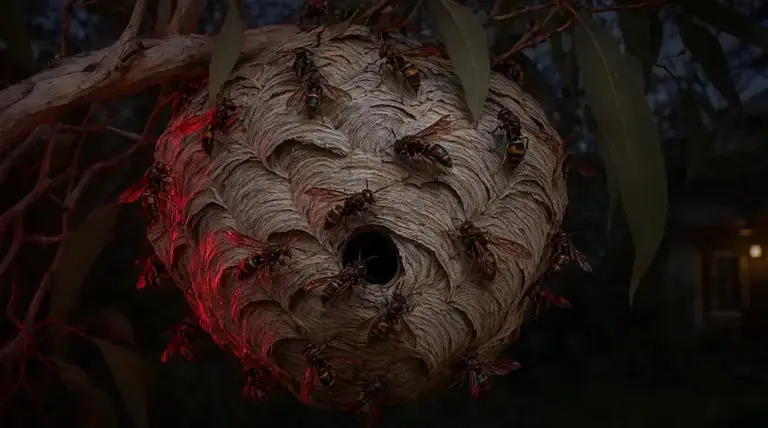
- Visible nest material: grey, papery comb under eaves, in sheds, or behind meter boxes — typical of paper wasps.
- Ground activity: wasps disappearing into soil, lawn or a retaining wall gap, often a sign of European wasps nesting underground.
- Chewing and scraping sounds: faint rustling inside a wall or ceiling cavity as wasps strip wood fibre to expand the nest.
- Aggressive behaviour: wasps hovering defensively near one spot, or stings occurring near a doorway, deck or play area.
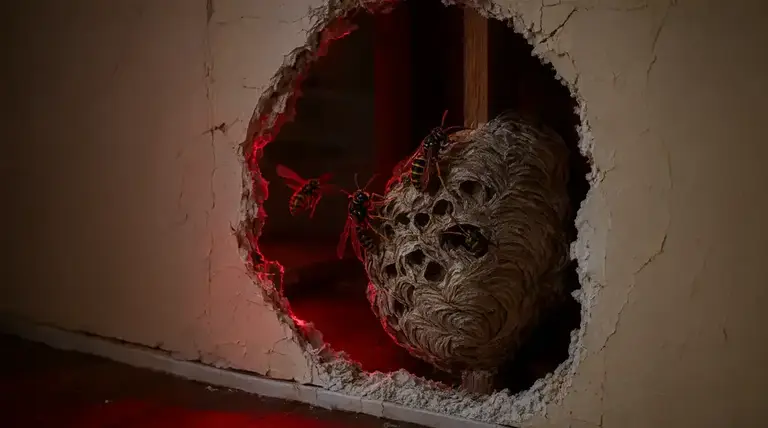
- Brown staining on plasterboard: large concealed nests can soften and stain internal plaster as they grow.
If you’re unsure whether you’re dealing with wasps or bees, identification matters — honeybees are usually relocated, not exterminated. Our guide to Bees in Your Wall: Relocation vs Removal Explained covers that decision in detail.
DIY Wasp Nest Removal vs Professional Treatment
DIY wasp nest removal fails because surface sprays can’t reach the queen and brood deep inside a cavity, while the disturbance provokes a mass defensive attack. Professional treatment succeeds because it delivers a registered insecticidal dust into the core of the nest, where returning foragers spread it to the entire colony. Here’s how the two approaches compare:
| Step | DIY approach | Professional approach |
|---|---|---|
| Identify | Guesses the species from the visible nest | Confirms species — European, paper or native — to choose the safest method |
| Protect | Everyday clothing, often on a ladder at night | Full bee/wasp suit and correct re-entry controls for occupants |
| Treat | Sprays the entrance with an aerosol; partial knock-down | Injects registered dust deep into the nest so returning foragers spread it |
| Outcome | Queen survives; colony rebuilds more defensively within days | Monitors activity and removes or seals the void so it isn’t reused |
The single biggest DIY mistake is treating the visible entrance and assuming the job is done. A European wasp nest is a three-dimensional structure that may extend a metre or more into a wall cavity or underground burrow, with the queen and brood protected deep inside. Surface aerosols knock down a few dozen foragers but leave the queen laying, so the colony rebuilds within days. Worse, the alarm pheromone released by dying wasps recruits the rest of the colony to attack — turning a quiet evening into an emergency. Around 3% of Australians are allergic to wasp venom, and reactions can be fatal without adrenaline. Add the fall risk of panicking on a ladder near a roof void, and the case against DIY is overwhelming. Blocking the entrance is just as bad — trapped wasps simply chew a new exit, sometimes straight into your ceiling or living room.
What Wasp Nest Removal Costs in Australia (2025-26)
Across the Australian pest control industry, professional wasp nest removal generally costs between $150 and $300 for a standard, accessible nest, with concealed, large or over-wintered nests sitting higher on the market. What the industry charges for any given job depends on nest location, size, species and access.
| Service | Typical market rate (AUD) | What’s included/notes |
|---|---|---|
| Exposed paper wasp nest (eaves, shed) | $150–$220 | Direct treatment and physical nest removal; single visit in most cases |
| Nest in wall cavity or roof void | $200–$300 | Dust injected into cavity; follow-up check; advice on sealing the void |
| Ground nest (European wasps) | $220–$350 | Treatment of burrow entrance and colony; monitoring for residual activity |
| Large or over-wintered colony | $300–$450+ | Multi-visit treatment, access work at height, void sealing |
These figures are typical Australian market rates — what the industry generally charges — not fixed quotes from any one provider. A reputable pest control company will inspect first and confirm the price before any treatment begins, so beware of anyone quoting a firm price sight unseen for a concealed nest.
Here’s the good news: Aussie Pest Strike typically comes in well under these market rates for the same professional-standard work. For an exact quote on your wasp nest removal, give us a call on [aps_phone] today.
Seasonal Wasp Activity in Australia
Wasp activity in Australia builds from early spring, peaks through summer and early autumn, then drops sharply in winter. Queens emerge in September–October to found new nests, worker numbers explode through December–March, and colonies decline from May as cold weather arrives.
Jan
Feb
Mar
Apr
May
Jun
Jul
Aug
Sep
Oct
Nov
Dec
Typical wasp activity pattern across most of Australia: colonies are founded in spring, peak in late summer when worker numbers and aggression are highest, and decline through winter. In warmer northern regions, activity starts earlier and some colonies survive year-round.
Timing matters. A nest the size of a golf ball in October is cheap and quick to treat; the same nest in February may hold thousands of workers. Early-season Wasp Removal & Nest Treatment is faster, safer and usually less expensive than an emergency call-out in peak season. If you’re seeing wasps around the garden but can’t find the source, our article on Paper Wasps: Managing Common Nests Around Your Home explains where they like to build.
The worst jobs I attend are the ones where someone had a go first — a half-sprayed nest in a wall cavity, wasps now pouring out of two exits, and a family that’s been stung. A quiet nest treated properly in spring is a fifteen-minute job. Leave it, or disturb it, and it becomes something else entirely.
If you’ve found a nest, keep people and pets away from the flight path, don’t spray or block the entrance, and book a licensed pest control technician promptly. Call immediately if the nest is in a wall, roof void or underground, if it’s near a doorway or play area, or if anyone in the household has a known sting allergy. Learn more about the most dangerous culprit in our guide to European Wasps in Australia: Identification and Dangers.
Frequently Asked Questions
Why is DIY wasp nest removal so dangerous?
Disturbing a nest releases alarm pheromones that recruit the entire colony to attack within seconds, and species like the European wasp can each sting repeatedly. What looks like a small nest often hides thousands of wasps, with European wasp nests capable of exceeding 100,000 individuals. Around 3% of Australians are allergic to wasp venom, and reactions can be fatal without adrenaline. Add the fall risk of panicking on a ladder near a roof void, and DIY attempts become genuinely hazardous.
What are the warning signs of a wasp nest on my property?
The clearest sign is a constant two-way stream of wasps entering and leaving a single gap. Other indicators include purposeful flight paths to weep holes, eaves or garden beds; grey papery comb under eaves or behind meter boxes; wasps disappearing into soil or retaining walls; faint chewing sounds inside walls; defensive hovering near doorways or play areas; and brown staining on plasterboard from large concealed nests growing inside cavities.
Why doesn't supermarket fly spray kill a wasp nest?
Over-the-counter aerosols only knock down a few dozen foragers at the entrance. A European wasp nest is a three-dimensional structure that may extend a metre or more into a wall cavity or underground burrow, with the queen and brood protected deep inside. Because the queen survives and keeps laying, the colony rebuilds within days — often more defensively. Dying wasps also release alarm pheromones that recruit the rest of the colony to attack.
Should I block the entrance to a wasp nest?
No. Blocking the entrance is just as bad as spraying it. Trapped wasps simply chew a new exit, sometimes straight into your ceiling or living room, turning a contained problem into an indoor emergency. The article's recommendation is to keep people and pets away from the flight path, leave the entrance alone, and book a licensed pest control technician promptly rather than attempting any form of DIY intervention.
What protective equipment do professionals use when removing a wasp nest?
Professional wasp nest removal pricing varies with the nest's location, size, and species. An easily accessible nest usually costs less than one hidden in a wall cavity, roof void, or underground. Larger or long-established colonies generally cost more because they require extra time and treatment. Many pest controllers provide a quote after inspecting the site, so costs can differ between providers and properties.
When is wasp activity highest in Australia?
Wasp activity builds from early spring, peaks through summer and early autumn, then drops sharply in winter. Queens emerge in September and October to found new nests, worker numbers explode through December to March when aggression is highest, and colonies decline from May as cold weather arrives. In warmer northern regions, activity starts earlier and some colonies survive year-round, meaning a nest ignored in November can become an emergency by March.
When should I call a professional about a wasp nest immediately?
Call straight away if the nest is inside a wall cavity, roof void or underground, because these concealed colonies are the hardest and most dangerous to treat. You should also act fast if the nest sits near a doorway, deck or children's play area, or if anyone in the household has a known sting allergy. Around 3% of Australians are allergic to wasp venom, and severe reactions can be fatal without adrenaline.
Could the insects in my wall be bees rather than wasps?
Yes, and correct identification matters because honeybees are usually relocated rather than exterminated. Wasps typically show a constant two-way traffic stream at a single gap, grey papery comb, or ground burrowing, while honeybees behave differently. If you're unsure what you're dealing with, avoid disturbing the entrance and have the species confirmed before any treatment. Treating bees as wasps can destroy a colony that could otherwise be safely relocated.
I've kept away from the nest and left the entrance alone — how do I arrange practical help now?
Once you've secured the area by keeping people and pets off the flight path and avoided spraying or blocking the entrance, the next step is booking a licensed pest control technician. Aussie Pest Strike treats active colonies using registered insecticidal dust delivered deep into the nest, so the queen and brood are destroyed rather than merely disturbed. Contact them to arrange an inspection and an exact quote based on the nest's location, size and species.
I tried spraying a wasp nest myself and it didn't work — what should I do next?
Stop all further DIY attempts, because a half-treated colony becomes more defensive and may have chewed extra exits. Keep everyone well clear of the flight paths and note where wasps are now entering and leaving. Aussie Pest Strike regularly attends jobs where someone has had a go first, and can treat the remaining colony properly with registered dust while advising on sealing the void so it isn't reused. Book a technician promptly rather than waiting.
Sources & further reading
Found Something
Dangerous?
Don’t touch it. Don’t spray it. Keep kids and pets clear, take a photo from a safe distance, and call us — or book a free inspection and we’ll come to you.
02 7235 0050