Cockroach or Beetle?How to TellThem Apart Fast
Cockroach or Beetle? How to Tell Them Apart Fast: practical advice from Aussie Pest Strike. Free inspection — call 1300 782 273 today.
Spotting a fast-moving insect in the kitchen and wondering “cockroach or beetle” is one of the most common identification puzzles Australian homeowners face. The letter o sums up the difference neatly: cockroaches have flattened, oval bodies built to slide into cracks, while beetles are rounder — almost o-shaped — with hard shell-like wing cases. Getting the call right matters, because the wrong treatment wastes weeks and hundreds of dollars.
Australia-wide, from humid Brisbane Queenslanders to Melbourne brick veneers, both pests turn up regularly, and they are frequently confused. This guide walks you through the fastest checks — body shape, wings, behaviour, droppings — so you can identify the pest tonight and decide whether a DIY fix or professional pest control is the smarter move.
- Cockroaches have flattened oval bodies, long whip-like antennae and sprint for cover; beetles have hard shell-like wing cases (elytra) and shorter antennae.
- The single most reliable clue is the back: beetle elytra meet in a straight line, while cockroach forewings are leathery and overlap.
- Pantry beetles are usually solved by binning infested food; cockroaches need baits, residuals and strict hygiene.
- German cockroach nymphs are wingless and commonly mistaken for biscuit beetles — misidentification lets infestations explode.
- Professional cockroach treatment in Australia typically costs $180–$450 (AUD) for a standard home.
Why the Cockroach or Beetle Question Matters Across Australia
Correct identification determines the entire treatment plan, and a wrong guess costs you time and money. Cockroaches breed rapidly, contaminate food surfaces and can trigger asthma and allergies, so they demand an aggressive response with gel baits, residual sprays and strict hygiene. Most beetles, by contrast, are accidental visitors or stored-product pests solved by removing infested food or sealing entry points.
Australian conditions make the mix-up especially common. Summer humidity across Queensland and New South Wales — particularly after wet La Niña periods — supercharges cockroach breeding, while Christmas beetles and ground beetles swarm towards lights in early summer and wander indoors. Housing styles play a role too: subfloor homes and raised Queenslanders give oriental cockroaches cool, damp harbourages, while slab-on-ground brick veneer homes in Melbourne and Adelaide funnel German cockroaches straight into kitchens. Treating a pantry beetle problem with cockroach bait achieves nothing, and ignoring a German cockroach because you assumed it was a harmless beetle lets the population explode. If you do confirm roaches, our Cockroach Control & Treatment service is built for exactly that scenario.
Cockroach or Beetle: The Key Differences (Shape, Wings, the “O” Test)
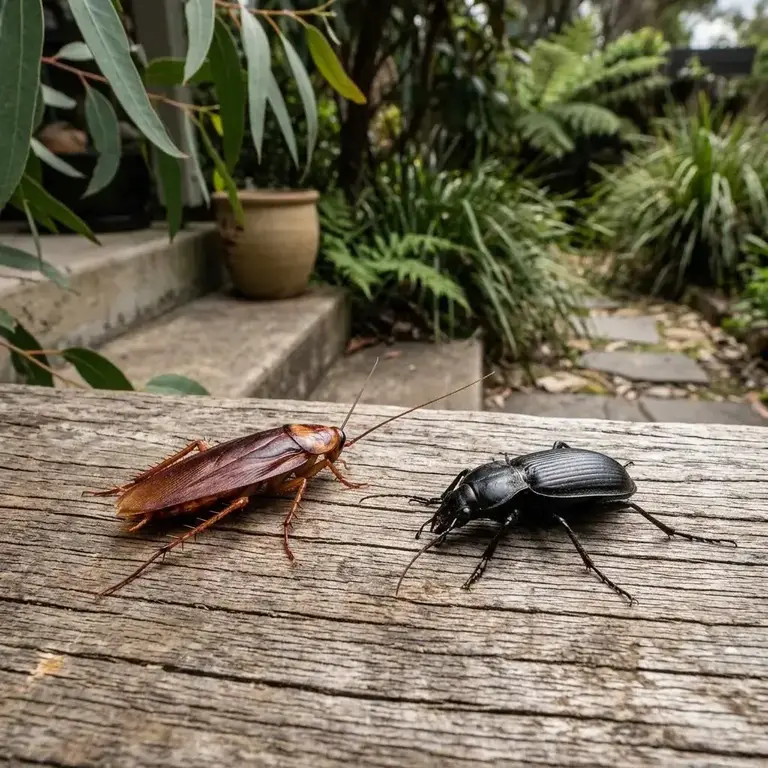
The fastest way to separate the two is to check three things: body shape, the back, and behaviour. Think of the letter o — beetles are rounded and domed like an o, while cockroaches are that same o pressed flat.
Body Shape and Antennae
Cockroaches have a distinctly flattened, oval body built for squeezing into cracks, with a shield-like plate called the pronotum hiding the head when viewed from above. Their antennae are long and whip-like, often longer than the body. Beetles tend to be rounder or more cylindrical, with antennae that are short, clubbed or saw-toothed and usually less than half the body length.
Wings and Wing Covers
The single most reliable clue is the back. Beetles possess hardened forewings called elytra that meet in a straight line down the middle and form a protective shell. Cockroaches have leathery forewings that overlap at the tip and look softer, and many common pest species — such as juvenile German cockroaches — have no functional wings at all.
Movement and Behaviour
Cockroaches are nocturnal sprinters: flick on the kitchen light and they dart for the fridge motor or a crack in the splashback. Beetles are generally slower, often wander in daylight, and many species fly towards lights at night. If the insect freezes or strolls rather than bolts, it’s more likely a beetle.
Species confusion is common across the country. In Queensland and New South Wales, the shiny black oriental cockroach (Blatta orientalis) is regularly mistaken for a black ground beetle. The Australian cockroach (Periplaneta australasiae), common around Sydney and Brisbane in summer, gets confused with small Christmas beetles thanks to its tan-edged wings — see our American Cockroaches in Australia: ID and Control Guide for more on the large Periplaneta group. German cockroach nymphs, tiny and wingless, are mistaken for biscuit beetles in pantries from Melbourne to Adelaide. Meanwhile the Australian carpet beetle is a genuine beetle whose larvae damage wool and clothing — a problem no cockroach treatment will fix.
Warning Signs: Is It a Cockroach Infestation?
Cockroaches leave physical evidence long before you see one in daylight, while beetles rarely do. Run through this checklist tonight:
- Torch test after dark: cockroaches scatter when light hits them; beetles usually don’t.
- Droppings: cockroach frass resembles ground coffee or black pepper, often with dark smear marks along walls and cupboard hinges.
- Egg cases: cockroaches leave brown, purse-shaped oothecae in warm corners; beetles do not.
- Odour: a heavy cockroach infestation produces a distinct oily, musty smell.
- Location: cockroaches favour warm, moist spots like under sinks and behind dishwashers; pantry beetles stay near flour, cereal and pet food.
- Daytime sightings: seeing roaches during the day signals overcrowding and an established infestation.
For a deeper rundown, read our guide on the 7 Signs of a Cockroach Infestation You Shouldn’t Ignore.
DIY vs Professional Pest Control: Which Approach Works?
Pantry beetles are usually a genuine DIY job; established cockroach infestations almost never are. Shop-bought sprays kill the roaches you see but miss the harbourages, egg cases and resistant German cockroach populations hiding behind appliances. In Australia, licensed technicians use APVMA-registered products that aren’t available over the counter, and they confirm the species on the spot — removing all the guesswork.
| Factor | DIY approach | Professional treatment |
|---|---|---|
| Best for | Pantry beetles, occasional ground beetle visitors | German, American, oriental and Australian cockroach infestations |
| Typical method | Bin infested food, vacuum, airtight containers, seal entry points | Gel baits, residual sprays, dusts, harbourage treatment |
| Identification | Guesswork from photos | On-the-spot species confirmation |
| Success rate | High for beetles, low for established roaches | High, with follow-up visits if needed |
German cockroaches are a special case — they breed year-round indoors, hide in tiny harbourages and resist many insecticides. Our article on German Cockroach Infestations: Why They’re So Hard to Kill explains why professionals are usually essential.
How Much Does Cockroach Treatment Cost in Australia?
Across the Australian pest control industry, most households are quoted between $180 and $450 for professional cockroach treatment, depending on species, property size and severity. The figures below reflect typical 2025–26 market rates charged by operators nationwide — a free inspection is the standard way the industry confirms an exact price.
| Service | Typical market rate (AUD) | What’s included/notes |
|---|---|---|
| Pest identification / inspection | $0–$150 | Species confirmation; most operators waive this with a treatment booking |
| General cockroach treatment (standard home) | $180–$320 | Internal/external residual spray, gel baiting in kitchens and wet areas |
| German cockroach program | $280–$450 | Intensive gel baiting, dusts, crack-and-crevice work, follow-up visit |
| Large/severe infestations or big homes | $400–$650+ | Multiple visits, subfloor or roof void treatment as needed |
Acting early saves money no matter who you hire: at typical market rates, a $250 treatment now beats a $600 program after a summer of unchecked breeding.
Here’s the good news: Aussie Pest Strike typically comes in well under these market rates, so the figures above are best treated as a worst-case benchmark. For an exact, no-obligation quote tailored to your property, call us on [aps_phone] today.
Seasonal Activity: When Cockroaches and Beetles Peak in Australia
Both pests peak in the warmer months, with cockroach activity surging from October through April. Humid Queensland and northern NSW summers drive the highest pressure, while winter indoor sightings usually point to German cockroaches breeding inside regardless of season. Christmas beetles and ground beetles appear in early summer and often fly indoors towards lights.
Jan
Feb
Mar
Apr
May
Jun
Jul
Aug
Sep
Oct
Nov
Dec
Indicative cockroach and beetle activity across Australia: pressure climbs from October, peaks December–February, and eases through winter — except German cockroaches, which breed indoors all year.
Nine times out of ten, when a customer says they’ve got beetles in the kitchen, we open the cupboard and find German cockroach nymphs. The o-shape test is a good start, but droppings and egg cases tell the real story. Get the ID right first and the treatment takes care of itself.
Run the five checks above tonight. If it’s a pantry beetle, bin the infested food, vacuum the shelves and store dry goods in airtight containers — you’re done. If you find droppings, egg cases, a musty odour or daytime activity, book a licensed technician for a proper cockroach treatment rather than burning money on supermarket sprays.
FAQ: Cockroach or Beetle — How to Tell Them Apart Fast
Is a cockroach or beetle infestation harder to get rid of?
Cockroaches are almost always the tougher problem. German cockroaches breed year-round indoors, hide in tiny harbourages and have developed resistance to many insecticides. Most beetle issues resolve by discarding infested food, vacuuming thoroughly and sealing entry points. Correct identification first means you only pay for the treatment you actually need.
Can beetles infest my pantry like cockroaches do?
Yes. Stored-product beetles such as the biscuit beetle and confused flour beetle thrive in Australian pantries, infesting flour, rice, spices and dry pet food. The fix is simple: bin infested packets, vacuum shelves and store dry goods in airtight containers. Cockroaches, by contrast, need baits and residual treatment to eradicate.
When are cockroaches and beetles most active in Australia?
Both peak in the warmer months. Cockroach activity surges from October through April, especially during humid Queensland and northern NSW summers, while Christmas beetles and ground beetles appear in early summer and fly indoors towards lights. Winter indoor sightings usually point to German cockroaches, which breed inside regardless of season.
Still not sure whether it’s a cockroach or beetle? Don’t guess and waste money on the wrong fix. Aussie Pest Strike offers a free inspection Australia-wide — our licensed technicians will identify the species on the spot and recommend the right pest control treatment the first time. Book your free inspection today — call Aussie Pest Strike on [aps_phone] and get your home sorted before a small problem becomes a full-blown infestation.
Sources & further reading
Found Something
Dangerous?
Don’t touch it. Don’t spray it. Keep kids and pets clear, take a photo from a safe distance, and call us — or book a free inspection and we’ll come to you.
02 7235 0050