Redback vsFunnel-Web: Telling Australia’sDeadliest Apart
Redback vs funnel-web — Redback funnel-web — Redback vs funnel web — the quickest way to tell a redback from a funnel-web is size and colour: a redback is a...
Redback vs funnel web is one of the most important identification questions an Australian homeowner can face, because these are two of our most dangerous spiders and they look, live and behave completely differently. Across Australia — from Sydney’s bushland fringes to backyard sheds in Perth, Brisbane and Adelaide — knowing which spider you’re looking at can literally change the first aid you give.
In short: a redback is a small, glossy black spider (about 10 mm body) with a distinctive red or orange stripe on its abdomen, while a funnel-web is a larger, bulky, all-black or dark-brown spider (up to 35 mm body) with a shiny head region and no red marking. Both are dangerous, both have effective antivenoms, but they demand different responses. This guide breaks down identification, habitat, danger level, treatment costs and when to call in professional spider control and removal.
- Fastest ID clue: red stripe = redback (small, ~10 mm); bulky all-black spider = funnel-web (15–35 mm).
- First aid differs completely: pressure immobilisation and 000 for a funnel-web; cold pack only for a redback — never bandage a redback bite.
- Habitat rarely overlaps: redbacks like dry, sheltered spots around structures; funnel-webs need moist ground and burrows.
- Both have antivenoms: no Sydney funnel-web death since 1981; redback deaths essentially eliminated since 1956.
- Don’t handle either spider: a licensed pest control technician can identify, treat and proof your property safely.
Why Redback vs Funnel Web Identification Matters Across Australia
Getting the redback vs funnel web call right matters because the first aid for each is the opposite of the other — pressure immobilisation for a funnel-web, a cold pack for a redback. Misidentify the spider and you can make the outcome worse, which is why every Australian household should know the basics.
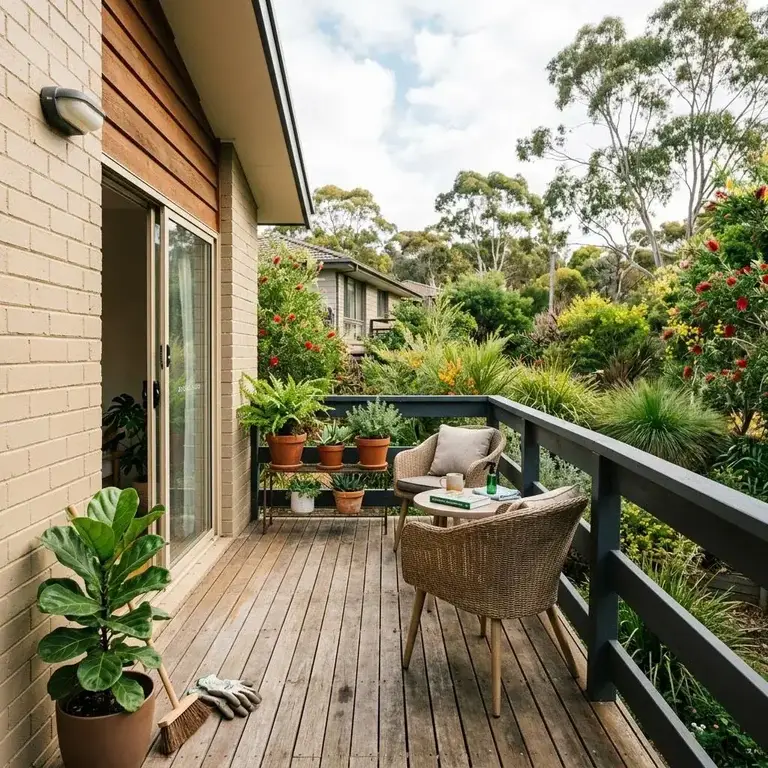
Australia’s climate and housing styles practically invite both species. Redbacks are found Australia-wide and thrive around human structures, exploiting the dry, sheltered voids created by brick veneer walls, subfloor spaces, garden sheds, letterboxes and stacked materials. Elevated Queenslanders with open under-house areas, and slab-on-ground homes with cluttered garages, are classic redback territory. Funnel-webs, by contrast, need moisture. The Sydney funnel-web (Atrax robustus) is largely confined to a roughly 100 km radius of Sydney, favouring humid bushland, rockeries and well-watered gardens, while related Hadronyche species extend the group’s range up the east coast and into the highlands. Homes backing onto bush, properties with heavy mulch, and gardens with retained moisture after summer rain all carry higher funnel-web risk. Our warm, wet summers drive activity for both — redback bites peak across December to February, and male funnel-webs wander after summer rain, sometimes falling into pools or sheltering in shoes left outside.
Redback vs Funnel Web: Side-by-Side Identification Checklist
The fastest way to separate the two is size, colour and build — a small striped spider is a redback, a large bulky black one is a funnel-web. Use this checklist before you go near either spider, and treat any unidentified black spider as dangerous until confirmed otherwise.
- Body size — female redback about 10 mm body length; funnel-web 15–35 mm, noticeably bigger and heavier.
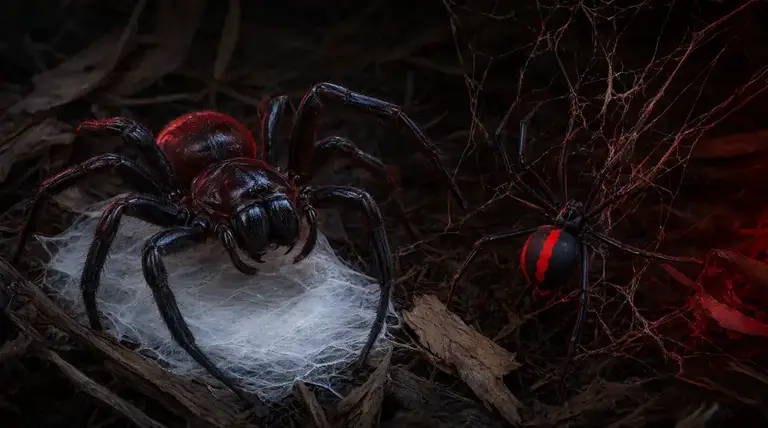
- Colour — redback is glossy black with a red or orange stripe on the rounded abdomen; funnel-web is uniform black to dark brown with a glossy carapace and no red marking.
- Build — redback has a round abdomen and thin legs; funnel-web is bulky and powerful with thick legs.
- Web — redback builds a messy, tangled web with a funnel-shaped retreat, often under furniture or pot rims; funnel-web lives in a silk-lined ground burrow with trip-lines radiating from the entrance.
- Location — redbacks turn up in sheds, letterboxes, under outdoor seats and play equipment; funnel-webs live in moist ground, gardens, under logs and around pool edges.
- Behaviour — redbacks stay in their webs; male funnel-webs wander at night after summer rain, which is when most human encounters occur.
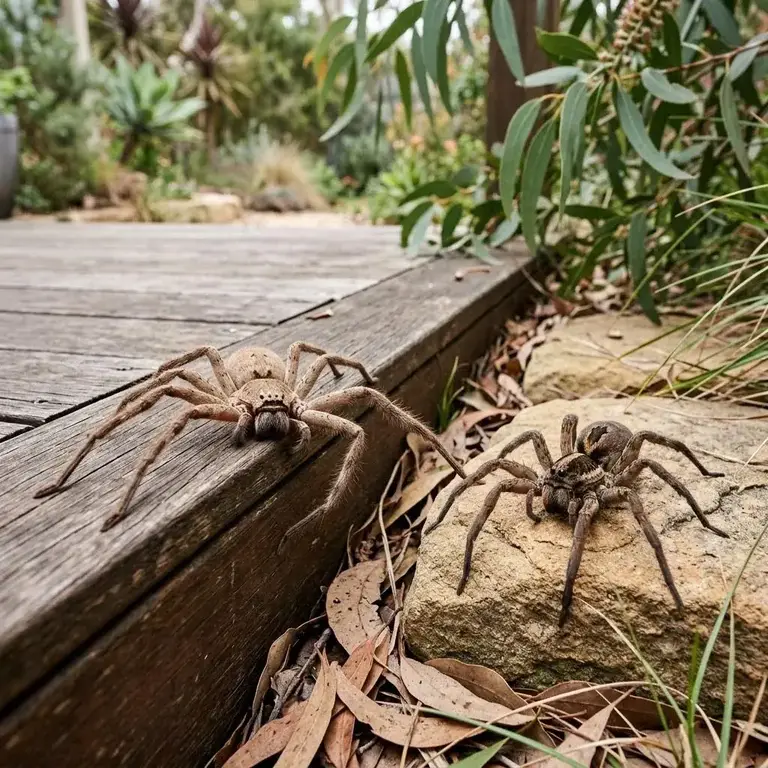
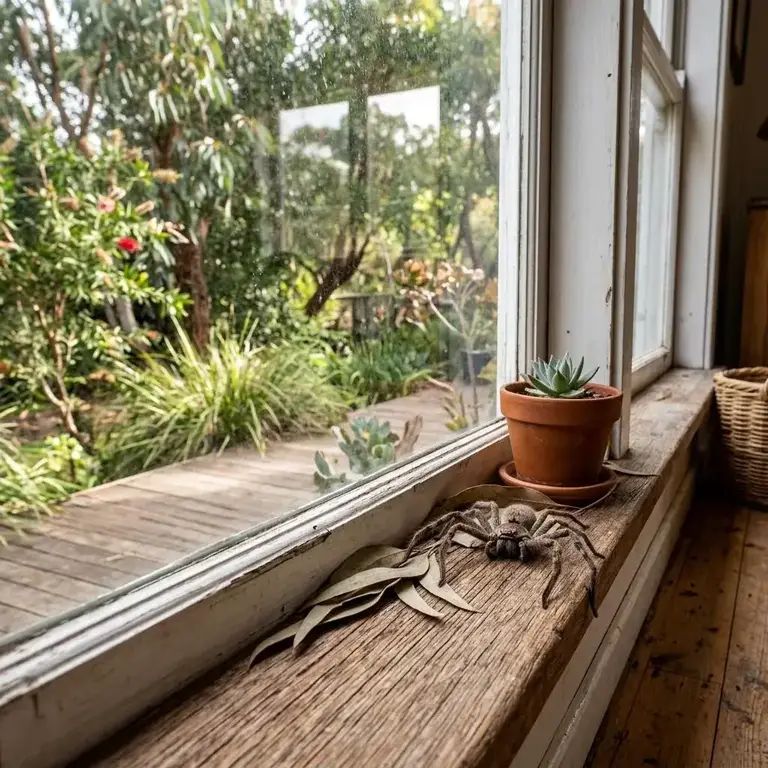
For species-level detail, see our full guide to the funnel-web spider: identification, danger and control, and our companion piece on the redback spider: identification, bites and safe removal. It’s also worth knowing the harmless lookalikes — many “big black spider” scares turn out to be huntsman spiders, which are largely harmless housemates, while the mouse spider is the funnel-web’s near-twin and deserves the same caution.
Which Is More Dangerous — and What First Aid Applies?
The funnel-web is the more acutely dangerous of the two: its venom can cause life-threatening symptoms within an hour, while redback bites progress slowly and allow more time to reach medical care. In practice, though, most Australians are far more likely to encounter a redback — hundreds of redback bites are treated each year, while funnel-web bites are rarer and concentrated around the Sydney basin, Blue Mountains and parts of the NSW and Queensland coast.
This is exactly why identification matters. For a funnel-web (or mouse spider) bite, apply the pressure immobilisation technique — a firm bandage over the bite and up the whole limb, then a splint — and call 000 immediately. For a redback, do the opposite: never bandage, apply a cold pack for pain, and seek medical advice. Using pressure immobilisation on a redback bite traps the venom and intensifies the pain. Reassuringly, both spiders have well-established antivenoms held in Australian hospitals. No death has been recorded from a Sydney funnel-web since antivenom was introduced in 1981, and redback deaths have been essentially eliminated since 1956. Reaching hospital promptly is what turns a dangerous bite into a treatable one.
DIY vs Professional Spider Control
Basic prevention — decluttering, sealing gaps, checking shoes and gloves — is genuine DIY territory, but treating confirmed redback or funnel-web harbourages with chemicals is best left to a licensed pest control technician. The risk profile of these two species means a missed treatment is not a harmless mistake.
| Factor | DIY approach | Professional treatment |
|---|---|---|
| Identification | Homeowner compares against photos; easy to confuse funnel-webs with mouse spiders | Licensed technician confirms species and harbourages on site |
| Safety | Risk of bites when disturbing webs, burrows or stored items | Trained handling, correct PPE and APVMA-approved products applied per label |
| Effectiveness | Supermarket sprays kill visible spiders but miss egg sacs and burrows | Targeted residual treatment of webs, cracks, subfloors and garden harbourages |
| Prevention | Decluttering and sealing gaps helps but doesn’t address established populations | Full inspection report plus proofing advice tailored to your home’s construction |
What Does Spider Treatment Cost in Australia?
Across the Australian pest control industry, a standard residential spider treatment generally sits between $150 and $450 in 2025–26, depending on property size, construction type and the severity of the infestation. These are typical market rates, and they vary by state and access — subfloor treatments and larger acreage properties tend to sit at the higher end of the range.
| Service | Typical market rate (AUD) | What’s included / notes |
|---|---|---|
| General spider spray (standard home) | $150–$250 | Internal/external residual treatment, web removal, eaves and fence lines |
| Targeted redback treatment | $180–$300 | Sheds, garages, outdoor furniture, play equipment, egg sac removal |
| Funnel-web inspection & garden treatment | $220–$380 | Burrow identification, garden and subfloor treatment, proofing advice |
| Large property / acreage treatment | $350–$450+ | Extended perimeter, outbuildings, follow-up visit options |
The figures above reflect what the Australian industry generally charges — not what you’ll pay with Aussie Pest Strike. Our quotes typically come in well under these market rates, so give us a call on [aps_phone] for an exact price tailored to your property.
Seasonal Activity: When Redbacks and Funnel-webs Peak
Both spiders are most active through the warmer months, with redback encounters peaking from December to February and male funnel-webs wandering after summer rain. Winter sees activity drop sharply, though redbacks persist year-round in sheltered spots like sheds and garages.
Jan
Feb
Mar
Apr
May
Jun
Jul
Aug
Sep
Oct
Nov
Dec
Typical combined redback and funnel-web encounter risk across Australia. Activity builds from September, peaks across the summer months (Dec–Feb) when redback bites are most common and male funnel-webs wander after rain, then tapers through autumn and winter.
“In summer we get calls about redbacks in letterboxes almost daily — they’re everywhere, but they stay put and are manageable. Funnel-webs are different: if you’ve got burrows in a moist garden bed in Sydney’s north, that’s not a DIY job. Treat both seriously, but treat them differently.”
Don’t handle, squash or spray either spider at close range. Photograph it from a safe distance if you can, keep kids and pets away, and book a licensed pest control inspection. A technician will confirm the species, treat harbourages with APVMA-approved products, and give you proofing advice so the problem doesn’t return next summer.
Frequently Asked Questions
How do I tell a redback apart from a funnel-web spider?
A redback is small, about 10 mm in body length, glossy black with a distinctive red or orange stripe on its rounded abdomen. A funnel-web is much larger and bulkier, 15 to 35 mm, uniform black to dark brown with a shiny head region and no red marking. Redbacks have thin legs and stay in messy tangled webs, while funnel-webs are powerful spiders that live in silk-lined ground burrows.
What first aid should I give for a funnel-web bite?
For a funnel-web or mouse spider bite, apply the pressure immobilisation technique: a firm bandage over the bite site and up the entire limb, then a splint. Call 000 immediately. Funnel-web venom can cause life-threatening symptoms within an hour, so reaching hospital promptly is critical.
What is the correct first aid for a redback spider bite?
For a redback bite, never apply a pressure bandage. Using pressure immobilisation on a redback bite traps the venom near the surface and intensifies the pain, which is why the first aid for redbacks is the opposite of what you would do for a funnel-web.
Where do redback spiders live around Australian homes?
Common harbourages include garden sheds, letterboxes, under outdoor furniture and play equipment, brick veneer wall voids, subfloor spaces and stacked materials. They build messy, tangled webs with a funnel-shaped retreat, often under pot rims or furniture. Elevated Queenslanders with open under-house areas and homes with cluttered garages are classic redback territory.
Where are funnel-web spiders found in Australia?
Related Hadronyche species extend up the east coast and into the highlands. Funnel-webs need moisture, living in silk-lined ground burrows in moist soil, under logs, in heavy mulch and around pool edges. Homes backing onto bush carry higher risk.
Which spider is more dangerous, the redback or the funnel-web?
The funnel-web is more acutely dangerous because its venom can cause life-threatening symptoms within an hour, while redback bites progress slowly. Both have effective antivenoms, making prompt treatment highly successful. The practical next step is to note the signs, inspect the relevant area carefully, and seek property-specific advice if the issue continues.
When are redbacks and funnel-webs most active?
Both spiders peak through the warmer months. Redback encounters and bites peak from December to February, though redbacks persist year-round in sheltered spots like sheds and garages. Male funnel-webs wander at night after summer rain, which is when most human encounters occur — sometimes falling into pools or sheltering in shoes left outside. Activity builds from September and tapers sharply through autumn and winter.
Can I treat redbacks or funnel-webs myself with supermarket sprays?
Basic prevention like decluttering, sealing gaps and checking shoes and gloves is genuine DIY territory. However, treating confirmed redback or funnel-web harbourages with chemicals is best left to a licensed pest control technician. Supermarket sprays kill visible spiders but miss egg sacs and burrows, and disturbing webs or burrows carries a real bite risk. A missed treatment on these species is not a harmless mistake.
How can a professional identify whether the spider in my home is a redback or a funnel-web?
An on-site assessment from Aussie Pest Strike is most useful when you have seen a suspected redback or funnel-web but cannot confirm the species, when you have found burrows in a moist garden bed, or when redbacks keep reappearing in sheds, letterboxes or play equipment despite your own efforts. A technician can confirm the species, locate all harbourages including egg sacs and burrows, and provide proofing advice tailored to your home's construction.
What should I do after spotting a dangerous spider near my home?
Do not handle or disturb the spider. Keep children and pets away from the area, note where you saw it and any web or burrow features, then contact Aussie Pest Strike. A licensed technician can identify whether it was a redback, funnel-web or a harmless lookalike such as a huntsman or mouse spider, treat the harbourage properly, and advise on prevention steps like decluttering and sealing gaps to reduce future encounters.
Sources & further reading
Found Something
Dangerous?
Don’t touch it. Don’t spray it. Keep kids and pets clear, take a photo from a safe distance, and call us — or book a free inspection and we’ll come to you.
02 7235 0050