Removing Spider WebsProperly (SoThey Don’t Return)
Removing spider webs — to remove spider webs so they do not return, you need to do more than sweep clear the web, remove any egg sacs, eliminate the insect...
To remove spider webs so they don’t return, you need to do more than sweep — clear the web, capture the spider, remove any egg sacs, eliminate the insect prey it feeds on, and treat surfaces to deter re-nesting. Across Australia, from humid Queensland eaves to brick veneer homes in Melbourne and Sydney, cobwebs rebuild within a day or two when the spider is left in place. In practical terms, removing spider webs properly means removing the reason the web was there in the first place.
Simply knocking down cobwebs is a cosmetic fix, not pest control. The spider retreats into a crevice at the edge of its web, waits for dark, and spins again overnight. This guide walks through a proven step-by-step method, the prevention changes that actually hold, realistic 2025-26 costs for professional treatment, and the seasonal patterns that decide when webs are at their worst — so you can stop the weekly sweep and keep your home clear for months at a time.
- Sweeping a web without capturing the spider means it rebuilds within 24-48 hours — always vacuum up the spider and egg sacs together.
- Outdoor lighting is the biggest driver: warm-white or yellow globes attract fewer insects, and fewer insects means fewer spiders.
- A professional residual treatment on eaves, frames and entry points can keep exterior surfaces web-free for several months.
- Web activity peaks from October through March in most of Australia, and is close to year-round in Queensland and the NT.
- DIY removal suits a handful of webs; recurring webs across eaves, fences and outbuildings are faster and cheaper to handle professionally.
Why Spider Webs Are Such a Persistent Problem Across Australia
Spider webs persist across Australia because our climate gives spiders a long warm breeding season and our housing gives them endless sheltered anchor points. Eaves, cornices, window frames, subfloors and fence lines all offer the undisturbed corners spiders need, while outdoor lights deliver a nightly buffet of moths and midges.
Housing style plays a big part. Queenslanders on stumps have shaded subfloor voids where black house spiders and daddy long-legs web undisturbed for years. Post-war brick veneer homes have deep eaves and weep holes that funnel insects inside. Slab-on-ground builds in newer estates still cop webs across porticos, alfresco areas and garage doors wherever downlights run all night. In the tropical north, web-building barely pauses in winter; in southern states it surges from the first warm nights of spring.
The species matter too. Garden orb weavers spin their classic wheel-shaped webs across paths and doorways overnight, often rebuilding daily. Messy cobwebs in corners and window frames usually belong to black house spiders or daddy long-legs. More concerning web-builders include the redback, which favours sheltered spots around outdoor furniture, letterboxes and sheds — see our guide to Redback Spider: Identification, Bites and Safe Removal — and funnel-webs, which build silk-lined burrows rather than aerial webs but still demand caution when gardening (see Funnel-Web Spider: Identification, Danger and Control).
Warning Signs Your Web Problem Needs More Than a Broom
A web problem has outgrown DIY when webs reappear within 48 hours of clearing, egg sacs keep turning up, or you’re finding spiders in living areas rather than just outside. Use this checklist to gauge where you stand.
- Webs rebuilt within a day or two: the spider is still in place, hiding in a crevice at the web’s edge.
- Egg sacs in the webbing: a single swept-over sac can hatch dozens of spiderlings within weeks during the warm season.
- Webs concentrated near lights: bright white globes near doorways keep drawing the insects that make the spot worth webbing.
- Webs in garages, sheds and subfloors: undisturbed voids pile up webbing fast — our guide to preventing spiders in garages and sheds covers these trouble spots.
- Large wandering spiders indoors: huntsmen often follow prey inside; read Huntsman Spiders: Dangerous or Harmless Housemates? before you panic.
- Tangled webs at ground level near furniture or stored items: classic redback territory — don’t reach in blind.
How to Remove Spider Webs Step by Step (DIY vs Professional)
To remove spider webs properly yourself, capture the spider and sac with a vacuum rather than relocating them with a broom, then wash exterior surfaces and change the conditions that attracted the spider. Professionals do the same job faster and add a residual treatment that keeps spiders from re-establishing.
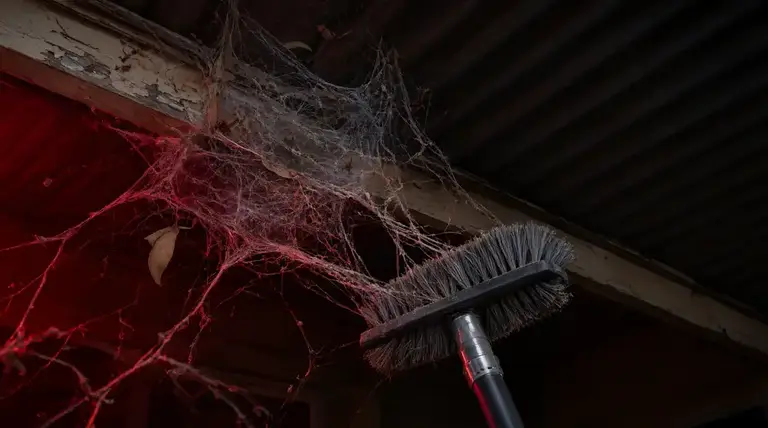
The DIY method: use a cobweb brush or a broom wrapped in an old cloth for high corners and eaves; vacuum interior webs with a nozzle to capture spiders and egg sacs in one pass; check for and remove every egg sac (our egg sac identification and removal guide shows what to look for); hose or pressure-wash exterior webbing and dust; and wipe window frames and sills where insects and spiders congregate. Then compare what each approach delivers:
| Factor | DIY web removal | Professional treatment |
|---|---|---|
| Immediate result | Webs gone; spider often survives | Webs, spiders and sacs removed in one visit |
| How long it lasts | Days to a couple of weeks | Typically several months with residual treatment |
| Effort | Weekly sweeping in season | Seasonal service at most |
| Safety | Risk of disturbing redbacks or sacs bare-handed | Licensed technician, APVMA-approved products |
| Best for | A few webs, low activity | Recurring webs, eaves, outbuildings, egg sacs |
Pair removal with prevention: switch to warm-white or yellow outdoor globes, trim vegetation off walls, and seal gaps around windows and eaves — our spider-proofing guide covers the sealing and lighting changes in detail. The most common mistakes are only clearing what you can see, leaving egg sacs behind, using a broom that just relocates the web, and ignoring the lighting. Get those four things right and the job shifts from weekly to seasonal.
What Does It Cost to Remove Spider Webs Professionally in Australia?
Across the Australian pest control industry, professional spider web removal and treatment typically costs between $150 and $450 for a standard home in 2025-26, depending on property size, access and whether outbuildings are included. Market rates vary by region, with two-storey homes and acreage properties sitting at the higher end of the typical range.
| Service | Typical market rate (AUD) | What’s included / notes |
|---|---|---|
| Web sweep + spot treatment (small home/unit) | $150 – $220 | De-webbing of eaves and entry points, targeted residual spray |
| Full exterior spider treatment (standard house) | $220 – $350 | De-webbing, residual barrier to eaves, frames, fences, entry points |
| Large/two-storey or acreage property | $350 – $450+ | Extended coverage, sheds, subfloor, high-access equipment |
| Ongoing seasonal plan | $180 – $300 per visit | 2-3 visits per year; reduced per-visit pricing |
These figures reflect typical industry charges, and the value at any price point is in the residual treatment. Professionals apply an APVMA-approved residual product to eaves, window frames and entry points; when a spider walks across a treated surface to rebuild, it picks up a lethal dose, which is why treated homes stay web-free far longer than swept-only ones. A quality residual can protect exterior surfaces for several months. Chemical applications should always be carried out by a licensed technician — no product can be called completely safe, and correct application matters.
While the figures above reflect typical Australian market rates, Aussie Pest Strike typically comes in well under these prices without cutting corners on products, licensing or workmanship. For an exact quote tailored to your property, give the team a call on [aps_phone].
Seasonal Spider Web Activity Across Australia
Web activity across Australia builds from September, peaks between December and March, and drops away through the cooler months — except in Queensland and the NT, where it stays high nearly all year. Time your major treatments for early spring to get ahead of the breeding season.
Jan
Feb
Mar
Apr
May
Jun
Jul
Aug
Sep
Oct
Nov
Dec
Typical web-building activity for southern and temperate Australia. Tropical regions see a flatter curve, with activity of 70%+ in most months; southern winters drop to the 25-35% range shown.
Nine times out of ten, the webs keep coming back because the food source is still there — usually a bright white downlight pulling insects to the same corner every night. We sweep, treat the surface and get the customer to swap the globe, and that corner stays clear for months. Web removal done properly is pest control, not housework.
Vacuum webs and egg sacs rather than brushing them, switch outdoor lighting to warm-white, and trim vegetation off the walls. If webs return within days or you’re finding sacs around eaves and outbuildings, book a professional Spider Control & Removal treatment — one seasonal visit with a residual barrier beats a year of weekly sweeping.
Frequently Asked Questions
Why do spider webs keep coming back after I sweep them away?
Sweeping a web is a cosmetic fix, not pest control. The spider retreats into a crevice at the edge of its web, waits for dark, and spins a new one overnight, which is why cobwebs rebuild within 24 to 48 hours across most Australian homes. To stop webs returning you need to capture the spider itself, remove any egg sacs, and address the conditions that attracted the spider in the first place.
What is the proper way to remove spider webs myself?
Use a vacuum with a nozzle to remove interior webs so spiders and egg sacs are captured in one pass rather than relocated. For high corners and eaves, use a cobweb brush or a broom wrapped in an old cloth. Check carefully for egg sacs and remove every one, then hose or pressure-wash exterior webbing and dust, and wipe window frames and sills where insects and spiders gather.
Why is outdoor lighting linked to spider webs around my home?
Bright white globes near doorways and eaves attract moths, midges and other insects each night, giving spiders a reliable food source worth webbing. Warm-white or yellow globes attract fewer insects, which means fewer spiders setting up in those corners. Swapping your globes is one of the most effective prevention changes, because webs usually return when the food source stays put.
How long does professional spider treatment keep webs away?
A professional residual treatment applied to eaves, window frames, fences and entry points can keep exterior surfaces web-free for several months. When a spider walks across the treated surface to rebuild, it picks up a lethal dose. Sweeping alone lasts only days to a couple of weeks, which is why treated homes stay clear far longer than swept-only ones.
When is spider web activity worst in Australia?
Web activity builds from September, peaks between December and March, and drops through cooler months in southern and temperate Australia. In Queensland and the Northern Territory, web-building barely pauses in winter and stays high nearly all year. Timing a major treatment or clean-up for early spring helps you get ahead of the breeding season before webs multiply.
Which spiders cause the cobwebs around Australian homes?
Messy cobwebs in corners and window frames usually belong to black house spiders or daddy long-legs. Garden orb weavers spin wheel-shaped webs across paths and doorways overnight, often rebuilding daily. Redbacks favour sheltered spots at ground level near outdoor furniture, letterboxes and sheds, while funnel-webs build silk-lined burrows rather than aerial webs but still demand caution when gardening.
When should I call a professional instead of removing webs myself?
DIY removal suits a handful of webs with low activity. It has outgrown DIY when webs reappear within 48 hours of clearing, egg sacs keep turning up, or spiders appear in living areas rather than just outside. Recurring webs across eaves, fences, garages, sheds and subfloors are faster and cheaper to handle professionally, especially where redbacks may be present.
What mistakes should I avoid when removing spider webs?
The most common mistakes are only clearing what you can see, leaving egg sacs behind, using a broom that simply relocates the web elsewhere, and ignoring the lighting that draws insects to the spot. A single swept-over egg sac can hatch dozens of spiderlings within weeks during the warm season. Get these four things right and the job shifts from weekly sweeping to seasonal maintenance.
Can Aussie Pest Strike help me tell dangerous web-builders apart from harmless ones?
Yes. Tangled webs at ground level near furniture, letterboxes or stored items can signal redbacks, which should never be disturbed bare-handed, while messy corner cobwebs are more likely black house spiders or daddy long-legs. Aussie Pest Strike technicians can identify which species is behind the webbing on your property, check for egg sacs, and recommend the right level of treatment rather than guesswork.
What should I do if webs return days after I clear them?
If webs rebuild within a day or two despite vacuuming spiders and sacs, book a professional Spider Control & Removal service. Aussie Pest Strike can de-web eaves and entry points, apply a residual barrier to frames, fences and access points, and advise on lighting and vegetation changes that hold results for months. One seasonal visit with a residual barrier beats a year of weekly sweeping.
Sources & further reading
Found Something
Dangerous?
Don’t touch it. Don’t spray it. Keep kids and pets clear, take a photo from a safe distance, and call us — or book a free inspection and we’ll come to you.
02 7235 0050