AS 3660.2Explained: Australian TermiteManagement Standards
Termites cause hundreds of millions of dollars in damage to Australian homes every year, and the single document that decides whether your home is
Termites cause hundreds of millions of dollars in damage to Australian homes every year, and the single document that decides whether your home is properly protected is AS 3660 — the Australian Standard for termite management. Whether you live in a Queenslander in Brisbane, a brick veneer in Melbourne or a slab-on-ground home in Perth, any treatment carried out on your property should be measured against this standard.
In simple terms, AS 3660 is the Australian Standard that sets out how termite management systems must be designed, installed, assessed and documented, with Part 2 (AS 3660.2) covering treatments on existing buildings. This guide breaks down what the standard actually requires, what it means for your home, what it costs, and the questions you should ask before signing off on any termite work.
- AS 3660 is a three-part Australian Standard: Part 1 covers new construction, Part 2 covers existing buildings, and Part 3 covers assessment criteria.
- No compliant system claims to make a home “termite-proof” — the standard manages risk through treated zones, barriers, monitoring and regular inspection.
- A compliant treatment must be documented, usually with a durable notice fixed at the meter box or under the kitchen sink.
- Chemical treated zones typically last 5-8 years before renewal; annual professional inspections are still required.
- Always use a licensed pest control technician who works to the standard and provides full paperwork.
Why AS 3660 Matters for Australian Homes
Australia has some of the most termite-prone conditions on earth, and AS 3660 exists because ad-hoc, undocumented treatments routinely fail in our climate and housing stock. Warm, humid conditions across Queensland, northern New South Wales, WA and the NT drive year-round termite pressure, while even southern states see heavy activity through spring and summer.
Our housing styles make compliance critical. Subfloor homes and Queenslanders offer termites concealed entry via stumps and ant caps, while slab-on-ground construction — common in newer estates — can be bridged by garden beds, paving or weep holes blocked by render. Brick veneer homes hide timber framing behind masonry, so damage can advance undetected for years. A treatment that ignores the standard may leave these bridging points unaddressed, giving you a false sense of security while foraging termites quietly bypass the treated zone. Compliance ensures the chemical is applied at the correct rate and depth, gaps are treated, and the product’s registered label and APVMA approval are respected.
The AS 3660 Family: A Quick Map
The standard is split into three parts, each covering a different stage of a building’s life. Knowing which part applies to your situation helps you ask the right questions of any technician.
| Standard | Applies to | Covers |
|---|---|---|
| AS 3660.1 | New construction | Termite management for new buildings |
| AS 3660.2 | Existing buildings | Treatment and protection to existing structures |
| AS 3660.3 | Assessment | Testing and assessment criteria for termite systems |
Warning Signs Your Termite Protection Isn’t Up to Standard
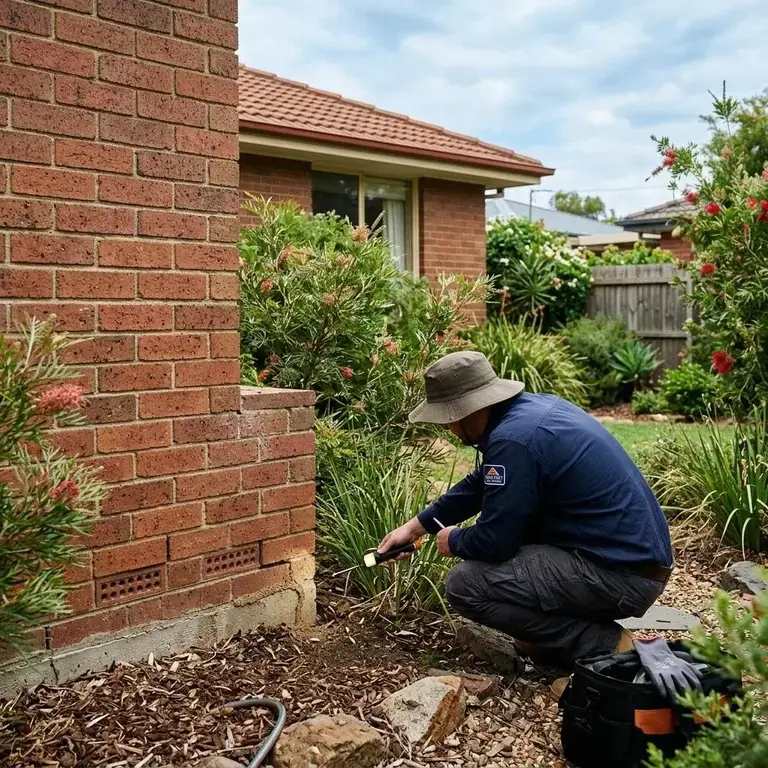
The clearest warning sign is a treatment with no paperwork — but there are several red flags that your home’s protection may not meet the standard, or that termites are already active.
- No durable notice — a compliant treatment should have a notice fixed at the meter box or under the kitchen sink recording the chemical, date and expected service life.
- No treatment certificate or documentation — without records, you cannot prove the job was done properly for warranty, insurance or resale purposes.
- Bridged or disturbed treated zones — garden beds, new paving, decking or plumbing work built over the treated zone can create a gap termites exploit.
- Expired chemical life — if your notice shows the zone is past its stated service life, protection may have lapsed.
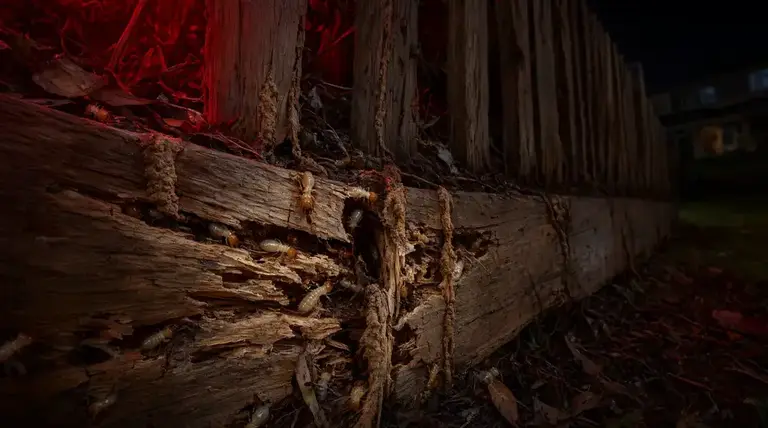
- Mud leads or damaged timber — see our guide to the 10 Warning Signs of Termites in Australian Homes for the physical evidence to look for.
What AS 3660.2 Actually Requires
For an existing home, AS 3660.2 sets out how a competent operator should assess the building, choose a suitable management system and install it correctly. It recognises several protection approaches — chemical soil treated zones, reticulation systems, physical and physico-chemical barriers, and monitoring or baiting systems.
Critically, the standard emphasises that no system makes a building “termite-proof”. Instead, it manages the risk by forcing termites into detectable areas or through a treated zone. That is why even a fully compliant installation still requires annual professional checks — the standard treats detection and treatment as partners, not alternatives. Understanding this helps owners set realistic expectations and avoid the false comfort of thinking one treatment makes the problem disappear forever. For a deeper look at inspection scope, read Termite Inspection: What It Includes and Why It Matters, and for system design see What Is a Termite Barrier and How Does It Protect Your Home?
DIY vs Professional Compliance
Termite management to AS 3660 is not a DIY job — chemical application rates, drilling depths, soil types and documentation all require licensed expertise, and APVMA-registered products should only be applied by qualified technicians. Here is how the two approaches compare.
| Factor | DIY approach | Licensed professional |
|---|---|---|
| Products | Retail sprays and baits, limited strength | APVMA-registered professional products at label rates |
| Coverage | Spot treatment; bridging points often missed | Full perimeter treated zone, subfloor and penetration treatment |
| Documentation | None | Treatment certificate and durable notice as required by the standard |
| Warranty and resale | No proof of protection | Records support warranty claims and pre-purchase inspections |
AS 3660-Compliant Treatment Costs in Australia (2025-26)
Across the Australian market, homeowners are generally charged between $250 and $450 for an annual inspection and $2,500 to $4,500 for a full chemical treated zone on a standard home, with baiting systems typically priced per station. What the industry charges varies with house size, construction type (slab vs subfloor), soil conditions and access. The figures below are typical pest control market rates for 2025-26, not a quote for any one property.
| Service | Typical market rate (AUD) | What’s included / notes |
|---|---|---|
| Annual termite inspection | $250 – $450 | Visual and moisture inspection, written report; see our Termite Inspections & Reports |
| Chemical treated zone (perimeter) | $2,500 – $4,500 | Trenching/drilling, chemical at label rate, durable notice; larger or subfloor homes may exceed this |
| Monitoring / baiting system | $2,000 – $3,500 install + $300 – $600/yr servicing | In-ground stations, ongoing monitoring visits |
| Reticulation system recharge | $800 – $1,800 | Refill of existing pipe network, typically every 3-5 years |
Those are the going market rates across the industry — Aussie Pest Strike typically comes in well under them while still meeting AS 3660. For an exact quote on your home, call [aps_phone] and we’ll price it properly on inspection, not off a generic table.
Seasonal Termite Activity Across Australia
Termite pressure peaks from October through March in most of Australia, when warmth and storm-season humidity trigger swarms (alates) and aggressive foraging. Northern regions stay active almost year-round, while southern states dip in winter — but activity never truly stops inside a heated home.
Jan
Feb
Mar
Apr
May
Jun
Jul
Aug
Sep
Oct
Nov
Dec
Indicative national termite activity: peaks in late spring and summer swarming season, easing through the cooler southern winter. Northern Australia remains elevated year-round.
The most expensive jobs we see aren’t the treatments — they’re the homes where someone sprayed a bit of chemical ten years ago with no notice, no records and no follow-up inspections. AS 3660 exists so the next owner, and the next inspector, knows exactly what was done and when it’s due again. If your technician won’t put it in writing, find one who will.
Book an annual inspection and ensure any treatment on your home is installed to AS 3660.2 with a durable notice and full documentation. Ask your technician which part of the standard applies, what system they are installing and why, the expected service life, and the re-treatment interval. Our Termite Treatment & Barrier Systems are installed to the standard with complete paperwork for warranty, inspection and resale purposes.
Frequently Asked Questions
What is AS 3660 and what does it cover?
AS 3660 is the Australian Standard for termite management, setting out how termite management systems must be designed, installed, assessed and documented. It has three parts: Part 1 covers new construction, Part 2 covers treatment of existing buildings, and Part 3 covers testing and assessment criteria. Any termite work on your home should be measured against the relevant part of this standard.
What does AS 3660.2 specifically apply to?
AS 3660.2 applies to existing buildings rather than new construction. It sets out how a competent operator should assess an existing home, choose a suitable termite management system and install it correctly. It recognises several approaches, including chemical soil treated zones, reticulation systems, physical and physico-chemical barriers, and monitoring or baiting systems.
Does a compliant termite system make my home termite-proof?
No. The standard is clear that no system makes a building termite-proof. Instead, compliant systems manage risk by forcing termites through a treated zone or into detectable areas where activity can be spotted. That is why even a fully compliant installation still requires annual professional inspections — detection and treatment are treated as partners under the standard, not alternatives.
What documentation should I receive after a termite treatment?
A compliant treatment must be documented with a durable notice, usually fixed at the meter box or under the kitchen sink, recording the chemical used, the date of application and the expected service life. The practical next step is to note the signs, inspect the relevant area carefully, and seek property-specific advice if the issue continues.
How long does a chemical treated zone last before renewal?
Chemical treated zones typically last five to eight years before they need renewal, depending on the product applied and site conditions. The durable notice fixed at your meter box or kitchen sink records the expected service life, so you can check when re-treatment is due. Annual professional inspections are still required even while the zone remains within its service life.
What warning signs suggest my termite protection isn't up to standard?
Key red flags include no durable notice at the meter box or kitchen sink, no treatment certificate or paperwork, treated zones bridged or disturbed by garden beds, paving, decking or plumbing work, and a notice showing the chemical's stated service life has expired. Physical evidence such as mud leads or damaged timber also suggests termites may already be active despite any past treatment.
Can I do termite treatment to AS 3660 myself?
No — termite management to AS 3660 is not a DIY job. Chemical application rates, drilling depths, soil types and documentation all require licensed expertise, and APVMA-registered professional products should only be applied by qualified technicians.
What questions should I ask a technician before signing off on termite work?
Ask which part of AS 3660 applies to your situation, what system they are installing and why, the expected service life of the treatment, and the re-treatment interval. Also confirm they are licensed, that products are APVMA-registered and applied at label rates, and that you will receive full documentation including a durable notice and treatment certificate.
Can I check whether Aussie Pest Strike services my area for termite treatments to AS 3660.2?
Yes. Aussie Pest Strike installs termite treatments to AS 3660.2 with complete paperwork, including durable notices and treatment certificates. Because coverage depends on your location, the simplest way to confirm availability for your property is to get in touch directly and describe your situation. They can then advise whether they attend homes in your area and arrange an on-site assessment if appropriate.
How do I get a proper quote for an AS 3660-compliant termite treatment from Aussie Pest Strike?
Aussie Pest Strike prices termite work properly on inspection, taking into account your house size, construction type, soil conditions and access. Book an assessment, ask which part of the standard applies to your home, and make sure any quote includes the durable notice and full documentation required for compliance.
Sources & further reading
Found Something
Dangerous?
Don’t touch it. Don’t spray it. Keep kids and pets clear, take a photo from a safe distance, and call us — or book a free inspection and we’ll come to you.
02 7235 0050