Bush Turkeys inthe Yard: LegalControl That Works
Bush Turkeys in the Yard: practical advice from Aussie Pest Strike. Free inspection — call 1300 782 273 today. Licensed, insured and servicing homes and...
If bush turkeys have turned your yard into a building site, you’re not alone — and yes, there is legal control that works. Whether you found this page searching for brush turkey help or simply typed “u” into a search bar looking for answers, the key fact is this: bush turkeys are protected native birds, so you can’t trap, harm or kill them — but you can legally deter them.
Bush turkey control is the legal practice of deterring protected Australian brush turkeys from your property using habitat modification, physical barriers and food-source removal, rather than trapping, harming or relocating the birds. The most effective approach combines heavy coarse mulch, wire mesh over garden beds, secured compost and removing food sources — and it works best when you act early, before a male claims your yard and builds his mound.
- Bush turkeys are protected under NSW and Queensland law — harming, trapping, shooting or poisoning them, or disturbing eggs, is illegal without a permit.
- Deterrence beats removal: a relocated male is usually replaced by another within weeks if the habitat still suits them.
- Heavy mulch, mesh barriers, sealed compost and daily food clean-up form the core of any effective, legal control plan.
- Act in late winter (August) before mound building peaks — once eggs are in a mound, you can’t touch it without a permit.
- A licensed professional can design a compliant deterrent plan and advise on permits when the problem is entrenched.
Why Bush Turkeys Target Australian Gardens
Bush turkeys target suburban gardens because our yards offer exactly what they need: soft mulch, leaf litter, insects and easy food. The Australian brush turkey (Alectura lathami) is a native megapode found along the east coast, from Cape York down through Queensland and into NSW as far south as the Illawarra. Once hunted almost to local extinction, they’ve made a remarkable comeback and are now common in suburban Brisbane, the Gold Coast, Sydney’s North Shore and the Northern Beaches.
Australia’s warm, humid eastern climate suits them perfectly, and our housing styles help too. Leafy blocks around Queenslanders, established gardens behind brick veneer homes and mulched beds on modern slab estates all provide mound-building material within easy reach. The same lush lawns that attract turkeys can also harbour other destructive pests — if your turf is being torn up, it’s worth ruling out lawn grubs and curl grubs or an armyworm outbreak, which cause similar-looking lawn damage.
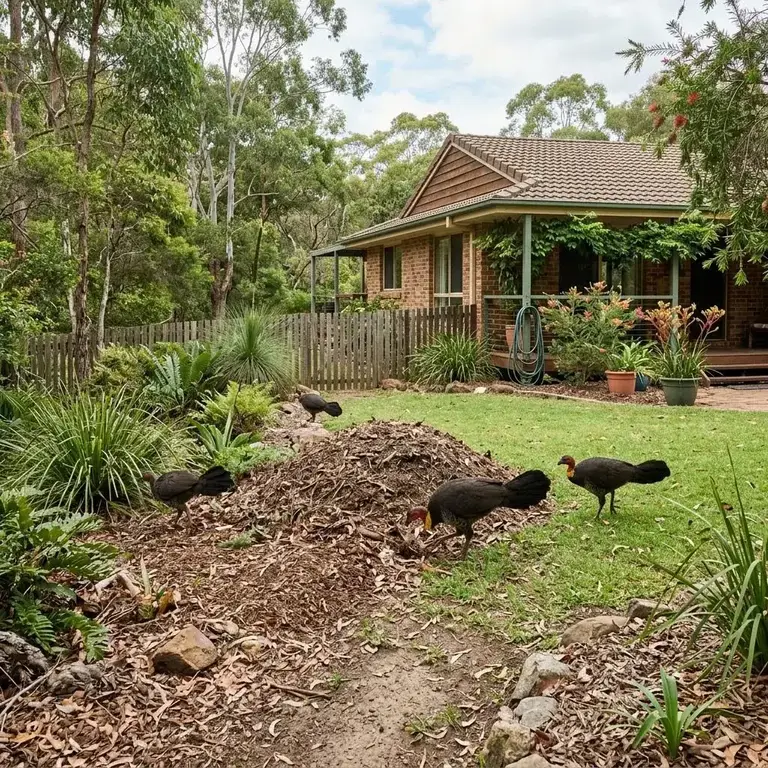
It’s the male that causes the damage. Between about August and February he rakes together a nesting mound of leaf litter, soil and mulch that can reach four metres across and over a metre high. The decomposing vegetation incubates the eggs at a steady 33–34°C. Building that mound means stripping every garden bed within range — your mulch, seedlings and irrigation lines included. Turkeys are also opportunistic feeders, scratching through lawns and garden beds for insects, seeds, fallen fruit and pet food left outdoors.
Warning Signs: Is a Bush Turkey Claiming Your Yard?
The clearest warning sign is a male turkey raking debris into a growing pile, usually in the early morning. Catch these signs early and you can stop him before he invests in the site:
- Fresh scratch marks in garden beds — long, backwards-swept gouges through mulch, very different from the small conical holes left by bandicoots.
- Mulch migrating downhill or towards fences — turkeys rake everything towards the mound site, often against a fence line, shed or dense shrub.
- A debris pile that regrows overnight — rake it flat in the evening and it’s rebuilt by morning? A male has claimed the spot.
- Uprooted seedlings and disturbed irrigation lines — dripper tubing and shallow plants are casualties of constant raking.
- Scattered lawn and soil scratchings — feeding birds tear at turf; if the lawn itself is thinning in patches, check for curl grubs underneath as well.
- A large, dark bird roosting in trees at dusk — turkeys roost off the ground and will defend a territory for a whole season.
DIY vs Professional Bush Turkey Control
Most turkey problems respond well to persistent DIY deterrence, and because the birds are protected, professional pest control for turkeys is really about expert habitat modification and permit guidance — not chemical treatment. DIY suits early-stage problems; professionals earn their fee when a dominant male has held your yard for multiple seasons or a mound with eggs is involved.
| Factor | DIY deterrence | Professional service |
|---|---|---|
| Best for | New arrivals, early mound scraping, motivated homeowners | Entrenched males, mounds with eggs, large or sloped blocks |
| Typical cost (AUD) | $80–$400 in mulch, mesh, sprinklers and bins | $180–$550 for assessment and deterrent installation |
| Legal risk | Moderate — easy to accidentally disturb a nest with eggs | Low — licensed advice on permits and wildlife law |
| Time commitment | Daily raking and monitoring for 1–3 weeks | Minimal — plan implemented for you |
| Long-term success | Good if started early and kept up | Very good — whole-of-yard habitat design |
While you’re assessing the yard, remember that turkey scratching can mask other issues. Portuguese millipedes swarming through leaf litter, or grubs hollowing out turf roots, need completely different treatments — a professional inspection sorts one from the other. A targeted lawn grub and garden pest treatment can run alongside your turkey deterrent plan so you’re not fixing one problem while another eats your lawn from below.
Legal Deterrents That Actually Work
The deterrents that work all follow one principle: make your yard harder to rake and less rewarding to feed in than the neighbour’s. Persistence matters more than any single product.
Protect your garden beds
Swap fine, soft mulch for heavy, coarse material turkeys can’t rake — large pine bark nuggets or chunky tea tree mulch laid at least 75–100mm deep. Peg chicken wire or mesh over freshly planted beds, and use rock borders or sleepers to anchor mulch piles.
Remove food and nesting material
A yard with easy pickings is a yard worth defending. Cut off the incentives: feed pets indoors and clean up fallen fruit daily; use a sealed compost bin rather than an open heap (open compost is both a food source and ready-made mound material); keep chook feed in rodent-proof, lidded containers; rake up leaf litter piles before spring; and fit tight lids to wheelie bins and secure chicken pens with mesh.
Discourage mound building early
If a male starts scraping, rake the pile flat every morning before he invests in it — most birds give up within a week or two and move on. Motion-activated sprinklers are surprisingly effective, as turkeys dislike sudden jets of water. Once a mound contains eggs, you can’t legally disturb it without a permit, so early action is everything.
Bush Turkey Control Costs in Australia (2025–26)
Across the Australian market, homeowners generally pay between $80 and $550 for bush turkey control, depending on whether they DIY or bring in a professional. The figures below are typical industry-wide rates for 2025–26 — they reflect what the market generally charges, not a quote from any single provider:
| Service | Typical market rate (AUD) | What’s included/notes |
|---|---|---|
| DIY materials (mulch, mesh, pegs) | $80–$250 (typical retail range) | Coarse bark mulch, chicken wire, sleepers or rock borders |
| Motion-activated sprinkler | $60–$150 (typical retail range) | Solar or hose-connected unit; reposition every few days |
| Sealed compost bin | $70–$180 (typical retail range) | Lidded tumbler or enclosed bin replacing an open heap |
| Professional site assessment & deterrent plan | $180–$350 (typical industry rate) | Inspection, species confirmation, written deterrent plan |
| Full deterrent installation | $350–$550+ (typical industry rate) | Mesh, barriers and habitat modification installed; permit advice where eggs are present |
While the rates above reflect what the Australian industry generally charges, Aussie Pest Strike typically comes in well under these market rates. For an exact quote tailored to your property, give us a call on [aps_phone] today.
Seasonal Activity: When Bush Turkeys Strike
Bush turkey damage peaks between September and December, when males are building and defending nesting mounds. Activity ramps up from late winter and winds down by late summer, which is why August is your window to act.
Jan
Feb
Mar
Apr
May
Jun
Jul
Aug
Sep
Oct
Nov
Dec
Indicative mound-building and garden damage activity across Queensland and NSW. Males start scraping in late winter, peak through spring and early summer, and wind down by late summer. Start deterrents in August for the best results.
The biggest mistake we see is homeowners waiting until the mound is waist-high before doing anything. If you flatten those first scrapes every morning for a fortnight, nine times out of ten the bird gives up and moves on. Leave it a month, and you’re locked in for the whole breeding season — legally, your hands are tied once there are eggs.
Start your deterrent program in August: lay coarse mulch 75–100mm deep, mesh any fresh beds, seal the compost and flatten new scrapes daily. If a male has already built a substantial mound or eggs may be present, don’t touch it — book a professional assessment so any action stays on the right side of NSW and Queensland wildlife law.
Bush Turkeys in the Yard: Frequently Asked Questions
Are bush turkeys protected in Australia?
Yes. Bush turkeys are protected native wildlife in every state where they occur, including under NSW’s Biodiversity Conservation Act 2016 and Queensland’s Nature Conservation Act 1992. Harming, trapping or killing them without a permit is illegal, and penalties can run into the tens of thousands of dollars.
Can I relocate a brush turkey from my yard?
No — relocating a brush turkey yourself is unlawful. In NSW and Queensland, only licensed wildlife handlers may trap and move a brush turkey, and birds are usually released close by. Relocation often fails because another male quickly moves in, so deterrence and habitat modification deliver far better long-term results.
When are bush turkeys most active?
Mound building ramps up from late winter through spring, peaking between September and December across Queensland and NSW. Males rake hardest in the early morning, and activity winds down by late summer. Starting your deterrents in August, before breeding peaks, gives you the best chance of success.
Don’t let a determined turkey wreck another season of gardening. Aussie Pest Strike offers free inspections across our service areas, and our licensed pest control technicians will design a legal, effective deterrent plan for your property — and check for hidden lawn pests while we’re there. Contact Aussie Pest Strike today to book your free inspection.
Need help fast? Call Aussie Pest Strike on [aps_phone]. Related reading on pest control: Armyworm: The Lawn Destroyer Spreading Across Australia and Portuguese Millipedes: The Plague Pest.
Sources & further reading
Found Something
Dangerous?
Don’t touch it. Don’t spray it. Keep kids and pets clear, take a photo from a safe distance, and call us — or book a free inspection and we’ll come to you.
02 7235 0050