Compost andRodents: Safe CompostingWithout Rats
Compost and rodents — compost attracts rats mainly when it contains the wrong ingredients, stays cold and dry, or sits in an open unsecured bay, but you can...
Compost rats are rarely about bad luck; in most Australian gardens they arrive when an open heap offers easy tucker, shelter and water. The good news is that a well-managed system is one of the least inviting spots on the block: balance greens and browns, keep the pile hot and moist, skip meat and dairy, and use a sealed base or fine mesh so nothing can burrow or gnaw in.
This guide walks through exactly how to do that, Australia-wide, whether you are running a bay behind a Queenslander, a tumbler on a Melbourne courtyard slab or a worm farm on a Perth balcony. We cover the warning signs that rodents have already moved in, when DIY fixes are enough and when you need professional Rodent Control & Removal, plus realistic 2025-26 pricing if the problem has spread beyond the compost.
- Compost attracts rats mainly when it contains meat, dairy, cooked food or bread, or sits cold, dry and undisturbed — a hot, well-turned vegetable-only heap is largely unattractive to rodents.
- The most rodent-resistant setups are an enclosed bin on 6 mm galvanised mesh or a sealed rotating tumbler mounted off the ground.
- Weekly turning, correct moisture and a balanced green-to-brown mix do most of the pest-deterrence work for free.
- Burrows beside the bin usually mean the colony has spread further — check for signs of rats or mice in your home at the same time.
- Professional rodent treatments in Australia typically range from about $250 to $650 AUD, depending on property size and severity.
Why compost rats are a problem across Australia
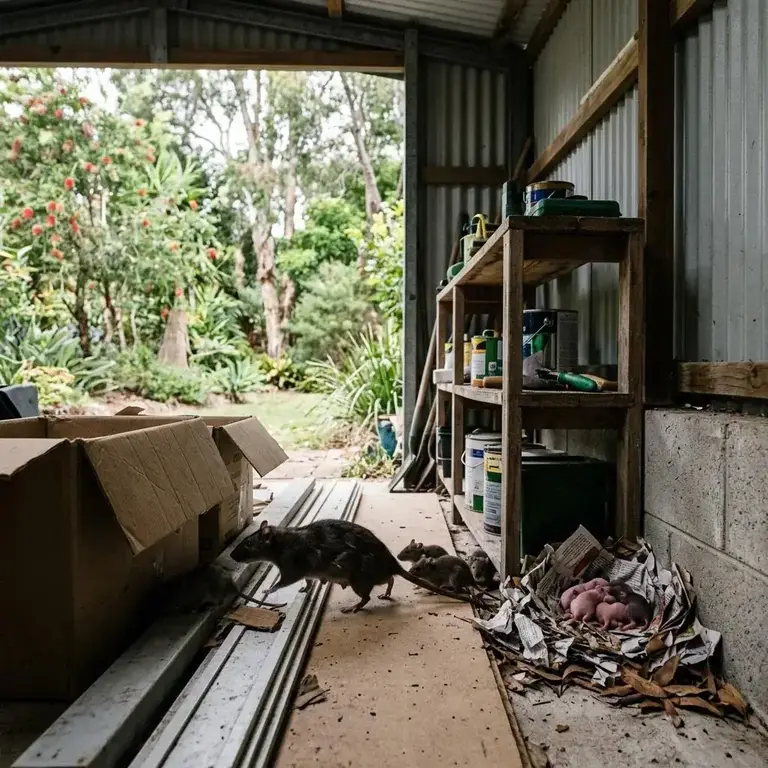
Compost bins attract rodents because they concentrate food, shelter and warmth in one quiet corner of the yard — exactly what rats need. Australia’s mild winters in the southern states and year-round warmth from Brisbane to Darwin mean rodents breed almost continuously, so a neglected compost heap can support a colony in every season rather than just autumn.
Housing style makes it worse. Queenslanders and older weatherboard homes on stumps give rats easy subfloor access straight from the garden, while brick veneer homes have weep holes and wall cavities that a compost-fed rat can exploit within metres of the bin. The two species you are most likely dealing with are the black or roof rat (Rattus rattus) — a superb climber covered in detail in our guide to roof rats in Australia — and the brown Norway rat, which burrows under slabs, garden beds and compost bays. Either way, the fix starts with how you run the heap itself.
Step 1: Keep the wrong food out
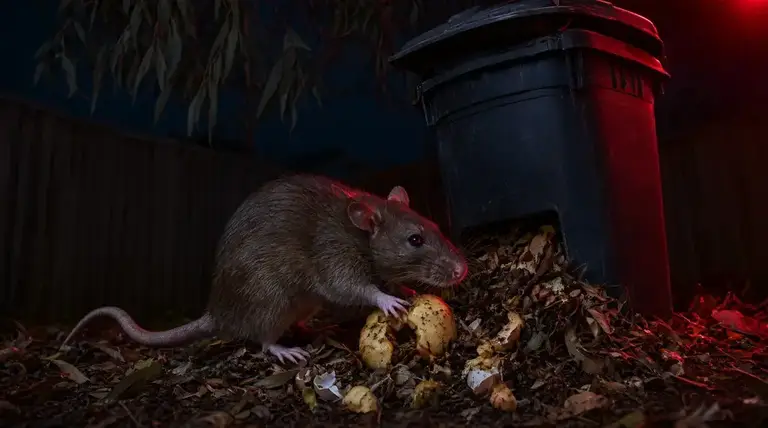
Rats are drawn to easy protein and starch, not garden waste, so the single most effective step is controlling what goes into the bin. The most common composting mistake is adding the o scraps rodents crave.
- Never add meat, fish, dairy, cooked food, oils or bread.
- Do add fruit and vegetable scraps, coffee grounds, eggshells and garden clippings.
- Bury fresh food scraps in the centre of the heap rather than leaving them exposed on top.
- Rinse and crush eggshells, and avoid adding pet food or spilled chicken feed nearby.
Step 2: Keep it hot and moist
A working compost heap reaches 40 to 65 degrees Celsius in its core, and that heat — combined with constant disturbance — makes the pile actively hostile to nesting rodents. A cold, dry, forgotten heap is the opposite: stable, sheltered and perfect for a nest.
Turn the heap weekly and keep it as damp as a wrung-out sponge. Aim for roughly equal parts “greens” (kitchen scraps, grass clippings) and “browns” (dry leaves, shredded paper, cardboard). Too many wet greens create a smelly, cold sludge rodents love; the right mix keeps the heap aerobic, hot and unwelcoming. In an Australian summer a well-managed bay holds its core temperature easily, doing much of the pest-deterrence work for you.
Step 3: Secure the structure
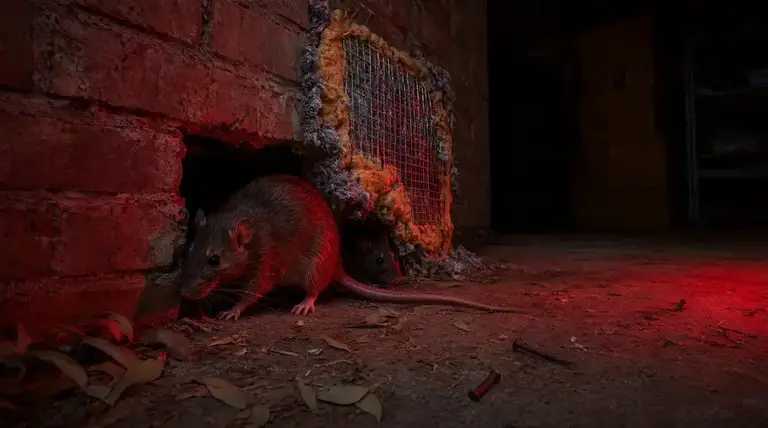
Rats gnaw through soft plastic and burrow under open bases, so a truly rodent-proof bin needs both a lid and a hard floor. The benchmark setup is an enclosed bin sitting on galvanised rodent mesh with holes no larger than 6 mm, with the mesh edge buried a few centimetres into the soil.
- Open pile with scraps on top — very low resistance; essentially a feeding station.
- Plastic bin with no base — low resistance; rats burrow straight up through the soil.
- Enclosed bin on 6 mm galvanised mesh — high resistance; blocks burrowing and gnawing.
- Sealed rotating tumbler off the ground — very high resistance; no soil contact and no gnawable entry point.
If food scraps are your main concern, a sealed worm farm or anaerobic Bokashi bucket keeps kitchen waste beyond the reach of compost rats entirely, and many Australian councils subsidise these units, making them an affordable, rat-proof way to divert food waste from landfill.
Warning signs rodents are already in your compost
If you spot any of the following, rats or mice have moved in and the colony may already extend beyond the bin. Act on these signs quickly — compost populations rarely stay in the compost.
- Burrow holes — smooth 5–8 cm openings beside or under the bin, bay edging or nearby garden beds.
- Droppings — dark, spindle-shaped pellets 10–18 mm long (rats) or small rice-grain pellets (mice) around the heap or along fences.
- Gnaw marks — chewed bin edges, lids or irrigation pipe near the compost area.
- Grease marks and runways — dark smears and flattened paths along fences and walls leading to the bin.
- Nesting material — shredded paper or dry grass pulled into the heap’s cool outer edges.
- Nocturnal sightings or pet agitation — dogs fixating on the bin after dark is a classic early indicator.
DIY compost fixes vs professional pest control
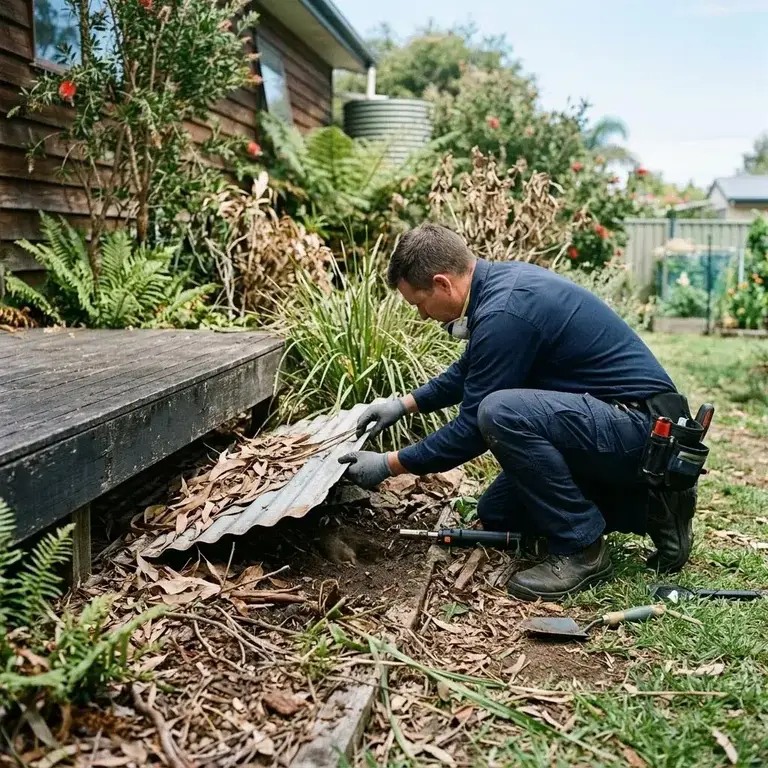
Prevention — diet control, heat, moisture and mesh — is squarely a DIY job, and done properly it stops most compost rodent problems before they start. But once burrows, droppings or indoor signs appear, DIY baiting in an open garden is risky around pets and native wildlife, and a licensed pest control technician is the safer, faster option.
| Factor | DIY approach | Professional treatment |
|---|---|---|
| Best for | Prevention and very early activity | Established burrows, indoor signs, repeat problems |
| Typical cost (AUD) | $0–$120 (mesh, tumbler, bins) | $250–$650 depending on severity |
| Speed of result | Weeks of consistent management | Usually 1–3 visits over 2–4 weeks |
| Risk to pets/wildlife | Higher if loose baits are used | Lower — locked, tamper-resistant stations by licensed technicians |
| Long-term proofing | Bin upgrades only | Full property exclusion and entry-point sealing |
For a deeper look at elimination methods, see Rat Control: How Professionals Actually Eliminate Rats.
How much does rodent control cost in Australia? (2025-26)
Across the Australian market, professional rodent control for a compost-driven infestation typically runs between $250 and $650 AUD, with proofing work usually quoted separately by the industry. What operators generally charge varies with property size, access (subfloor and roof void work costs more) and how far the colony has spread.
The table below shows the typical market rates you’ll see quoted by Australian pest control businesses heading into 2025-26:
| Service | Typical market rate (AUD) | What’s included/notes |
|---|---|---|
| Inspection and assessment | $0–$150 | Runway tracing, entry-point audit; many operators waive this with a treatment booking |
| Standard baiting/trapping program | $250–$450 | Tamper-resistant stations, 2–3 visits, garden and perimeter coverage |
| Severe or multi-area infestation | $450–$650 | Roof void and subfloor treatment, follow-up monitoring |
| Rodent proofing & exclusion | $300–$900 | Sealing weep holes, vents and gaps; see our Rodent Proofing & Exclusion service |
Keep in mind those figures are typical Australian market rates, not our price list. Aussie Pest Strike typically comes in well under these rates for the same scope of work, so call us on [aps_phone] for an exact quote tailored to your property.
Seasonal rodent activity around compost in Australia
Rodent pressure on compost bins peaks in autumn and winter, when rats seek warmth and reliable food, and dips in late spring when outdoor food is abundant. The chart below shows typical relative activity by month across most of Australia.
Jan
Feb
Mar
Apr
May
Jun
Jul
Aug
Sep
Oct
Nov
Dec
Typical pattern: activity climbs from March as nights cool, peaks May–July when rats push toward warm compost and buildings, and eases through spring. In tropical northern Australia, pressure stays elevated for longer and tracks wet-season food supply.
Nine times out of ten, when we trace a backyard rat job back to its source, there’s a compost bay with food scraps sitting on top and no mesh underneath. Fix the heap and you remove the reason the rats moved in — but if they’ve already burrowed, you need to clear the colony first or they’ll just relocate to the shed. Proof the bin and the house at the same time.
Run a vegetable-only, hot and weekly-turned heap in an enclosed bin on 6 mm galvanised mesh — or switch to a sealed tumbler. If you find burrows, droppings or indoor signs, book a professional inspection rather than baiting an open garden yourself.
Compost and rodents: Frequently Asked Questions
Does compost attract rodents to my garden?
Compost attracts rats mainly when it contains meat, dairy or cooked food, or sits cold and undisturbed. A hot, well-turned heap of fruit, vegetable and garden waste is largely unattractive to rodents, and burying fresh scraps in the active centre removes the food scent that draws them in.
How do I rat-proof my compost bin?
Sit an enclosed, lidded bin on galvanised mesh with holes no larger than 6 mm, burying the mesh edge a few centimetres into the soil, or use a sealed rotating tumbler mounted off the ground. Both stop rats burrowing up from below or gnawing through the sides.
Can I still compost food scraps safely?
Yes. Bury fruit and vegetable scraps, coffee grounds and crushed eggshells in the hot centre of the heap and keep meat, dairy, oils, bread and cooked food out entirely. Alternatively, use a sealed worm farm or Bokashi bucket, which many Australian councils subsidise.
Composting should feed your garden, not the local rat population. If rodents have moved from the compost toward the house, Aussie Pest Strike’s pest control team can trace the runways, clear the colony and proof the entry points — call [aps_phone] to request a free on-site inspection today at aussiepeststrike.com and get your yard back.
Sources & further reading
Found Something
Dangerous?
Don’t touch it. Don’t spray it. Keep kids and pets clear, take a photo from a safe distance, and call us — or book a free inspection and we’ll come to you.
02 7235 0050