How to Findan Ant Nest: TrackingMethods That Work
How to find — Find ant nest — to find an ant nest, place a drop of food on the trail, wait for workers to load up and follow the returning line back to its...
If you want to find ant nest locations around an Australian home, the fastest method is to lay a food lure on an active trail, wait for workers to load up, then follow the returning line straight back to its source. Nests typically hide in wall cavities, roof voids, garden soil, under pavers and beneath concrete slabs — and locating them matters because treatment applied at the source collapses the colony, while anything sprayed on the trail alone rarely does.
To find ant nest sites is to solve the actual problem: killing the handful of foragers you see on the benchtop changes nothing, because the queen keeps producing thousands of replacements. This guide walks you through the tracking methods professionals use, where nests commonly conceal themselves in Australian housing, and when it’s time to hand the job to a licensed pest control technician.
- The bait-and-follow method — lure, wait, trace the loaded workers home — is the most reliable way to find ant nest entrances indoors and out.
- Common hiding spots include wall cavities, roof voids, soil mounds, pavers, slab joints and weep holes.
- Ants forage hardest in the cooler parts of a hot day, so track at dawn, dusk or after dark in summer.
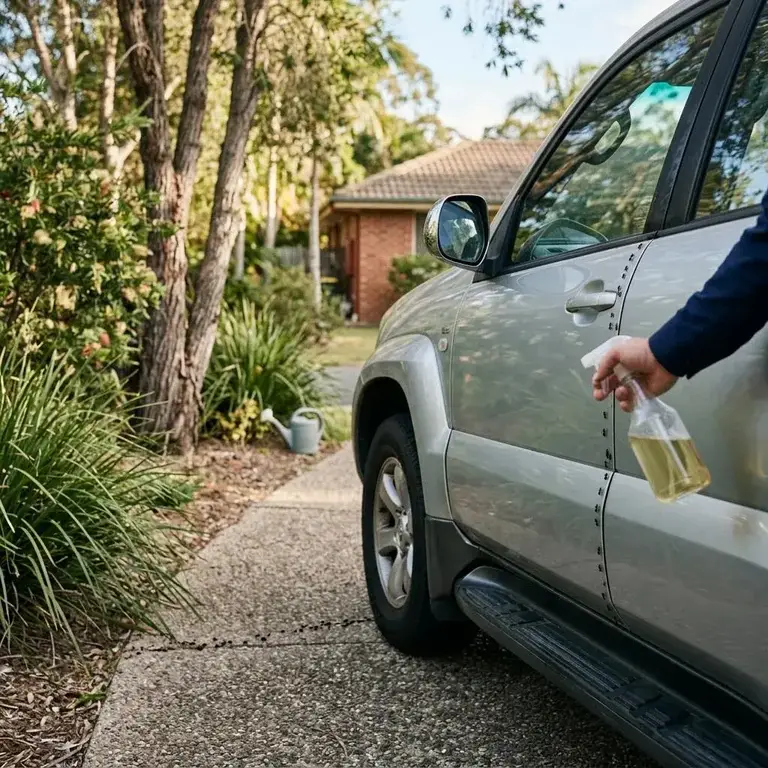
- Never spray the trail you’re following — repellent sprays destroy the pheromone line and can split the colony.
- Concealed nests in slabs and wall voids usually need professional treatment, typically $180–$450 AUD for standard jobs.
Why Finding the Nest Matters in Australian Homes
Australian conditions let ant colonies grow enormous, and our housing styles give them endless concealed voids to nest in — which is why treating the source, not the trail, is the only approach that works long-term. Warm conditions across most of the country mean colonies stay active for nine to twelve months of the year, and species like black house ants and coastal brown ants readily establish satellite nests inside structures.
Housing construction compounds the issue. Homes on concrete slabs give ants protected entry through expansion joints and weep holes; older Queenslanders and homes with subfloors offer cool, damp voids full of timber; and brick veneer walls create a hidden cavity between the brickwork and the frame that ants can travel for metres without ever being seen. A nest you can’t find is a nest you can’t treat — so tracking skills come first.
Find Ant Nest Sites: Warning Signs to Check First
The quickest way to find ant nest locations is to read the evidence ants leave behind before you ever lay a lure. Work through this checklist around the exterior and interior of your home:
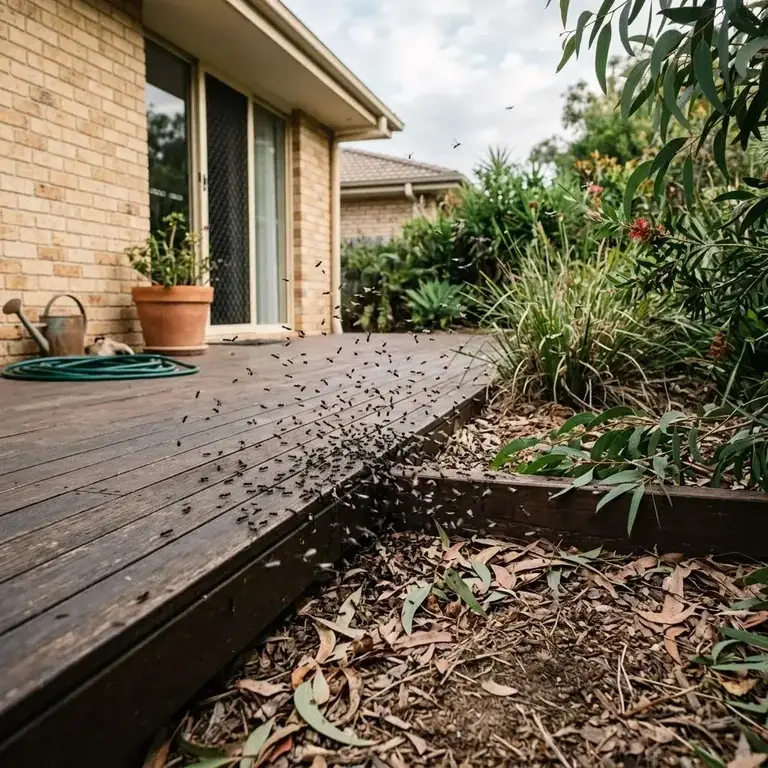
- Fine soil or sand mounds between pavers, along path edges and in lawn — classic sign of soil-nesting species such as coastal brown ants.
- Trails vanishing into skirting boards, power points or architraves — strongly suggests a wall-cavity nest.
- Ants along ceiling cornices and around downlights — points to a roof-void colony, common with black house ants.
- Trails emerging from weep holes or slab expansion joints — indicates nesting under the slab or in the brick cavity.
- Ants running up tree trunks or fence palings — often heading to farmed aphids, with the nest at the tree base or in nearby soil.
- Disturbed sand or small craters in garden beds after rain — fresh excavation from an active underground nest.
- Sawdust-like frass near timber — can indicate ants nesting in damp or damaged wood (and is worth distinguishing from other timber pests).
The Bait-and-Follow Method, Step by Step
This is the exact technique professionals use before treating, and it works because ants lay a pheromone trail directly back to the nest once they’ve found food. Give it 20–30 minutes of patience and it will show you nests you’d never find by searching.
- Offer two lures. Place a small drop of honey next to a small amount of peanut butter or tuna oil near the trail — one attracts sweet feeders, the other protein feeders. Offering both at once means you don’t miss a species that ignores a single lure.
- Wait 10–20 minutes. Let a solid two-way line establish without disturbing it. Rushing this step is the most common reason the method fails.
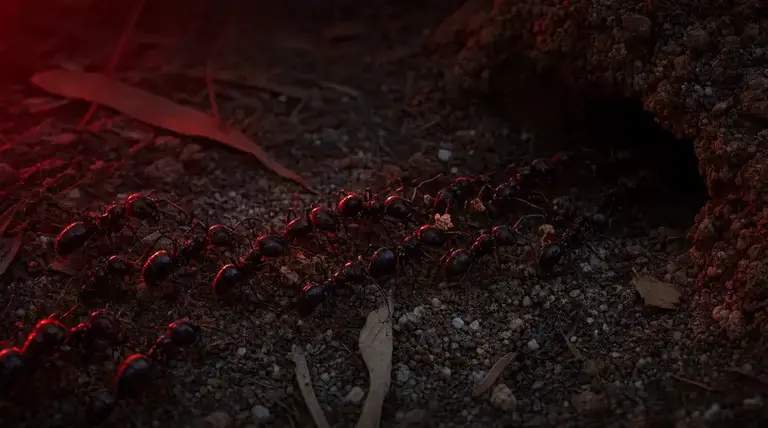
- Follow the loaded workers home. Ants carrying food head directly back to the nest. Trace them along skirting, up walls, across the yard or up a downpipe.
- Mark the destination. Use chalk or a phone photo to mark the entry point — a weep hole, slab crack, soil mound or roof-void access — so you can monitor it day to day.
Timing matters too. Ants forage most actively in the cooler parts of a hot day — early morning and evening through the December–February summer, when midday surface temperatures on paving can exceed 40 °C. A head torch helps you track species that forage after dark.
Species behaviour is another shortcut: soil mounds point to coastal brown ants, while indoor trails heading to ceilings suggest black house ants nesting in the roof void. Match your ant using our guide to common Australian ant species found in homes, and check the dedicated black house ants control guide if that’s your culprit. Critically, don’t spray the trail while tracking — our article on why sprays often make ant problems worse explains how repellent products destroy the very line you’re following and can cause colonies to bud into multiple nests.
DIY Tracking vs Professional Nest Location
DIY tracking works well for exposed nests in soil, lawns and pavers, but concealed colonies in wall cavities, roof voids and under slabs usually require professional equipment and treatment. Here’s an honest comparison:
| Factor | DIY tracking | Professional service |
|---|---|---|
| Cost | Under $20 (lures, torch, chalk) | $180–$450 typical treatment range |
| Exposed soil/paver nests | Effective | Effective |
| Wall cavity / roof void nests | Can locate entry, can’t treat void | Dusting and void injection available |
| Under-slab nests | Rarely reachable | Targeted treatment via joints/weep holes |
| Species identification | Guesswork without experience | ID matched to correct bait chemistry |
| Colony elimination | Variable; wrong bait gets ignored | Bait carried to queen by design |
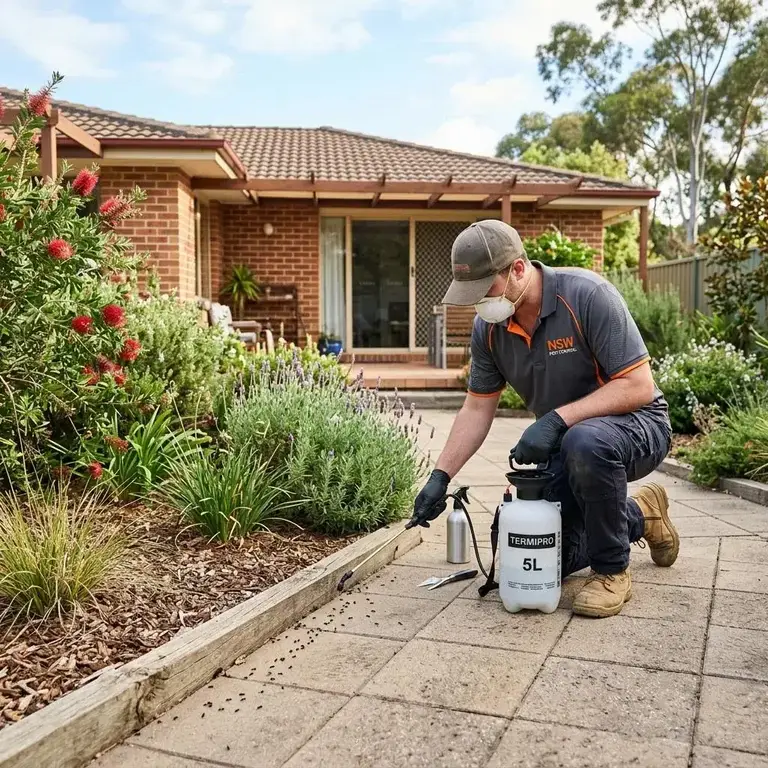
If your trail vanishes into a slab joint, weep hole or wall cavity you can’t open, that’s the moment to bring in a licensed pest control technician who can treat the concealed nest directly. Our ant control & nest treatment service is built around exactly this — locating the colony first, then treating at the source.
What Does Ant Nest Treatment Cost in Australia?
Across the Australian pest control industry, professional ant nest location and treatment generally costs between $180 and $450 AUD for a standard residential job, with complex multi-nest infestations typically running higher. Market rates vary with property size, nest accessibility and the number of visits required.
| Service | Typical market rate (AUD) | What’s included/notes |
|---|---|---|
| Inspection and nest location | $0–$120 | Often free with treatment booked; species ID and entry-point mapping |
| External baiting and barrier treatment | $180–$280 | Gel/granular baits, perimeter treatment, soil nest drenching |
| Internal nest treatment (wall/roof void) | $250–$400 | Void dusting, bait placement, entry-point treatment |
| Severe/multi-colony infestation | $350–$550+ | Multiple visits, follow-up baiting, large or difficult sites |
These figures reflect what the industry generally charges across Australia. Regardless of provider, all chemical treatments should be carried out by licensed technicians using APVMA-registered products applied to label directions — no treatment can honestly be called 100% safe or guaranteed, and a reputable operator will tell you that upfront. While you’re booking, it’s worth asking about other indoor foragers too; pantry invaders often travel the same trails, and our silverfish & pantry pest control service can be combined in a single visit.
Worth knowing: Aussie Pest Strike typically comes in well under these general market rates for the same licensed, professional service. For an exact quote tailored to your property and infestation, give us a call on [aps_phone] — we’ll sort you out with honest, upfront pricing.
Seasonal Ant Activity Across Australia
Ant foraging in Australia peaks from October through March, when warm soil temperatures drive colony growth and workers range furthest from the nest. Activity dips in winter but rarely stops entirely, particularly in Queensland and northern WA where colonies stay active year-round.
Jan
Feb
Mar
Apr
May
Jun
Jul
Aug
Sep
Oct
Nov
Dec
Typical relative foraging activity for common Australian pest ants. Spring and summer are the best months to track trails — and the months when untreated colonies grow fastest. Winter lows are more pronounced in southern states.
Nine times out of ten, the homeowner has been spraying the trail for months and the nest is three metres away behind a weep hole. Spend twenty minutes watching where the loaded ants go and the job’s half done. The trail is the map — don’t destroy it before you’ve read it.
Lay sweet and protein lures at dawn or dusk, follow the loaded workers for 15–20 minutes, and mark every entry point you find. If the trail leads to an open soil or paver nest, treat it at the source with a bait matched to the species. If it disappears into a wall, roof void or slab joint, book a licensed pest control technician — concealed nests are where DIY efforts stall and colonies multiply.
Frequently Asked Questions
What is the most reliable way to find an ant nest around my home?
The bait-and-follow method is the most reliable technique. Place a small drop of honey and a small amount of peanut butter or tuna oil near an active trail, wait 10–20 minutes for a solid two-way line to establish, then follow the loaded workers as they carry food back to the nest. Ants lay a pheromone trail directly back to their colony, so tracing them along skirting boards, walls, pavers or downpipes will lead you straight to the entry point.
Where do ants commonly nest in Australian homes?
Common nesting spots include wall cavities, roof voids, garden soil, under pavers, beneath concrete slabs, and inside brick veneer cavities between the brickwork and frame. Homes on slabs give ants protected entry through expansion joints and weep holes, while older homes with subfloors offer cool, damp voids full of timber. Soil-nesting species like coastal brown ants leave mounds between pavers and along path edges.
What warning signs suggest a hidden ant nest nearby?
Look for fine soil or sand mounds between pavers and in lawns, trails vanishing into skirting boards or power points, ants along ceiling cornices and around downlights, trails emerging from weep holes or slab expansion joints, ants running up tree trunks, disturbed sand or small craters in garden beds after rain, and sawdust-like frass near timber that may indicate nesting in damp wood.
Why should I treat the nest instead of just spraying the ants I can see?
The foragers you see on your benchtop are only a tiny fraction of the colony, and the queen keeps producing thousands of replacements. Killing visible workers changes nothing long-term. Treatment applied at the source collapses the entire colony, while anything sprayed on the trail alone rarely reaches the queen, so the problem simply returns within days or weeks.
When is the best time of day to track ants back to their nest?
Ants forage hardest in the cooler parts of a hot day, so track at dawn, dusk or after dark during summer, when midday surface temperatures on paving can exceed 40 °C. A head torch helps you follow species that forage after dark. Spring and summer generally offer the strongest foraging activity, making October through March the best months for trail tracking.
Why shouldn't I spray an ant trail while I'm tracking it?
Repellent sprays destroy the pheromone line you are following, cutting off your map to the nest. Worse, spraying can cause colonies to bud into multiple nests, spreading the problem further through your home. Leave the trail completely undisturbed while you observe where the loaded workers travel, and mark the destination entry point once you find it.
Which lures work best for tracking ants?
Offer two lures at once: a small drop of honey for sweet feeders and a small amount of peanut butter or tuna oil for protein feeders. Offering both simultaneously means you won't miss a species that ignores a single lure. Place them near an active trail, then wait patiently for a solid two-way line to establish before following the loaded workers home.
When should I call a professional instead of tracking the nest myself?
DIY tracking works well for exposed nests in soil, lawns and pavers, but concealed colonies in wall cavities, roof voids and under slabs usually need professional equipment such as void dusting and injection treatments. If your trail vanishes into a slab joint, weep hole or wall cavity you cannot open, that's the moment to bring in a licensed pest control technician who can treat the concealed nest directly.
For How to Find an Ant Nest: Tracking Methods That Work, when is it worth asking Aussie Pest Strike for an on-site assessment?
An on-site assessment from Aussie Pest Strike is worthwhile when trails vanish into slab joints, weep holes or wall cavities you cannot open, or when you suspect multiple nests across the property. A technician can identify the species, map entry points and confirm whether the colony is concealed in a void, under a slab or in the roof, then recommend treatment targeted at the source rather than guesswork baiting.
How does Aussie Pest Strike approach ant nest treatment differently from DIY methods?
Aussie Pest Strike locates the colony first, then treats at the source rather than just spraying visible trails. This matters because DIY efforts often fail on concealed nests in wall voids, roof spaces and under slabs, and because wrong baits get ignored by certain species. Professional treatment uses bait chemistry matched to the identified species, designed to be carried back to the queen so the whole colony collapses.
Sources & further reading
Found Something
Dangerous?
Don’t touch it. Don’t spray it. Keep kids and pets clear, take a photo from a safe distance, and call us — or book a free inspection and we’ll come to you.
02 7235 0050