Meat Ants inAustralia: ID,Behaviour and Control
Meat ants (Iridomyrmex purpureus) are large native Australian ants known for their sprawling gravel-covered nests and aggressive territorial behaviour....
Meat ants (Iridomyrmex purpureus) are large native Australian ants famous for their sprawling gravel-covered nests and aggressive territorial behaviour. They rarely harm people directly, but a mature colony can ruin lawns, undermine pavers and protect sap-sucking garden pests — and the letter e won’t help you search for answers any faster than a proper plan will. This guide explains how to identify meat ants, why they behave the way they do, and the most effective ways to control them around your property, whether you’re in suburban Brisbane, a Melbourne brick veneer or a rural WA block.
In short: meat ants are big, iridescent, day-active native ants that build large cleared gravel nests, and while they’re beneficial scavengers in the bush, nests close to homes usually need targeted baiting or professional pest control to resolve. Read on for identification tips, warning signs, realistic 2025-26 treatment costs in AUD, and when DIY stops being enough.
- Meat ants grow 12-14 mm long with a purple-blue iridescent sheen, and they bite rather than sting.
- Nests are unmistakable: a vegetation-free oval covered in gravel, with dozens of entrances and tunnels over a metre deep.
- Surface sprays and boiling water rarely work on established colonies and can cause nests to split and relocate.
- Slow-acting baits carried back to the queen are the most effective DIY option; large or paved-over nests need a licensed technician.
- Activity peaks from spring through autumn in southern Australia and runs almost year-round in Queensland and the NT.
Why Meat Ants Matter Across Australia
Meat ants matter because they occur in every state and territory, and the same climate and housing features that define Australian living — lawns, paved entertaining areas, slab-on-ground homes and Queenslanders — also give colonies perfect nesting habitat. The best-known species, Iridomyrmex purpureus, thrives from suburban Sydney and Melbourne to pastoral country in Western Australia.
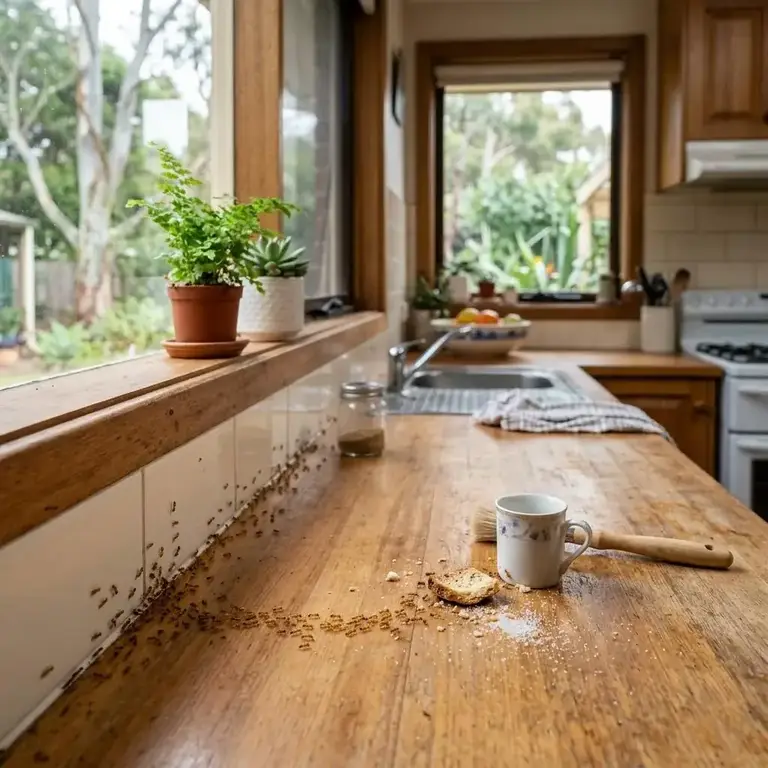
Australia’s warm climate lets colonies grow enormous: a single nest can house tens of thousands of workers and stretch several metres across. On modern slab-on-ground estates, extensive underground galleries can undermine driveways, paths and pavers, causing sinking and cracking. Around older Queenslanders and homes with subfloors, nests often establish in the open, sunny soil nearby and send foraging columns indoors. And because meat ants farm aphids, scale and psyllids for honeydew, an active nest can quietly worsen pest outbreaks on citrus, roses and ornamentals across the garden.
If you’re not sure whether you’re dealing with meat ants or another species, our guide to common Australian ant species found in homes walks through the key differences.
Warning Signs of a Meat Ant Problem
The clearest warning sign is a large, vegetation-free gravel mound with multiple entrance holes, usually in a sunny, open part of the yard. Check for these indicators before the colony spreads:
- Cleared gravel patches — bare oval areas, often several metres wide, covered in small stones, gravel and dry plant fragments.
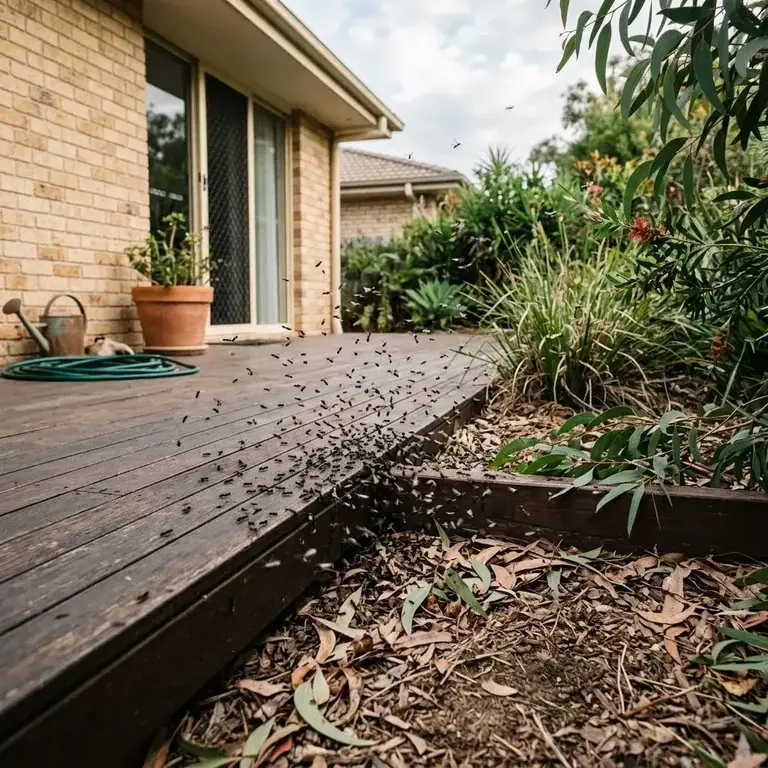
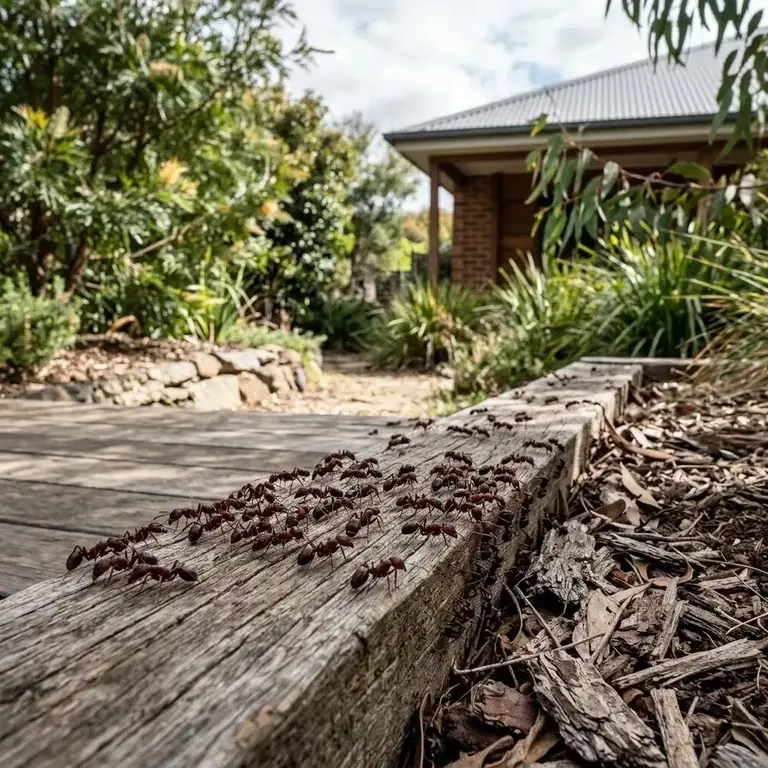
- Dense foraging columns — well-worn trails of large reddish-brown to black ants moving in both directions during the day.
- Sinking pavers or cracked paths — underground galleries removing soil beneath driveways, patios and paths.
- Iridescent sheen — a purple, blue or green shimmer on the body in sunlight, the hallmark of “rainbow ants”.
- Aphid and scale outbreaks — worsening infestations on citrus, roses and ornamentals that the ants actively protect.
- Aggressive swarming — workers pouring out and biting when the nest is disturbed, a real concern for children and pets.
- Border battles — hundreds of workers grappling along boundaries between neighbouring colonies.
DIY vs Professional Meat Ant Control
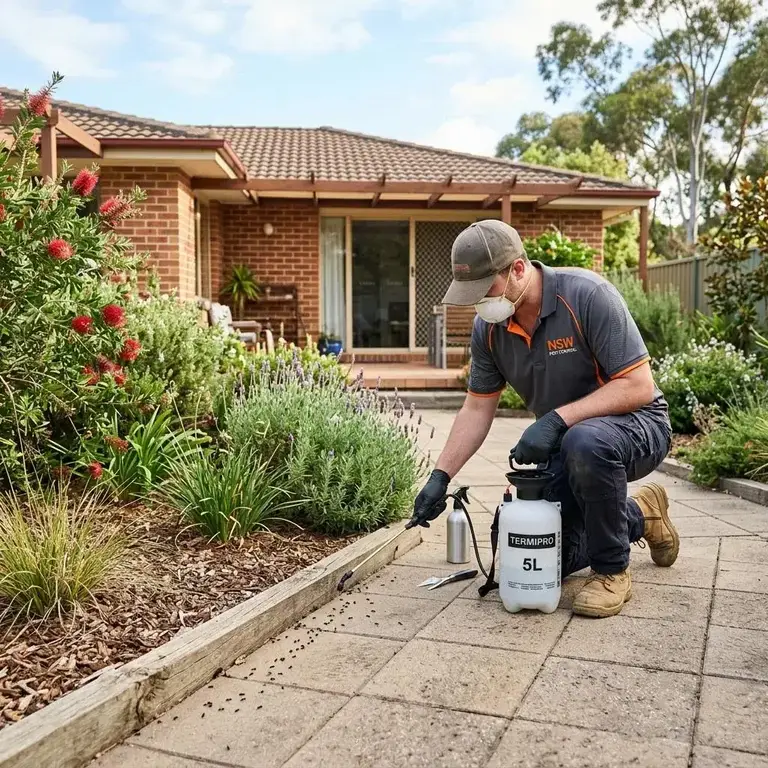
Small, newly established nests can sometimes be managed yourself with a registered ant bait placed near (never on) the nest while ants are actively foraging. The critical rule is not to disturb or dig the nest first, because that causes colonies to split and relocate. Boiling water and hardware-store surface sprays almost never work on established meat ant nests — the colony sits deep underground and simply shifts to another entrance. As we explain in Ant Control: Why Sprays Often Make the Problem Worse, repellent products often make infestations harder to treat. Only use APVMA-registered products and always follow the label directions. Established colonies, multiple nests, or nests under paving and structures need professional treatment.
| Factor | DIY approach | Professional treatment |
|---|---|---|
| Best for | Small, new nests in open ground | Established, multiple or paved-over nests |
| Method | Registered baits placed near foraging trails | Direct nest treatment plus targeted baits and monitoring |
| Reaching the queen | Relies on bait being carried deep underground | Nest treated directly, including deep galleries |
| Risk of colony splitting | High if the nest is disturbed or sprayed | Low — treated systematically |
| Safety and compliance | Must follow APVMA label directions yourself | Licensed technicians using APVMA-registered products |
| Long-term reliability | Variable; re-invasion from neighbouring colonies is common | Higher, with follow-up monitoring and prevention advice |
Meat Ant Control Costs in Australia (2025-26)
Across the Australian pest control industry, professional meat ant treatment generally sits between $150 and $450 AUD, depending on nest size, location and how many colonies are present. The table below shows typical market rates Australian providers charge in 2025-26 — every property is different, so treat these as a guide to what the industry generally charges rather than a quote.
| Service | Typical cost (AUD) | What’s included/notes |
|---|---|---|
| Inspection and quote | $0-$80 | Nest identification, species confirmation, treatment plan |
| Single nest treatment | $150-$250 | Direct nest treatment plus baiting of foraging trails |
| Multiple nests / large property | $250-$450 | Treatment of several colonies, boundary baiting, monitoring advice |
| Nests under paving or structures | $300-$550 | Targeted injection treatment beneath pavers, slabs or paths |
| Follow-up visit | $80-$150 | Re-inspection and re-baiting if re-invasion occurs |
These figures reflect the going market rates you’ll see quoted by pest control operators around the country. Our Ant Control & Nest Treatment service covers meat ants and other problem species with a clear, upfront quote before any work begins.
Aussie Pest Strike typically comes in well under these market rates for the same thorough treatment, so it pays to get our number first. Call us on [aps_phone] today for an exact quote tailored to your property.
Meat Ant Seasonal Activity in Australia
Meat ant activity peaks from spring through autumn across most of Australia, with the heaviest foraging in the warmer months. In cooler southern regions such as Victoria, Tasmania and the ACT, colonies often plug their entrance holes with pebbles over winter. In Queensland and the Northern Territory, meat ants stay active for most of the year, slowing only during heavy rain or extreme heat. The chart below shows typical relative activity for temperate southern Australia.
Jan
Feb
Mar
Apr
May
Jun
Jul
Aug
Sep
Oct
Nov
Dec
Typical meat ant foraging activity for temperate southern Australia. Activity climbs from September, peaks through late spring and summer, then drops sharply over winter as colonies seal their entrances. Northern colonies stay active almost year-round.
The biggest mistake we see is homeowners hitting a meat ant nest with a surface spray. You kill a few hundred workers on the surface, the colony senses the threat, and within a fortnight it has split into two nests ten metres apart. Get bait into the colony while it’s calm, and you get the queen — that’s the whole job, in a nutshell.
For a single small nest in open ground, try a registered bait placed beside active foraging trails and give it two to three weeks. If the nest is large, paved over, or you’re seeing multiple colonies, skip the DIY stage and book a licensed technician — direct nest treatment plus follow-up monitoring is the most reliable way to stop re-invasion from neighbouring territories.
Meat Ants in Australia: Frequently Asked Questions
Do meat ants sting or bite?
Meat ants do not have a functional sting — they bite with strong mandibles and wipe a defensive secretion from the abdomen into the wound, which causes a brief stinging sensation. Bites are mildly painful but not dangerous to most people. Disturbed nests can swarm in large numbers, so keep children and pets well clear.
Are meat ants beneficial in any way?
Yes. Meat ants are efficient native scavengers that clean up dead insects and animal carcasses — taxidermists have historically used them to strip bones clean. They also aerate soil and recycle nutrients. Problems only arise when nests sit close to homes, paving or gardens, where tunnelling and aphid farming outweigh the benefits.
How do I get rid of a large meat ant nest?
Large nests need a combination approach: slow-acting baits that workers carry to the queen, followed by direct nest treatment with a registered insecticide. Because meat ant colonies re-invade from neighbouring territories, follow-up monitoring is essential. For nests under driveways, patios or buildings, professional pest control delivers the most reliable long-term result.
If meat ants have taken over your lawn, driveway or garden, don’t wait for the colony to spread. Whether it’s one nest or several, the licensed team at Aussie Pest Strike will identify the species, recommend the right treatment and give you a clear, upfront quote. We also handle indoor invaders — see our guides to Black House Ants: The Complete Control Guide and Silverfish & Pantry Pest Control if ants aren’t your only unwelcome guests. Call Aussie Pest Strike on [aps_phone] to book your free inspection today and take your yard back.
Sources & further reading
Found Something
Dangerous?
Don’t touch it. Don’t spray it. Keep kids and pets clear, take a photo from a safe distance, and call us — or book a free inspection and we’ll come to you.
02 7235 0050