Rodent Damageand Home Insurance:What’s Covered
Rodent damage and — Rodent damage home — most Australian home insurance policies do not cover rodent damage, because chewed wiring, gnawed pipes and...
Most Australian homeowners assume their building insurance will step in when something goes badly wrong inside the house. When it comes to rodent damage insurance, though, cover rarely works that way: nearly every standard policy in Australia excludes damage caused by rats and mice, treating chewed wiring, gnawed pipes and shredded insulation as gradual wear or a maintenance failure rather than a sudden, accidental event. That single distinction — sudden versus gradual — decides almost every rodent-related claim.
Claims for rodent damage are routinely declined under vermin exclusion clauses that appear in almost every home and contents policy sold in this country. This guide explains exactly what you can and can’t claim, why insurers take this position, the one important exception around fire damage, and what you can do right now to stop an uninsured repair bill from ever landing on your kitchen table.
- Standard Australian home insurance excludes rodent damage under vermin and gradual-damage clauses — chewed wiring, pipes and insulation are almost never covered.
- The main exception: if gnawed wiring causes a house fire, the resulting fire damage is usually covered even though the cable repair itself is not.
- Burst pipes from acute gnawing are assessed case by case; slow leaks are typically declined as gradual damage.
- Dated inspection reports, invoices and photos are your strongest evidence that you maintained the property reasonably.
- Professional rodent control and exclusion work costs far less than a typical uninsured rewiring or insulation replacement job.
Why rodent damage insurance matters in Australian homes
Rodent damage hits Australian homes harder than in many other countries because our climate, housing styles and native-adjacent rodent species create near-perfect conditions for infestation. Roof rats (Rattus rattus), house mice and Norway rats thrive across the continent, and each of them gnaws constantly to keep their incisors worn down.
Housing design plays a big part. Older timber Queenslanders and weatherboard homes have countless gaps around stumps, vents and eaves. Brick veneer homes on concrete slabs still have weep holes, subfloor vents and roof voids that invite entry. Homes on raised subfloors give rodents a sheltered highway straight to the wall cavities. In southern states, the autumn-to-winter cool snap drives rodents into warm ceiling spaces; in Queensland and northern New South Wales, they shelter from wet season humidity inside roof voids year-round. Once inside, they chew PVC cable sheathing, polyethylene water pipes and insulation batts — damage that builds quietly over weeks and months. If you’re unsure whether you have activity, our full checklist of signs of rats or mice in your home is the fastest way to confirm it before the damage compounds.
Warning signs of rodent damage before it becomes a claim
Rodents almost never cause one dramatic incident; they leave a trail of small clues that, read together, tell you exactly how much trouble is brewing. Catching these signs early is the single best way to avoid an uninsured loss.
- Scratching and scurrying sounds in the ceiling or walls, especially at night, indicating animals nesting in the roof void.
- Droppings — small, dark, rice-sized pellets along skirtings, in pantries or on top of hot-water units.
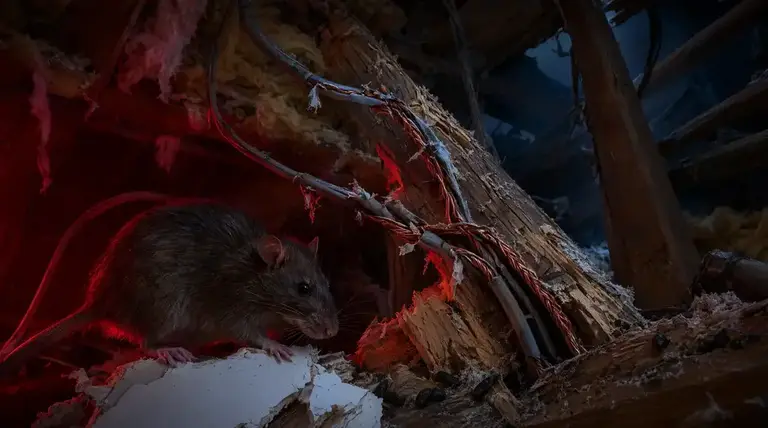
- Gnaw marks on timber framing, food packaging, cable insulation or pipe lagging in the roof space.
- Grease rub marks along walls and entry points where oily fur brushes the same path nightly.
- Shredded insulation or nesting material — torn batts, paper and fabric gathered in quiet corners of the ceiling.
- Unexplained water stains on plasterboard that may trace back to a gnawed polyethylene pipe.
- Flickering lights or tripped circuits with no obvious cause, which can point to chewed wiring.
- Musky, ammonia-like odour in enclosed spaces such as the roof void or under the house.
If two or more of these apply, treat it as active activity rather than a one-off visitor. Roof rats in particular are skilled climbers that exploit overhanging branches and power lines — our guide to roof rat behaviour and control in Australia explains how they move through typical Australian rooflines.
DIY fixes versus professional rodent control
DIY traps and hardware-store baits can knock down a small, early infestation, but they rarely address the entry points or the breeding population, which is what actually determines how much damage accumulates. Professional pest control combines inspection, targeted treatment and proofing so the damage stops at the source rather than pausing for a fortnight.
| Factor | DIY approach | Professional treatment |
|---|---|---|
| Upfront cost | $30–$120 in traps and bait | $250–$600 typical for a full program |
| Entry points sealed | Often missed (mice fit through 6 mm gaps) | Systematically identified and proofed |
| Colony elimination | Partial; breeding continues out of reach | Whole-population strategy with follow-up |
| Documentation for insurers | None | Dated reports and invoices as evidence of maintenance |
| Safety | Risk of misuse around kids and pets | APVMA-registered products applied by licensed technicians |
Chemical rodent control should always be handled by a licensed technician using APVMA-registered products placed in tamper-resistant stations — no product is without risk, and correct placement matters. Our breakdown of how professionals actually eliminate rats walks through the methods step by step.
What rodent control and the uninsured damage cost in Australia
Across the Australian market, professional rodent management generally costs a few hundred dollars, while even rodent damage insurance claims routinely run into the thousands. Here are realistic 2025–26 market rates charged across the industry, worth weighing against the repair bills you’d carry alone.
| Service | Typical market rate (AUD) | What’s included/notes |
|---|---|---|
| Rodent inspection and assessment | $150–$300 | Roof void, subfloor and perimeter inspection with written report — the going rate across most Australian operators |
| Baiting/trapping treatment program | $250–$600 | Tamper-resistant stations, 2–3 follow-up visits — see our Rodent Control & Removal service |
| Rodent proofing and exclusion | $400–$1,500+ | Sealing gaps, mesh over vents, door seals — details at Rodent Proofing & Exclusion |
| Rewiring a chewed circuit (uninsured) | $500–$3,000+ | Electrician call-out, cable replacement, safety certification — standard trade rates Australia-wide |
| Replacing contaminated ceiling insulation (uninsured) | $1,500–$6,000+ | Removal, sanitisation and new batts across a typical roof void at current industry rates |
| Repairing a gnawed water line (uninsured) | $300–$1,500+ | Plumber, pipe section replacement, plasterboard patch if leaking |
The maths is blunt: at typical Australian market rates, a full year of professional monitoring usually costs less than a single electrician’s visit after a chewed cable. Because roof rats and mice breed quickly, a small unnoticed infestation can inflict thousands of dollars of damage over one Australian winter while the animals shelter in the warm ceiling space.
One more thing worth knowing: Aussie Pest Strike typically comes in well under these general market rates, without cutting corners on treatment or follow-up. For an exact quote tailored to your property, give us a call on [aps_phone].
Seasonal rodent activity across Australia
Rodent pressure peaks in the cooler months across most of Australia, when falling temperatures push rats and mice from gardens and sheds into heated roof voids and wall cavities. Activity never drops to zero — indoor colonies breed year-round — but autumn and early winter are when new invasions spike.
Jan
Feb
Mar
Apr
May
Jun
Jul
Aug
Sep
Oct
Nov
Dec
Typical indoor rodent pressure in Australian homes: invasions climb sharply from April as temperatures fall, peak through the winter months, and ease in spring — though established indoor colonies remain active all year, particularly in Queensland’s milder climate.
What your insurer will and won’t pay for
Your Product Disclosure Statement (PDS) is the only document that settles this question, and in most policies you’ll find “damage caused by insects, rodents or vermin” listed under General Exclusions. Because rodent damage is progressive rather than instantaneous, it fails the “sudden and accidental” test most claims must pass.
The one exception matters enormously: if rodents chew wiring and that causes a house fire, the fire damage is usually covered even though the chewed cable itself is not. Gnawed wiring is a recognised ignition source, so the resulting-damage claim often succeeds while the root-cause repair does not. Water damage sits in a grey zone — a sudden burst from acute gnawing may be assessed case by case, while a slow leak is typically declined as gradual damage. Some contents policies also exclude damage to stored food, clothing and soft furnishings once rodents are involved, so the exclusion often reaches well beyond the building itself.
To strengthen any future position, keep dated inspection reports and invoices, photograph entry points and repairs, report damage promptly, and seal gaps larger than 6 mm — a mouse needs no more than that. An assessor will ask when you first noticed activity and what you did about it; the owner with a recent professional report is in a far stronger position than one who ignored droppings for months. The same “gradual damage” logic applies to termites, which is why proactive pest management protects you where no policy will.
In twenty years of crawl spaces and roof voids, the pattern never changes — the worst damage belongs to the owners who heard scratching in autumn and decided to wait until spring. By the time we get the call, the wiring’s stripped, the insulation’s shredded and there’s an insurance letter saying it’s a maintenance issue. An inspection in April costs a fraction of a rewire in August.
Don’t wait for an insurer to tell you rodent damage isn’t covered — assume it isn’t. Book a professional inspection each autumn, keep the report and invoice on file, seal every gap over 6 mm, and act on the first sign of activity. A treatment program plus exclusion work is the closest thing to insurance you’ll actually get against rodents.
Frequently Asked Questions
Does standard home coverage cover rodent damage in Australia?
No. Nearly every standard home and contents policy in Australia excludes damage caused by rats and mice under vermin exclusion clauses. Chewed wiring, gnawed pipes and shredded insulation are treated as gradual wear or a maintenance failure rather than a sudden, accidental event, so claims are routinely declined. Your Product Disclosure Statement is the only document that settles exactly what your policy covers.
Why do insurers decline rodent damage claims?
Most policies require damage to be sudden and accidental to qualify for a claim. Rodent damage builds progressively over weeks and months as animals chew cable sheathing, pipes and insulation batts, so it fails that test and falls under gradual-damage exclusions. Insurers view the underlying issue as a maintenance problem the homeowner could have addressed through inspection and proofing.
Is fire damage from chewed wiring covered by coverage?
Usually yes, and this is the one important exception. If rodents gnaw through wiring and that causes a house fire, the resulting fire damage is typically covered even though repairing or replacing the chewed cable itself is not. Gnawed wiring is a recognised ignition source, so insurers generally pay the consequential fire claim while declining the root-cause repair.
Will coverage cover water damage from gnawed pipes?
It depends on how the leak occurred. A sudden burst caused by acute gnawing may be assessed case by case, while a slow leak is typically declined as gradual damage. Because water damage sits in this grey zone, outcomes vary between insurers, so check your PDS and keep evidence of regular property maintenance if you need to lodge such a claim.
What warning signs suggest rodent damage is developing in my home?
Look for scratching sounds in the ceiling at night, rice-sized droppings along skirtings or pantries, gnaw marks on timber, cables or pipe lagging, grease rub marks along walls, shredded insulation, unexplained water stains on plasterboard, flickering lights or tripped circuits, and a musky ammonia-like odour in enclosed spaces. If two or more signs apply, treat it as active activity rather than a one-off visitor.
What evidence helps support an coverage claim involving rodents?
Dated inspection reports, invoices and photographs are your strongest evidence that you maintained the property reasonably. Professional pest control documentation shows you acted promptly rather than allowing damage to accumulate gradually, which matters because insurers assess whether damage was sudden or progressive. Keeping records of inspections, treatments and proofing work strengthens your position if a claim is ever disputed.
Is DIY rodent control enough to prevent uninsured damage?
DIY traps and hardware-store baits can knock down a small, early infestation, but they rarely address entry points or the breeding population, which determines how much damage accumulates. Mice fit through gaps as small as 6 mm, so entry points are often missed. Professional treatment combines inspection, targeted treatment and proofing so damage stops at the source, with follow-up visits to confirm colony elimination.
When is rodent pressure highest in Australian homes?
Rodent pressure peaks in the cooler months across most of Australia, when falling temperatures push rats and mice from gardens and sheds into heated roof voids and wall cavities. New invasions climb sharply from April and peak through winter before easing in spring. However, established indoor colonies breed year-round, particularly in Queensland's milder climate, so activity never drops to zero.
Would a property-specific inspection help clarify my rodent risk?
Yes. An inspection of your roof void, subfloor and perimeter identifies active infestations, entry points and existing gnaw damage before it compounds into an uninsured repair bill. A written report also provides dated documentation of your property's condition, which can support your position with insurers if damage is later disputed. Aussie Pest Strike offers tailored assessments suited to your home's construction and local rodent pressure.
What practical next step should I take after spotting signs of rodents?
Act quickly rather than waiting for the damage to build through another season. Arrange a professional inspection and treatment program that includes proofing of entry points, since sealing gaps is what stops reinfestation and further chewing of wiring, pipes and insulation. Aussie Pest Strike can assess your situation and recommend targeted treatment and exclusion work matched to your property.
Sources & further reading
Found Something
Dangerous?
Don’t touch it. Don’t spray it. Keep kids and pets clear, take a photo from a safe distance, and call us — or book a free inspection and we’ll come to you.
02 7235 0050