Bed Bug Lifecycle:Why TimingMatters for Treatment
The bed bug lifecycle explains why timing drives treatment success. Learn the egg-to-adult stages and why follow-ups matter. Book a free bed bug quote today.
The bed bug lifecycle runs from egg to adult through five nymph stages, and understanding it is the difference between a treatment that works and one that fails. Because bed bug eggs survive most sprays, a single missed treatment window lets the population rebound within weeks — which is why professional pest control is scheduled around the lifecycle, not done as a one-off spray. Across Australia, from Brisbane apartments to Melbourne brick veneers, the same rule applies: treat to the hatch cycle or treat again.
Put simply: the bed bug lifecycle is the sequence of stages — egg, five nymph instars, and adult — that a bed bug passes through, with each nymph stage requiring a blood meal to moult, and the full egg-to-adult cycle taking roughly five to seven weeks in warm conditions. Knowing where that cycle sits in your home is what determines when to treat, what method to use, and how many visits you’ll need.
- Bed bugs develop through an egg stage and five nymph instars before reaching adulthood — each nymph stage needs a blood meal to moult.
- Most residual insecticides do not penetrate eggs, so a follow-up treatment 10 to 14 days after the first visit is essential.
- Temperature is the biggest driver of lifecycle speed: around 5 to 7 weeks egg-to-adult in warm conditions, stalling below roughly 13°C.
- A single fertilised female can lay 200 to 500 eggs in her lifetime, so early intervention beats late intervention every time.
- Heat treatment kills all stages including eggs in one session; chemical programs rely on repeat visits timed to the hatch cycle.
Why the bed bug lifecycle matters so much in Australian homes
Because Australia’s climate accelerates bed bug development for much of the year, infestations here can multiply faster than many homeowners expect. Warm indoor temperatures — especially in Queensland, northern New South Wales and Western Australia — keep homes in the 21–27°C band where eggs hatch in six to ten days and nymphs race through their instars.
Housing style plays a role too. Older Queenslanders on stumps, weatherboard cottages and brick veneer homes all carry plentiful cracks, skirting gaps and wall voids where eggs are cemented out of sight. Even modern slab-on-ground apartments offer bed bugs what they need: mattress seams, bedhead fixings, power points and wardrobe joins. In multi-unit buildings, understanding how bed bugs actually spread (and how they don’t) matters just as much as the biology — they move on luggage, furniture and clothing, not by flying or jumping. The result is that a single introduced bug can become an established, multi-generational infestation within a couple of warm months.
The other Australian quirk is seasonal turnover: summer travel, school holidays and university semester changes all shift people and luggage around the country, seeding new infestations exactly when lifecycle speed is at its peak. That’s the “e” in the equation — exposure plus environment equals exponential growth.
Warning signs: is an infestation actively growing?
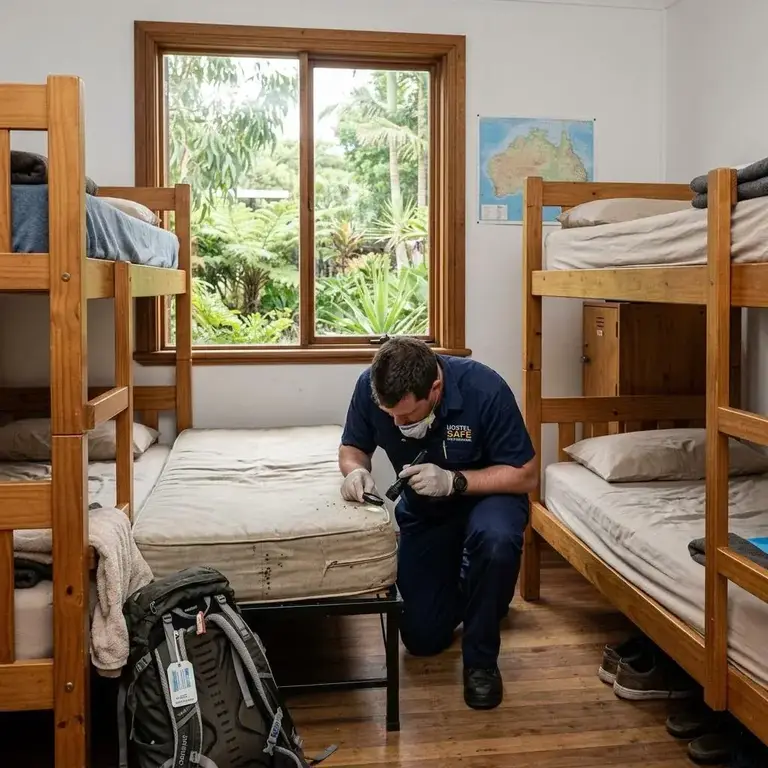
The clearest sign of an active infestation is evidence of multiple lifecycle stages at once — shed skins, eggs and live bugs of different sizes in the same hiding spot. Use this checklist during a torch-and-card inspection of the bed and surrounding furniture:
- Shed skins (exuviae) — pale, translucent casings left behind as nymphs moult; their presence confirms the population is breeding, not dormant.
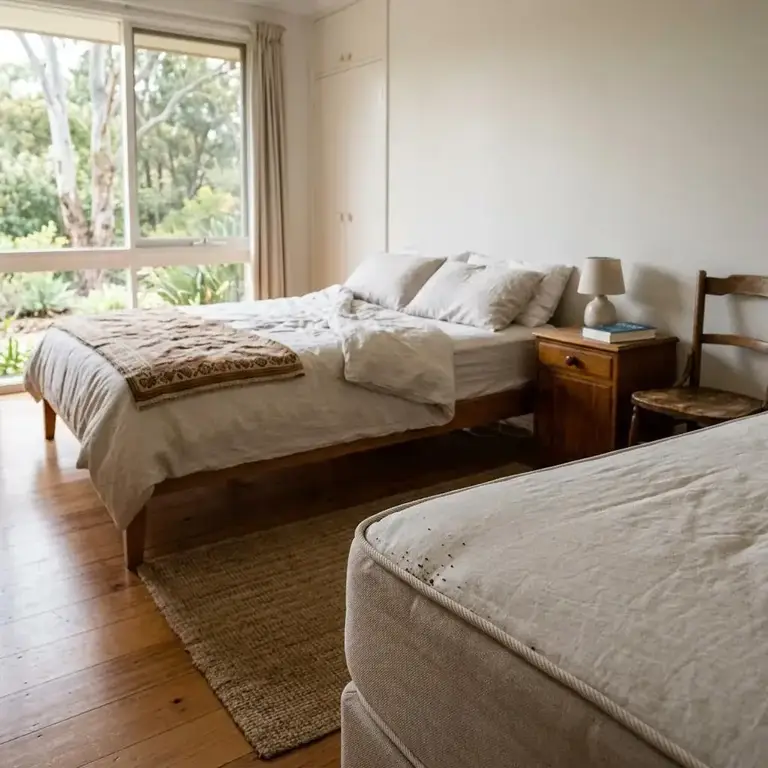
- Pearly white eggs — about 1 mm long, glued into mattress seams, bed frame joints and cracks; they often sit in clusters.
- Dark faecal spotting — small black or rust-coloured dots on sheets, mattress piping and skirting that smear when wiped.
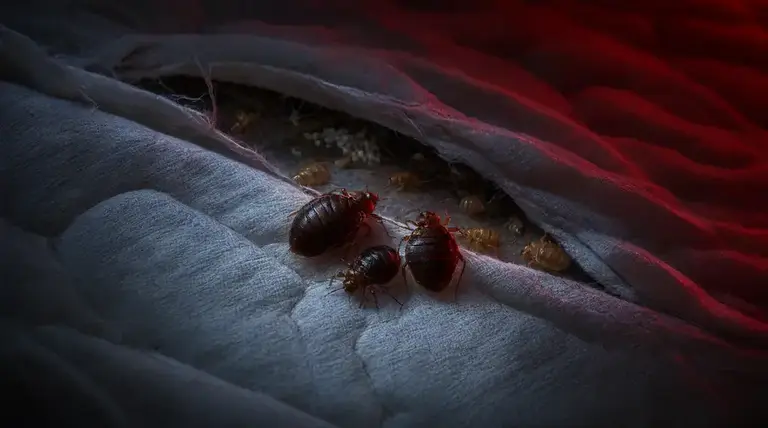
- Live bugs of mixed sizes — pale, pinhead-sized nymphs alongside flat, apple-seed-sized reddish-brown adults signals overlapping generations.
- Bites in lines or clusters — often on arms, shoulders and neck; our guide to bed bug bites: identification and your first steps helps you tell them apart from mozzie or flea bites.
- A sweet, musty odour — noticeable in heavier infestations around the bedhead and ensemble base.
Finding shed skins is the key tell. Exuviae mean nymphs are moulting, which means eggs are hatching, which means a spray-and-pray approach will miss the next generation entirely.
The five stages of a bed bug’s life
The common bed bug (Cimex lectularius) develops through incomplete metamorphosis: egg, five nymphal instars, then adult. A newly hatched nymph is essentially a tiny, pale version of the adult and must take a blood meal to moult into the next stage.
Egg. Eggs are about 1 mm long, pearly white, and cemented into cracks and seams where sprays struggle to reach. At 21–27°C they hatch in roughly 6 to 10 days. Critically, most residual insecticides do not penetrate the egg — this single fact drives the entire treatment schedule.
Five nymph stages. Each instar needs one blood meal to progress, moulting between stages and leaving behind those diagnostic shed skins. In warm Australian summer conditions the whole egg-to-adult run takes about 5 to 7 weeks; in cooler southern winters it stretches considerably, and below roughly 13°C development effectively stalls. Temperature is the single biggest factor in how fast an infestation grows.
Adult. Adults live around 4 to 6 months, sometimes longer, and each fertilised female lays 1 to 7 eggs per day — 200 to 500 over a lifetime. Adults can also survive several months without feeding, which is why an empty room never guarantees they’re gone.
DIY vs professional treatment: what actually works
DIY sprays and foggers typically kill exposed bugs on contact but leave eggs untouched, so the infestation rebounds as the hidden generation hatches. A licensed technician treats to the lifecycle — either with heat that kills all stages at once, or a chemical program with follow-ups timed to the hatch cycle. Here’s the honest comparison:
| Factor | DIY approach | Professional treatment |
|---|---|---|
| Effect on eggs | Little to none — most supermarket products don’t penetrate eggs | Heat kills eggs outright; chemical follow-ups target hatched nymphs |
| Number of attempts | Often repeated, with rebound between attempts | 1 heat session, or typically 2–3 scheduled chemical visits |
| Detection of hidden harbourages | Limited to visible areas | Trained inspection of voids, fixings, furniture and adjoining rooms |
| Product safety | Risk of misuse, over-application and bug dispersal | APVMA-registered products applied by licensed technicians to label directions |
| Likely outcome | Frequently spreads bugs deeper into the home | Eradication timed to the lifecycle, with monitoring to confirm |
One common DIY mistake deserves a mention: bug bombs and total-release foggers tend to scatter bed bugs into wall voids and neighbouring rooms, turning a single-room problem into a whole-house one. If you’re weighing methods, our breakdown of bed bug treatment: heat vs chemical — which works? explains the trade-offs in detail.
How the lifecycle shapes the treatment method
Timing drives the choice between heat and chemical approaches. Heat treatment raises the room to around 50°C and kills every stage — eggs included — in a single session, while chemical programs rely on repeat visits timed 10 to 14 days apart so newly hatched nymphs are destroyed before they can reproduce.
Because eggs resist most chemicals, any single spray leaves a hidden generation ready to hatch. Skip the second visit and the survivors rebuild the infestation — this egg-survival problem is the core reason bed bugs are nearly impossible to eliminate yourself. The reproductive maths adds urgency: one fertilised female can produce hundreds of eggs, and because nymphs mature in weeks, an untreated population grows exponentially. Catching it during the slower early stages, before multiple overlapping generations exist, makes professional bed bug treatment & removal dramatically faster and cheaper.
Bed bug treatment costs in Australia (2025–26)
Across the Australian pest control industry, most households are quoted between $300 and $900 for a standard chemical treatment program, or $1,200 to $2,500+ for whole-room heat treatment, depending on the number of rooms and the severity of the infestation. The figures below reflect typical market rates Australians are being charged in 2025–26, and they vary by city, property size and access.
| Service | Typical market rate (AUD) | What’s included/notes |
|---|---|---|
| Inspection & assessment | $0–$150 | Confirmation of activity, harbourage mapping, treatment plan; the industry often waives this with a booking |
| Chemical program (2–3 visits) | $300–$900 | Initial treatment plus follow-ups timed 10–14 days apart to the hatch cycle — the going market range |
| Heat treatment (per room/whole home) | $1,200–$2,500+ | Single session killing all stages including eggs; market rates climb for large or multi-room jobs |
| Mattress encasements & monitors | $50–$150 | Post-treatment protection and early-warning monitoring at standard industry pricing |
| Multi-unit/apartment treatments | Quoted per job | May require adjoining-unit inspection; body corporate coordination is common across the industry |
Beware of quotes anywhere in the market for a single cheap spray with no follow-up — given what you now know about eggs, that visit alone is unlikely to finish the job. Remember, every figure above reflects what the broader Australian industry typically charges, not what you’ll necessarily pay with us.
Here’s the good news: Aussie Pest Strike typically comes in well under these market rates, without cutting corners on follow-up visits or treatment quality. For an exact quote tailored to your property, give us a call on [aps_phone] today.
Seasonal activity: when bed bugs breed fastest in Australia
Bed bugs are active indoors year-round, but breeding speed peaks across the warmer months from October to April, when indoor temperatures sit in the fast-development band and holiday travel moves bugs between homes, hotels and short-stay accommodation. The chart below shows typical relative activity across the year in most Australian capitals.
Jan
Feb
Mar
Apr
May
Jun
Jul
Aug
Sep
Oct
Nov
Dec
Indicative pattern only: activity climbs through spring, peaks over the summer travel season (December–January), and eases through winter as cooler indoor temperatures slow the lifecycle — though heated homes keep bed bugs breeding in every month.
The practical takeaway: don’t wait for a “better season”. A winter infestation grows slowly but never stops, and it will explode the moment spring arrives. Treating during the slower months actually works in your favour, because fewer overlapping generations exist.
The biggest mistake we see is people cancelling the follow-up visit because they haven’t been bitten for a week. That quiet period is just the eggs sitting there, waiting to hatch. We schedule every chemical job around that 10-to-14-day window for a reason — it’s the difference between finishing the job and starting it all over again in a month.
If you’ve found shed skins, eggs or bites, act now — don’t wait for the infestation to announce itself more loudly. Book a licensed inspection, choose a method that accounts for the egg stage (heat for single-session knockdown, or a chemical program with timed follow-ups), and fit mattress encasements afterwards so any survivors are trapped and future activity is easy to spot. Whatever you do, never rely on a single spray.
Frequently Asked Questions
What are the stages of the bed bug lifecycle?
Bed bugs develop through incomplete metamorphosis: an egg stage, five nymph instars, then adulthood. Each nymph must take a blood meal to moult into the next stage, leaving behind pale shed skins as it progresses. In warm conditions the full egg-to-adult cycle takes roughly five to seven weeks. Adults then live around four to six months and can survive several months without feeding.
How long do bed bug eggs take to hatch?
At indoor temperatures of 21 to 27 degrees Celsius — common in warm Australian homes — bed bug eggs hatch in roughly six to ten days. The eggs are about 1 mm long, pearly white, and cemented into cracks, mattress seams and frame joints where sprays struggle to reach. Because most residual insecticides do not penetrate eggs, hatching timing drives the entire treatment schedule.
Why does one bed bug treatment often fail?
Most residual insecticides kill exposed bugs but do not penetrate eggs, so a hidden generation hatches after the initial spray and rebuilds the population within weeks. That is why professional chemical programs schedule follow-up visits 10 to 14 days after the first treatment, timed so newly hatched nymphs are destroyed before they can mature and reproduce. Skipping the second visit lets survivors restart the infestation.
How does temperature affect how fast bed bugs multiply?
Temperature is the single biggest driver of lifecycle speed. In the 21 to 27 degree band typical of warm Australian homes, eggs hatch in six to ten days and nymphs move quickly through their five instars, giving an egg-to-adult cycle of about five to seven weeks. Below roughly 13 degrees development effectively stalls, which is why infestations grow much faster in Queensland, northern New South Wales and Western Australia.
How many eggs can a female bed bug lay?
A fertilised female bed bug lays one to seven eggs per day, producing 200 to 500 eggs over her lifetime. Combined with nymphs maturing in a matter of weeks under warm conditions, this means an untreated population grows exponentially. A single introduced bug can become an established, multi-generational infestation within a couple of warm months, which is why early intervention matters.
What signs show a bed bug infestation is actively growing?
Evidence of multiple lifecycle stages in the same hiding spot is the clearest sign: shed skins, pearly white eggs around 1 mm long, dark faecal spotting that smears when wiped, and live bugs of mixed sizes from pinhead nymphs to apple-seed-sized adults. Bites in lines or clusters and a sweet, musty odour near the bedhead also point to an active, breeding population rather than a dormant one.
Why do bug bombs make bed bug problems worse?
Total-release foggers and bug bombs typically kill only exposed bugs on contact while leaving eggs untouched. Worse, they tend to scatter bed bugs into wall voids and neighbouring rooms, turning a single-room problem into a whole-house one. Because the hidden generation hatches afterwards, the infestation rebounds and spreads deeper into the home, making later professional treatment more difficult.
How does heat treatment differ from chemical treatment for bed bugs?
Heat treatment raises the room to around 50 degrees Celsius and kills every lifecycle stage — including eggs — in a single session. Chemical programs instead rely on repeat visits spaced 10 to 14 days apart, timed to the hatch cycle so newly emerged nymphs are destroyed before reproducing. Heat suits those wanting one session; chemical programs suit situations where heating a room is impractical.
I have tried the inspection steps in this article and found signs of bed bugs — how do I arrange practical help?
If your torch-and-card check turns up shed skins, eggs or live bugs of mixed sizes, the next step is a professional inspection to confirm activity and map harbourages before any treatment begins. Aussie Pest Strike can arrange an assessment of your home and recommend whether a heat session or a lifecycle-timed chemical program suits your situation, with follow-up visits scheduled around the hatch cycle if needed.
What should I do next if my DIY bed bug sprays have not worked?
Repeated DIY attempts usually mean eggs survived and each new generation keeps hatching. Stop spraying, avoid foggers that scatter bugs into other rooms, and get the infestation properly assessed. Aussie Pest Strike can inspect for hidden harbourages in mattress seams, bed frames and wall voids, then set out a treatment plan built around the bed bug lifecycle so follow-ups land before surviving nymphs mature.
Sources & further reading
Found Something
Dangerous?
Don’t touch it. Don’t spray it. Keep kids and pets clear, take a photo from a safe distance, and call us — or book a free inspection and we’ll come to you.
02 7235 0050